
Reviewed · FUSHIMI INARI TOURS
Fushimi Inari Shrine: Explore the 1,000 Torii Gates on an audio walking tour
Fushimi Inari is famous for its thousands of bright red torii gates, but the gates make more sense when you understand the Shinto customs around them. This self-guided audio walk adds that missing layer, leading you from a fox statue near Inari Station through hand-water rituals, the main hall, the Senbon Torii, and a wish-making stone.
I like the freedom to pause, wander, or replay a section, and I like the low $5.99 price for lifetime English access. The route also finishes at a pond by Kumataka Shrine, giving you a useful stopping point instead of leaving you unsure where the walk ends. The tradeoff is simple: you must bring your own charged smartphone and headphones, and the tour has no live guide to answer questions.
Key points at a glance

- Start beside a fox statue near Inari Station: The meeting point is easy to identify at the entrance to Fushimi Inari Taisha.
- Learn the ritual before admiring the gates: The route explains hand water, shrine customs, and Shinto beliefs rather than treating the torii as photo scenery only.
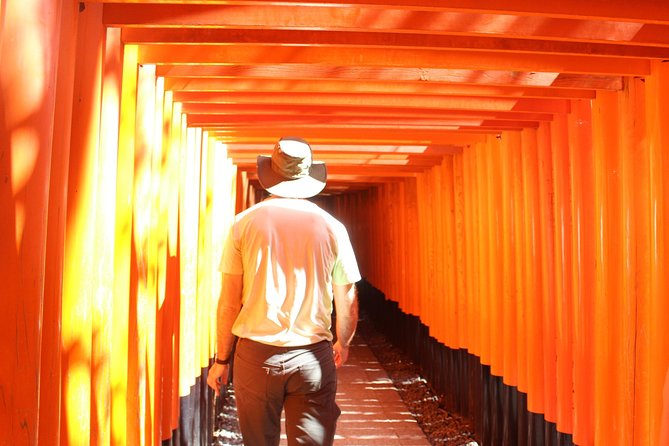
- Walk through the Senbon Torii: The famous passage of red gates is the main visual prize of the tour.
- Use the tour offline: Download the audio, maps, and geodata before arriving, especially if you want a smooth start.
- Make a wish at the Heavy-Light Stone: This gives the walk an interactive moment beyond sightseeing.
- Finish near Kumataka Shrine: You can pause at the pond or continue farther into the shrine complex.
Why an audio walk suits Fushimi Inari
Fushimi Inari can be a quick photo stop, but it rewards a slower pace. The shrine has influenced people’s lives for more than 1,300 years, and its symbols are easy to miss if you only follow the crowd toward the red gates.
This audio tour gives you a simple structure. You begin near Inari Station, learn how the shrine works, then move through its ritual spaces and wooded paths before reaching the Senbon Torii. The route lasts about 45 minutes to one hour, so it gives you a focused introduction without claiming to cover every corner of the complex.
I especially like the format for independent visitors. You are not tied to a departure time or a group’s walking speed. If you want an extra look at a fox statue, a break by the pond, or another pass through the torii gates, you can stop the audio and continue when ready.
The app provides lifetime access in English through VoiceMap. You also receive offline audio, maps, and geodata. That matters here because you can prepare before reaching the shrine rather than relying on a live connection at the entrance.
The main limitation is the lack of a person on site. A recorded route cannot respond to a question, change direction for your interests, or adjust the pace for your group. For $5.99, though, the tradeoff is fair if you want structure without paying for a private guide.
More ways to walk the Fushimi Inari gates:
- Kyoto: Fushimi Inari, Kinkakuji, Bamboo Grove 1 Day Bus Tour
★ 4.8 · 4,316 reviews - Fushimi Inari Hidden Hiking Tour (Private Option Available)
★ 5.0 · 1,750 reviews - Osaka/Kyoto:Kinkakuji,Arashiyama,FushimiInariShrine,NaraPark
★ 4.1 · 1,596 reviews
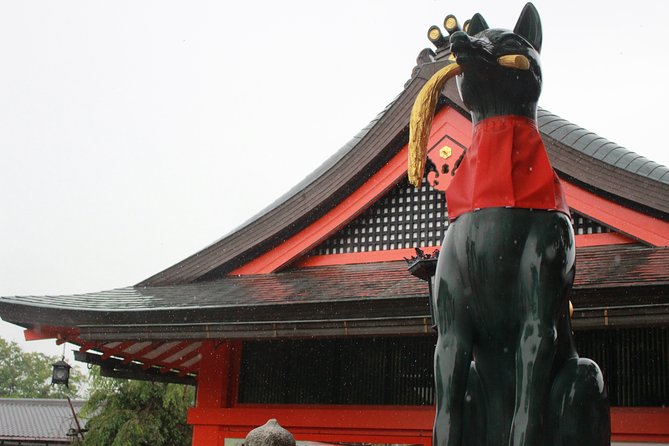
Starting at the fox statue near Inari Station
The walk begins opposite Inari Station, in front of a fox statue at the entrance to Fushimi Inari Taisha. This is a practical meeting point because the route begins beside public transportation rather than requiring you to search for a remote corner of the shrine grounds.
The fox is an important visual marker for the tour. Fox statues appear throughout the shrine, and the opening section uses them to introduce the beliefs and symbols connected with Fushimi Inari. You will see the statues again as you move along the route, so the first stop gives you a useful way to read what follows.
Before arriving, download the tour and check that the map and audio work offline. One person specifically found this essential. It is good advice for any app-based walk, since the first few minutes are when you want to focus on finding the statue, not troubleshooting your phone.
You will need your own smartphone and headphones. Food, drinks, transportation, and entrance fees for any museums or other attractions are not included, although the shrine walk itself is centered on the shrine grounds described in the route.
Learning what the shrine’s symbols mean
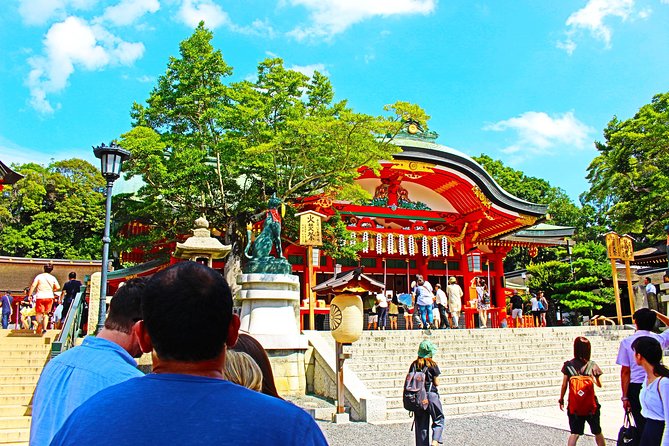
At the second stop, the audio begins explaining the significance of the shrine. This is where the walk shifts from simple directions to interpretation.
That shift is important. The torii gates are visually striking, but without context they can become a long series of red openings that look much the same. The audio helps connect the buildings, fox statues, rituals, and gates to the beliefs that give the place its meaning.
The experience is private in the practical sense that only your group uses the tour. It is not a live private guide, but you can listen together and set your own pace. That makes it suitable for couples, families, or solo visitors who prefer not to join a scheduled group.
The route also introduces Wabi-sabi at a later stop. You do not need to prepare for this part, but it adds an artistic and philosophical idea to the walk. Instead of rushing from one landmark to another, you are encouraged to notice the character of the setting and the way age, simplicity, and imperfection fit into Japanese culture.
Hand Water and the main hall
One stop explains the ritual called Hand Water. This is a useful early lesson because it shows that visiting a shrine involves more than walking up to a building and taking photographs.
The audio gives you a chance to understand the ritual as part of the visit. Since the tour is self-guided, you can listen first and then take your time observing the area. The route does not force you to hurry through this stop, which is helpful if you want to watch how the shrine space is used.
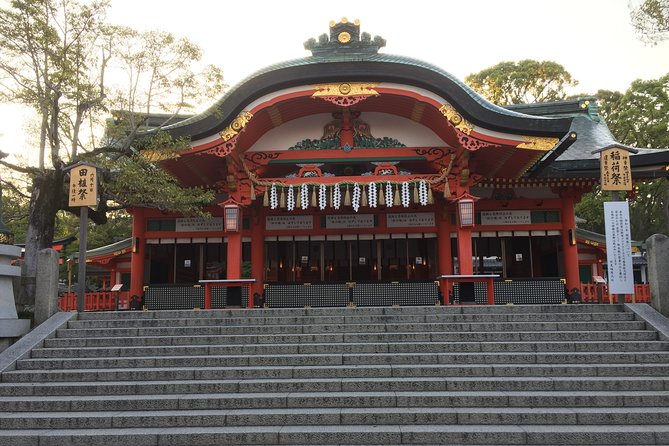
You then make a short stop at the beautiful main hall. This section provides a change of scale after the smaller details of fox statues and ritual practice. The main hall is one of the places where the shrine’s religious purpose becomes most visible, so the commentary helps connect the building to the customs you have just learned about.
The itinerary calls this a brief stop, not a long interior visit. Plan on listening and looking from the route rather than expecting a museum-style tour or access to every part of the complex.
More shrines to work into a Kyoto day:
- Osaka/Kyoto: Arashiyama, Nara & Fushimi Inari Shrine w/Lunch
★ 4.4 · 754 reviews - KYOTO Tea Ceremony with kimono near by Imamiya Jinjya Shrine
★ 5.0 · 343 reviews - Kyoto: 3-Hour Fushimi Inari Shrine Hidden Hiking Tour
★ 4.9 · 270 reviews - Kyoto Magical Night English Tour: Gion & Fushimi Inari Shrine
★ 5.0 · 97 reviews
Walking beneath the Senbon Torii
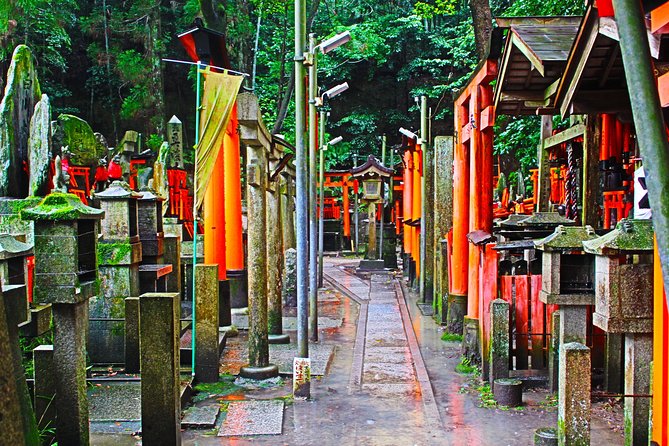
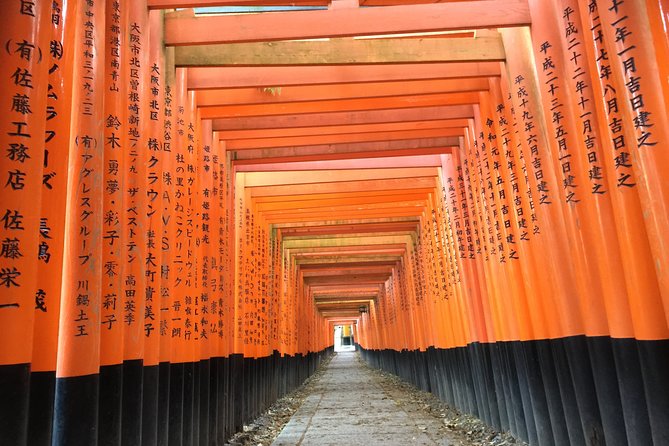
The central part of the experience is the Senbon Torii, the passage of 1,000 torii gates. This is the scene most people associate with Fushimi Inari, and the tour gives it enough space to become more than a quick backdrop for photographs.
The gates create a strong visual rhythm as you walk. The audio adds meaning while you move, so you can consider why these gates matter instead of simply counting how many pictures you can take.
This is also the point where the flexible format earns its keep. You can stop to take photographs, replay a section, or let other people pass without holding up a guide. If the route becomes busy, your group can pause and continue once you are ready.
The supplied itinerary lists the Senbon Torii twice. Treat that as the route’s main section rather than two separate attractions. The gates are a gradual passage, and the repeated listing reflects their importance in the walk.
The route focuses on the bright red gates and the forest setting around them. You should still expect a popular shrine rather than complete solitude, especially because Fushimi Inari receives large numbers of daily visitors. The promise here is not an empty path. It is a better understanding of a famous place while moving at your own speed.
The Heavy-Light Stone and the power of wishing
The tour includes the Heavy-Light Stone, where you can make a wish. This gives you one of the clearest hands-on moments in the experience.
A good audio tour should help you understand a place and give you reasons to pay attention. The Heavy-Light Stone does both. It is a specific landmark with a simple action attached, so you are not only hearing about the shrine’s beliefs. You are given a chance to take part in one small tradition.
The material provided does not explain exactly how the stone feels or how the wish is judged, so the audio commentary is the best place to learn the custom during the walk. Keep your expectations grounded: this is one brief stop within a short walking tour, not a full religious ceremony led by a priest.
Still, it is the sort of detail that can make the route more memorable. The torii gates are the grand visual feature. The stone offers a smaller, personal pause.
Okusha Shrine and the Root up Pine Tree
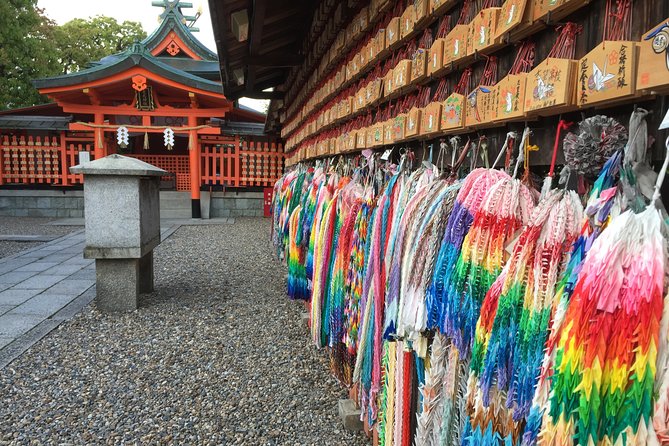
After the Senbon Torii, the walk continues to Okusha Shrine. This stop helps you see that Fushimi Inari is more than the entrance buildings and the first row of gates.
The audio points out the importance of the Okusha Shrine and gives you a reason to continue into the complex. If you are tempted to turn back after photographing the torii, this is the section that adds another layer to the visit.
You also make a brief stop at the Root up Pine Tree. The name alone makes it an easy landmark to remember, and the audio explains more about it. This is a good example of the route’s approach: it includes unusual details that you might pass without noticing if you were walking only by yourself.
The route then ends at Kumataka Shrine, by a lovely pond deeper in the complex. This is a practical finish. You can take a quick break there or keep going if you want to see more. You are not deposited at an unclear point in the middle of the gates.
What $5.99 gets you
At $5.99 per person, the tour is priced as a light add-on to a Kyoto sightseeing day. You are paying for lifetime access to the English audio walk, the VoiceMap app, and offline maps and location data.
The value depends on what you want. If you already know Fushimi Inari well and prefer to wander without commentary, you may not need it. If this is your first visit, the price is modest compared with a live private tour, and you can share the experience only with your own group.
The strongest value comes from flexibility. You can use the tour at any time during the stated operating period, from June 3, 2020 through February 7, 2027, with the listing showing the shrine as open all day. You can also return to the audio later because access is lifetime.
There is no food, drink, transportation, smartphone, or headphone provision. You must arrange those yourself. The tour is also non-refundable and cannot be changed after booking, so confirm that the date and format suit you before paying.
Who should choose this Fushimi Inari tour
I would choose this walk if you want a short, self-paced introduction with clear stops and cultural explanation. It fits well at the beginning of a Kyoto stay, when you want to learn how to approach a shrine before visiting more of the city.
It also suits anyone who has already seen the torii gates in a rushed visit. One account describes returning after an earlier Nara and Kyoto outing moved too quickly. That is a useful lesson: Fushimi Inari is easy to underappreciate when it is squeezed into a packed day.
Families and couples may like the private format because nobody outside your group sets the pace. Solo visitors can use it as a simple route through a large shrine complex. Most people can participate, and the start is close to public transportation.
I would hesitate if you want a live expert, detailed back-and-forth discussion, or help adapting the route during the walk. The audio is efficient and independent, but it cannot replace a person who knows your interests.
Should you book it?
Book this tour if you want a low-cost way to give Fushimi Inari structure, meaning, and a few specific landmarks beyond the famous gates. Download everything before you arrive, bring headphones, and allow enough time to pause at the fox statues, main hall, Senbon Torii, Heavy-Light Stone, and pond near Kumataka Shrine.
Skip it if you prefer complete freedom or already have a guide for Fushimi Inari. For most first-time visitors who want to walk alone but not miss the shrine’s rituals and symbols, $5.99 is a sensible price for a focused audio introduction.
FAQ
Where does the audio tour start?
It starts at the fox statue opposite Inari Station, at the entrance to Fushimi Inari Taisha Shrine in Kyoto.
Where does the tour end?
The route ends at Kumataka Shrine, near a pond within the shrine complex.
How long does the tour take?
The approximate duration is 45 minutes to one hour.
Is this a guided group tour?
No. It is a self-guided audio tour for your group, using the VoiceMap app.
What app do I need?
You need the VoiceMap app for Android or iOS.
Can I use the tour offline?
Yes. Offline access includes the audio, maps, and geodata. Download the material before reaching the shrine.
Is the tour available in English?
Yes. The tour includes lifetime access in English.
What landmarks are included?
The route includes fox statues, the main hall, the Senbon Torii, Okusha Shrine, the Root up Pine Tree, the Heavy-Light Stone, and Kumataka Shrine.
Are headphones and a smartphone provided?
No. You must bring your own smartphone and headphones.
Can I cancel or change the booking?
No. The experience is non-refundable and cannot be changed for any reason after booking.
More Self-Guided Tours in Kyoto
- One Day Private Customized Self-Guided Tour in Kyoto
★ 4.2 · 11 reviews
More Walking Tours in Kyoto
- Kyoto Geisha Walking Tour: Gion District & Hidden Gems
★ 4.7 · 3,273 reviews - Kyoto: Gion Magical Night Walking Tour with Geisha Trivia
★ 4.9 · 2,393 reviews - Kyoto: Gion Geisha District Walking Tour – Stories of Geisha
★ 4.7 · 2,187 reviews - Night Walk in Gion: Kyoto’s Geisha District
★ 4.5 · 2,003 reviews
Newest Kyoto experiences on the site
- Treasures of Kyoto: Gion & historical Walking Tour★ 5.0 · 6 reviews
- Whisk Your Own Matcha: A Zen Matcha Experience at Temple★ 3.6 · 7 reviews
- Kyoto tea town for matcha lovers★ 5.0 · 16 reviews
- Uji: Private immersion into Kyoto’s tea and reglious culture★ 5.0 · 17 reviews
- Kyoto Matcha Green Tea Tour★ 4.5 · 23 reviews
- Uji and Wazuka Matcha Farm Half Day Private Guided Tour★ 5.0 · 21 reviews
- Utilising upcycled Matcha! Creating matcha incense (Uji, Kyoto)★ 5.0 · 6 reviews
- Sacred Temple Yoga Experience in Japan★ 5.0 · 3 reviews
Fushimi Inari Tours, compared.

Fushimi Inari, Kinkakuji, Bamboo Grove 1 Day Bus Tour
Read our review →
Fushimi Inari Hidden Hiking Tour (Private Option Available)
Read our review →
Kinkakuji,Arashiyama,FushimiInariShrine,NaraPark
Read our review →
Nara, Fushimi Inari Taisha, Arashiyama Bus Tour
Read our review →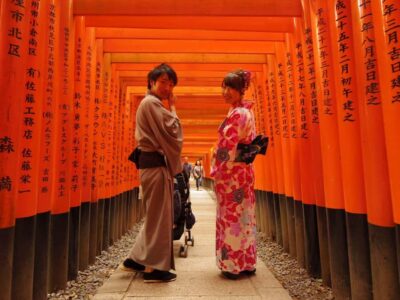
Arashiyama, Nara & Fushimi Inari Shrine w/Lunch
Read our review →
Nijo Castle, Kiyomizu & Fushimi Inari Guided Tour
Read our review →
Nijo, Kinkaku-ji, Arashiyama, Kiyomizu & Fushimi Inari
Read our review →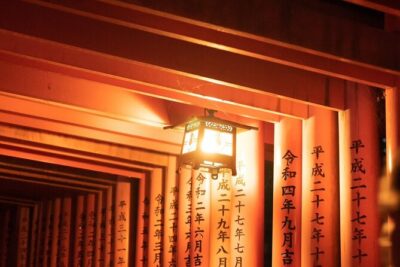
Browse the lists this tour appears in