
Reviewed · KYOTO CRAFT WORKSHOPS
Authentic knife making experience at a blacksmith in Kyoto
The best part of this Kyoto experience is that you do not simply watch a blacksmith work. You help turn red-hot steel into a usable knife, hammer by hammer. Mao and the other smiths guide every risky step, so beginners can take part without pretending to be experts.
I like two things right away: you leave with a practical souvenir rather than another trinket, and the work feels genuinely hands-on. The traditional uniform, furnace heat, and steady ring of the hammer give this three-hour class a real workshop feel.
The main drawback is the physical effort. Hammering and working near a hot furnace can leave you tired, and the short format means the instructors must help keep the process moving. Check the confirmed studio location before setting out, since the activity uses two Kyoto studios.
Key points to know before you book
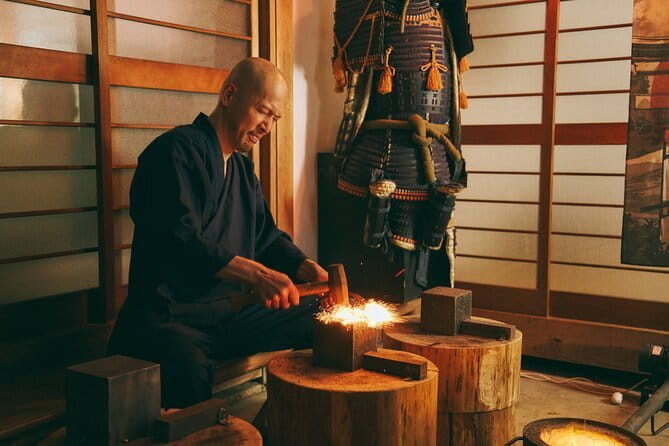
- You forge a real 13 to 15 cm knife: The finished blade is handmade and intended for everyday use or gifting.
- The heat is real: Steel is heated to a glowing red, and you work with hammers, tongs, grinders, and sharpening stones.
- Mao, Taka, and the team teach beginners: Instructions cover safety, hammer angle, rhythm, shaping, sharpening, and care.
- The session is physical: Stretch first, wear socks, and expect heat, repeated hammering, and time on your feet.
- Two studios are used in Sakyo-ku: Confirm whether you are going to Studio NIN Yase or Studio NIN Kendo before leaving.
- The price reflects a rare workshop: At $154 per person, you pay for instruction, materials, tools, costume, packing, and a finished knife.
Why forging a knife feels different from a normal Kyoto activity
Kyoto offers plenty of beautiful things to look at. This class asks you to make something. That difference matters.
You begin with raw metal and finish with an object you can use in your kitchen. The knife may carry small marks from the process, and that is part of its appeal. It is not a factory-perfect souvenir. It shows that you worked the steel yourself, even though the instructors step in to correct mistakes and help you finish a safe, usable blade.
The experience also gives you a brief look at a craft that is difficult to encounter in ordinary Japanese sightseeing. Blacksmithing is not a stage show here. You handle the tools, feel the vibration of the hammer, and learn why heat, timing, angle, and pressure all matter.
The class has earned a 4.8 rating from 350 bookings, with especially strong praise for the instructors’ patience, clear safety explanations, and friendly energy. That matches the shape of the activity: the staff do not leave you alone with a dangerous piece of steel, but they also do not do everything for you.
More craft workshops in Kyoto:
- Kyoto : Chopsticks Making Workshop in Gion with Engraving Option
★ 5.0 · 958 reviews - Roketsu dyeing experience: M course Roketsu Dyeing Experience
★ 5.0 · 163 reviews - Kyoto: Beginner Knife Sharpening & Handle Fitting Workshop
★ 4.9 · 141 reviews
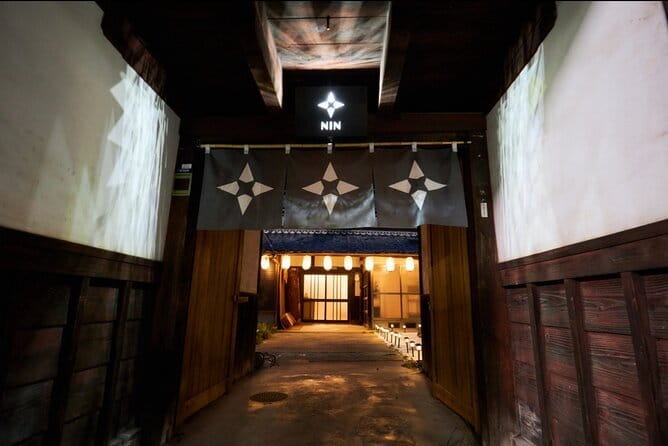
Arriving at Studio NIN in Sakyo-ku
The listed meeting point is Studio Shinobi YASE, at 168-1 Yase-no-secho in Sakyo-ku. It is described as a one-minute walk from the Yase-Hieizan Exit of the Eizan Electric Railway, and the train is the recommended way to arrive. Taxis are also available.
There is one detail I would take seriously. The business operates from two studios, Studio NIN Yase and Studio NIN Kendo, and the exact venue is confirmed by message before your visit. One person found the directions confusing because the initial information pointed toward one studio while the knife session took place at the other. Another found the walk longer than expected.
My advice is simple: wait for the final studio message, save the address, and allow extra time. Do not rely only on the phrase one minute from the station. If you are carrying bags or arriving from central Kyoto, an early start will make the beginning less rushed.
The setting around Yase is described as pleasant and scenic, which gives the class a different feel from a workshop in a dense city street. Still, the real concern is not the view. It is getting to the correct door before your booking begins.
Changing into blacksmith attire
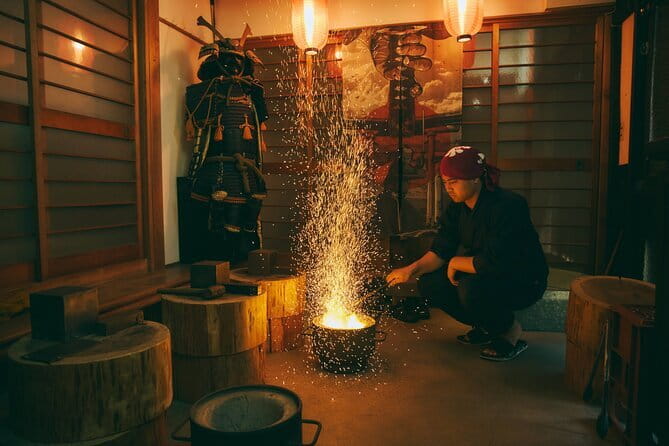
Once you arrive, you check in and meet the instructor. Mao is identified as a knife professional with more than ten years of experience. Other sessions have included Taka, Mits, Atsushi, Daiki, and Tom, so the exact teaching team may vary.
You put on the traditional craftsman’s uniform before the work begins. This is more than a costume photograph. It marks a clear change from sightseeing mode to workshop mode, and it keeps your ordinary clothes better suited to a hot, messy activity.
Bring socks, as requested. The included equipment also covers a towel, water, tools, materials, a box, and a bag. Photos and videos are welcome throughout the process, and the staff may help capture stages of the work, which is useful when your hands are occupied.
The group may be small, and that is a real advantage. With fewer people at the bench, an instructor can watch your grip and correct your hammering before a poor angle becomes a larger problem. Private sessions can also happen when attendance is low, though you should not book on the assumption that you will have the studio to yourself.
Safety first, then the steel
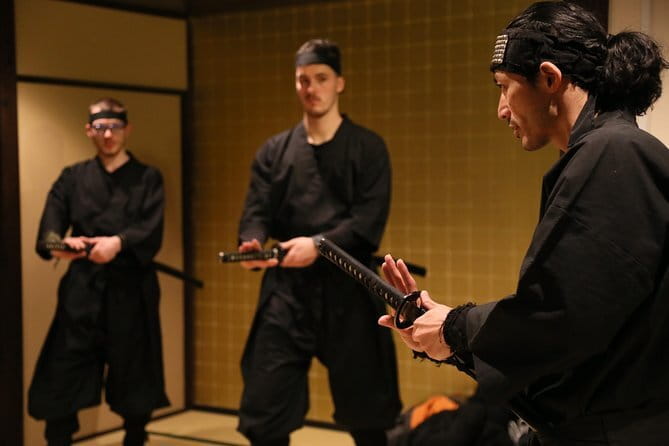
Before any hammering starts, the instructor introduces the main tools. You learn how to handle hammers, tongs, grinders, and sharpening equipment. The safety briefing is especially important because the steel reaches roughly 800 to 900 degrees Celsius during the hot-work stage.
The teaching style appears to be direct and patient. You are shown what to do, then guided while you try. This is the right balance for a first blacksmithing class. Too much control would turn the session into a demonstration. Too little would make the activity unsafe and frustrating.
You should take the warnings seriously. The activity involves heat, metal, grinders, and sharp edges, and the terms state that you are responsible in the unlikely event of an accident or injury. Alcohol and drugs are not allowed. Children under 15 must be accompanied by a guardian, and the activity is not suitable for children under 15 or people over 95.
A few more Kyoto tours worth putting on the shortlist
- PERFECT KYOTO 1-Day Bus Tour
★ 5.0 · 13,518 reviews - Kyoto: Fushimi Inari, Kinkakuji, Bamboo Grove 1 Day Bus Tour
★ 4.8 · 4,316 reviews - Kyoto: Tea Ceremony in a Traditional Tea House in Kiyomizu
★ 4.9 · 3,519 reviews - Kyoto Geisha Walking Tour: Gion District & Hidden Gems
★ 4.7 · 3,273 reviews
Heating the raw steel
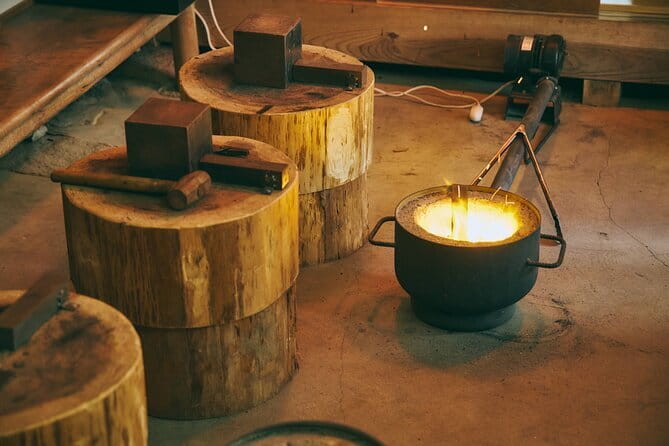
The raw iron or steel goes into the furnace until it glows red-hot. This is the moment when the process becomes physical and immediate. You are no longer discussing how a blade is made. You are watching your material change in front of you.
The instructor explains how Japanese kitchen knives are formed and how the different stages affect the final shape. The supplied details do not promise a long lecture on smithing history, so book this for the making rather than for a full cultural seminar. You receive useful context, but the class puts its time into doing.
The heat can be intense, particularly in summer. Air conditioning and frozen neck coolers have been used to make hot sessions more manageable. Even with those measures, you will be working close to a furnace. Wear clothing you can move in beneath the uniform and be ready for a warm room.
The hammering stage is the heart of the class
With the steel hot, you use a hammer to draw out and shape the blade. Mao or another instructor demonstrates the angle, rhythm, and force, then helps you repeat the motion.
This is the part that makes the souvenir feel earned. You do not need blacksmithing experience, but you do need to contribute. The hammering takes effort, and several people have found the class more tiring than expected. Stretch your shoulders and arms before arriving. That sounds like a joke until you are repeatedly lifting a hammer in furnace heat.
The instructors help fix errors, which is reassuring. Your finished knife should be usable, but you should not expect a flawless blade made entirely without assistance. The honest description is that you shape the knife yourself under expert supervision, with the smiths correcting or refining parts when needed.
That arrangement works well for a short class. A larger knife can require more than five hours and cost over $400, while this workshop uses a shorter format and makes a smaller 13 to 15 cm knife. The compact blade lets you experience the key stages without giving up most of a day.
Cooling, shaping, and sharpening the blade
After the hot work, the metal is cooled and checked. You refine rough edges and prepare the blade for sharpening. At this point, the object begins to look less like a strip of worked steel and more like a knife.
Sharpening brings another kind of concentration. You use sharpening stones and grinders with close instruction. The hammering is loud and forceful, but sharpening rewards patience. A small change in angle affects the edge, so this is where the class shows that knife making is not only about strength.
You then polish the blade. The supplied information describes a clean, elegant finish, but one useful detail from a participant is that the knife may retain a kurouchi finish. This is a dark, rustic surface left from forging rather than a fully silver, mirror-like polish. It is part of the handmade look and can help with resistance to rust.
Do not arrive expecting a restaurant-display knife with a flawless factory surface. The rougher finish is part of the style. If you prefer a handled knife, confirm the options and price before you start. A handled version has been offered for an additional 5,000 yen, payable at the studio by cash or card, including Apple Pay.
The final knife and what you take home
At the end, your knife is about 13 to 15 cm long and fully handmade during the session. It is packed in a box and bag, so you have a sensible way to carry it after class.
The best use of the knife is also the simplest. You can give it as a gift, use it at home, or keep it as a reminder of your time in Kyoto. A handmade kitchen tool has more staying power than a decorative souvenir, but you should still check the transport rules that apply to carrying knives on your journey home.
The staff answer final questions about techniques, knife care, and the work itself. Photos and videos help preserve the process, especially the red-hot steel and the first time the rough shape begins to resemble a blade.
The workshop can suit a family with older children, couples, solo visitors, and groups of friends. It has also worked well for birthday gifts and for parents making something with teenagers. It is less suitable if you want a quiet, passive activity or if you dislike heat, noise, repetitive work, or sharp tools.
Is $154 a fair price?
At $154 per person, this is not a cheap souvenir-making class. It is also not simply a three-hour demonstration. The fee includes instruction, costume, water, towel, tools, steel, sharpening equipment, packaging, and the knife you produce.
The value depends on what you want from Kyoto. If you would rather spend the money on several small attractions, this may feel expensive. If you want one activity that combines a rare craft, direct instruction, and a useful object to take home, the price is easier to justify.
The strongest value comes from the level of help. You do not need to buy or carry blacksmithing tools, learn alone, or worry about turning raw metal into a safe edge without supervision. The staff handle the complex parts while still giving you real work to do.
The shorter format is also part of the calculation. You get the main stages of knife making in about three hours, but not the long, slow process used for larger or more elaborate blades. Go in expecting a carefully managed introduction, not an apprenticeship.
Practical tips for a better session
- Stretch before you arrive. The hammering is fun, but it uses your arms and shoulders.
- Wear socks and comfortable clothing. The studio supplies the craftsman’s uniform.
- Confirm the studio address. The two locations in Sakyo-ku make this the most important arrival detail.
- Allow extra travel time. The official meeting point is near the Eizan Railway, but one account found the route longer and less clear.
- Use the photo opportunity. You can take pictures and videos during the process, and the staff may help record key moments.
- Ask about the handle option early. A handled knife has been offered for an extra 5,000 yen.
- Expect a rustic finish. The kurouchi surface is part of the handmade character.
- Do not book it after drinking. Alcohol and drugs are not allowed.
- Plan your luggage afterward. You will leave with a boxed knife, so make sure you can carry it safely.
Who should book this Kyoto knife-making class?
I would choose this for someone who likes making things with their hands and wants a souvenir with a story. It is especially good for couples, families with teenagers, and anyone who has already seen Kyoto’s temples and wants a more active afternoon.
It is also a strong choice for a solo visitor. The small-group format gives you a shared activity without requiring a private booking, and the instructors provide enough direction for a first attempt.
I would hesitate if you have limited mobility, do not want physical work, or prefer a detailed history lesson. The class includes some explanation of Japanese blacksmithing, but the main point is forging, shaping, sharpening, and polishing.
FAQ
How long does the knife-making experience last?
The activity lasts three hours. The knife-making format itself is described as a refined 2.5-hour process within that visit.
How large is the finished knife?
The finished handmade knife is about 13 to 15 cm long.
Which studio will I visit?
The experience uses two studios in Sakyo-ku, Kyoto: Studio NIN Yase and Studio NIN Kendo. Staff will message you before the visit to confirm the correct location.
What should I bring?
Bring socks. The experience includes the costume, towel, water, tools, materials, box, and bag.
Is the class available in English?
Yes. Instruction is available in English and Japanese.
Can I cancel or pay later?
You can cancel up to 24 hours before the activity for a full refund. A reserve-now, pay-later option is also available.
Should you book it?
Book this if you want to work for your souvenir. The furnace, hammering, sharpening, and rustic finish make it far more memorable than buying a ready-made knife in a shop.
At $154, it asks a fair amount of both money and energy. But if you value a rare craft, patient instruction, and an object you can use at home, this is one of Kyoto’s more personal hands-on activities. Confirm the studio, stretch your arms, and arrive ready to make some noise.
Newest Kyoto experiences on the site
- Treasures of Kyoto: Gion & historical Walking Tour★ 5.0 · 6 reviews
- Whisk Your Own Matcha: A Zen Matcha Experience at Temple★ 3.6 · 7 reviews
- Kyoto tea town for matcha lovers★ 5.0 · 16 reviews
- Uji: Private immersion into Kyoto’s tea and reglious culture★ 5.0 · 17 reviews
- Kyoto Matcha Green Tea Tour★ 4.5 · 23 reviews
- Uji and Wazuka Matcha Farm Half Day Private Guided Tour★ 5.0 · 21 reviews
- Utilising upcycled Matcha! Creating matcha incense (Uji, Kyoto)★ 5.0 · 6 reviews
- Sacred Temple Yoga Experience in Japan★ 5.0 · 3 reviews
Kyoto Craft Workshops, compared.
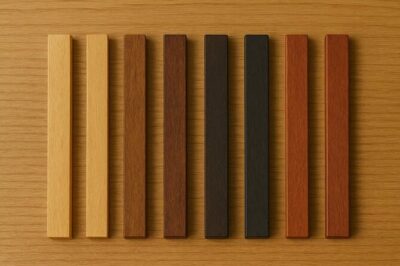
Chopsticks Making Workshop in Gion with Engraving Option
Read our review →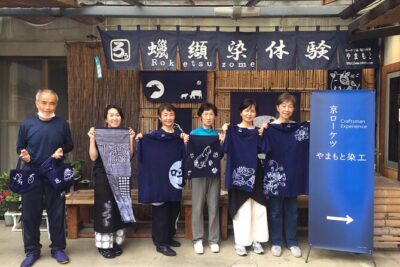
Roketsu dyeing experience: M course Roketsu Dyeing Experience
Read our review →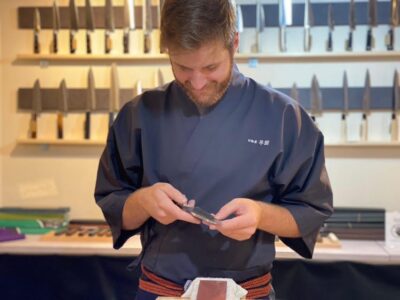
Beginner Knife Sharpening & Handle Fitting Workshop
Read our review →
Japanese Archery Workshop with Experienced Instructor
Read our review →
Kyoto Michelin Ramen Workshop or Painting Ramen Essentials
Read our review →

Browse the lists this tour appears in