
Reviewed · GION DISTRICT TOURS
Kyoto: Gion Geisha District & Yasaka Shrine Walking Tour
Gion is best understood on foot, where a stone lane, wooden townhouse, or quiet canal can tell you more than a quick photo stop. This 90-minute private walk links Hanamikoji Street, Shirakawa Canal, and Yasaka Shrine, giving you the cultural story behind Kyoto’s famous geiko and maiko district.
I like the way the tour looks beyond the hope of spotting a geiko or maiko. I also like the daytime timing, which lets you study the wooden facades, willow-lined canal, and shrine details without relying on dim evening light. The main drawback is its short length: you get a useful introduction, but not enough time for a slow, unhurried look at every corner of Gion.
Key points to know before booking
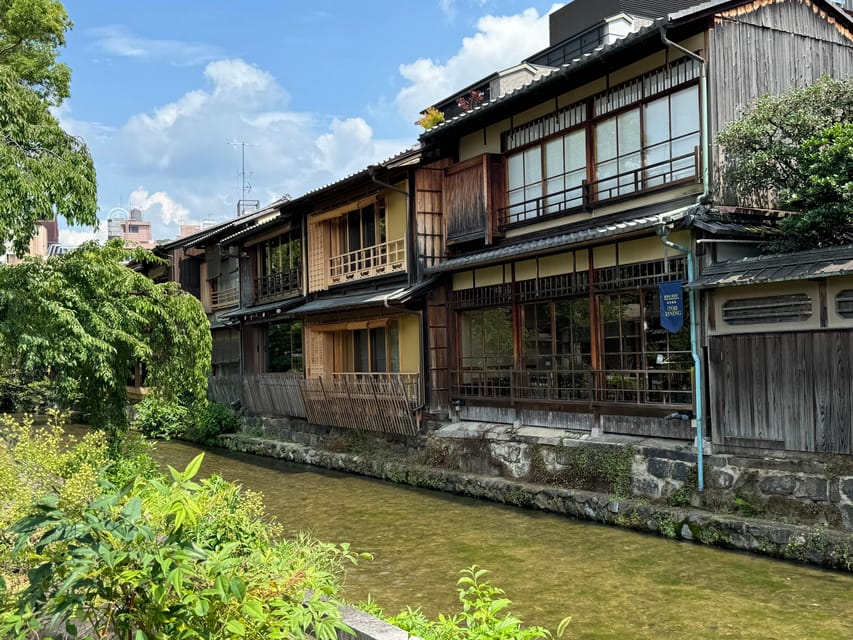
- Shirakawa Canal offers the prettiest stretch of the walk, with willow trees, small bridges, and preserved townhouses.
- Hanamikoji Street explains Gion’s public image, from machiya architecture to traditional ochaya tea houses.
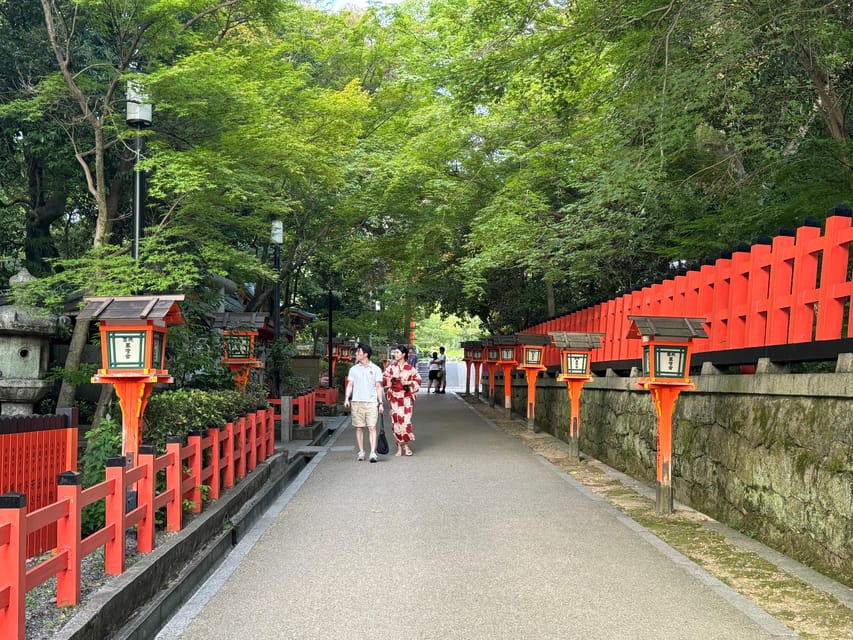
- Yasaka Shrine adds religious context, linking the neighborhood to Kyoto’s Shinto traditions and the Gion Matsuri.
- The tour focuses on understanding, not sightings, so it suits you if you want cultural context rather than a geisha-spotting chase.
- Guides Peco and Yozo received especially warm praise, including clear English, local knowledge, helpful photos, and careful pacing.
- The $38 price buys a private 90-minute introduction, with no food, drinks, or transport included.
Why Gion makes a good walking tour
Gion is often reduced to a simple label: Kyoto’s geisha district. That description is not wrong, but it leaves out most of the story. Gion is also a working cultural quarter shaped by religion, architecture, music, dance, hospitality, and strict social customs.
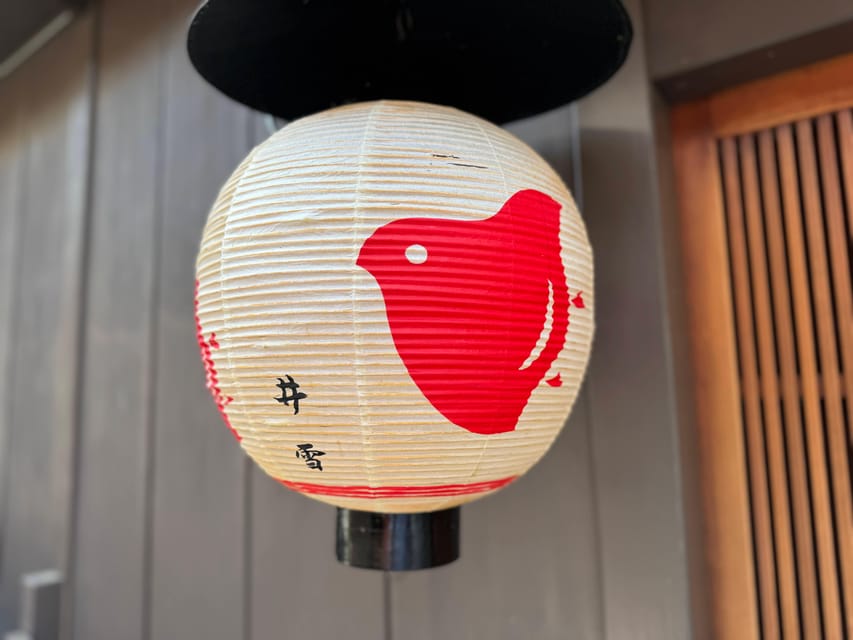
A guide helps you read details that are easy to miss. The narrow frontage of a wooden machiya, the screened entrance of a tea house, and the quiet formality of a traditional street all mean more once someone explains how the district developed.
I would not book this walk mainly to see a geiko or maiko. The tour does not promise sightings, and its purpose is more respectful and useful. You learn about the demanding training, artistic work, and social role associated with geiko and maiko in Kyoto.
That distinction matters. Gion is a lived-in neighborhood, not a stage set. A good guide helps you appreciate it without treating local people as a photo opportunity.
More ways to walk Gion:
- Kyoto Geisha Walking Tour: Gion District & Hidden Gems
★ 4.7 · 3,273 reviews - Kyoto: Gion Magical Night Walking Tour with Geisha Trivia
★ 4.9 · 2,393 reviews - Kyoto: Gion Geisha District Walking Tour – Stories of Geisha
★ 4.7 · 2,187 reviews
Hanamikoji Street and the wooden face of Kyoto
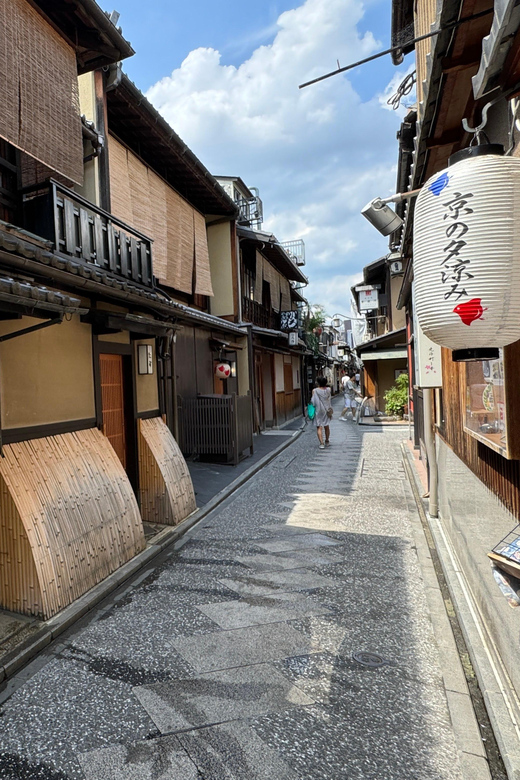
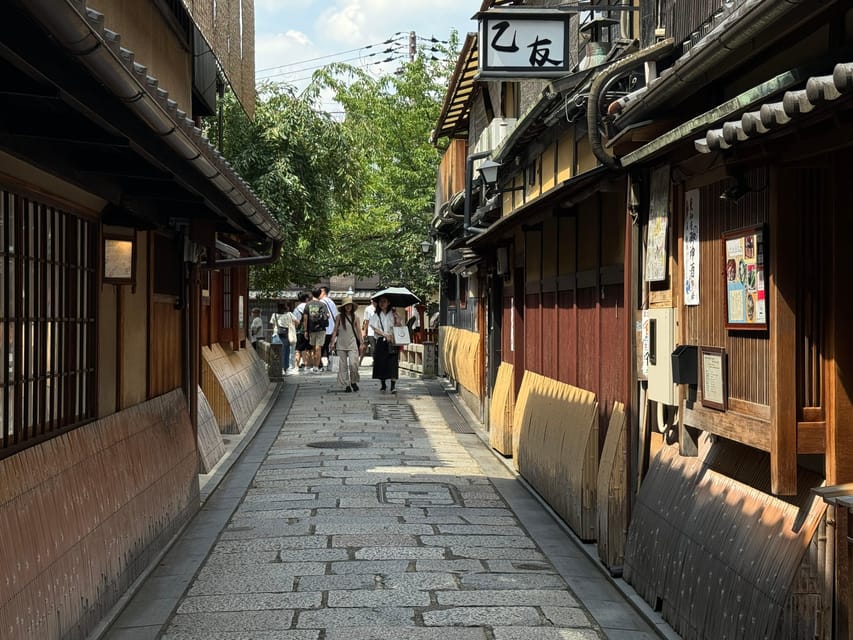
Hanamikoji Street gives you the clearest introduction to Gion’s traditional appearance. The road is lined with wooden machiya townhouses and ochaya tea houses, creating the classic Kyoto scene many visitors hope to find.
Look closely as you walk. The buildings are not just attractive backgrounds. Their narrow fronts and restrained decoration reflect a different approach to urban space, one that values privacy, proportion, and careful presentation.
The street is also where the district’s public image can feel strongest. It is picturesque, and that brings attention. Your guide’s role is useful here because the story goes beyond architecture. You learn how ochaya functioned as places connected to formal entertainment and artistic performance, and how geiko and maiko fit into that world.
The daytime setting is a practical advantage. In daylight, you can see the grain of the wood, the shape of rooflines, and the small changes between one facade and the next. Evening Gion has its own mood, but shadows and crowds can make architectural details harder to read.
Do not expect an extended stop at every building. Ninety minutes is enough for a well-shaped route, not a detailed architectural survey. If you want time for photography, allow yourself a little extra time before or after the tour.
Shirakawa Canal, Gion’s quietest view
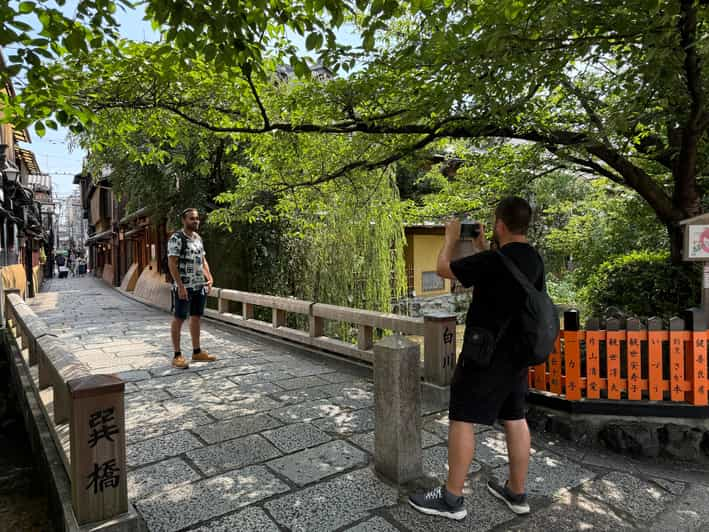
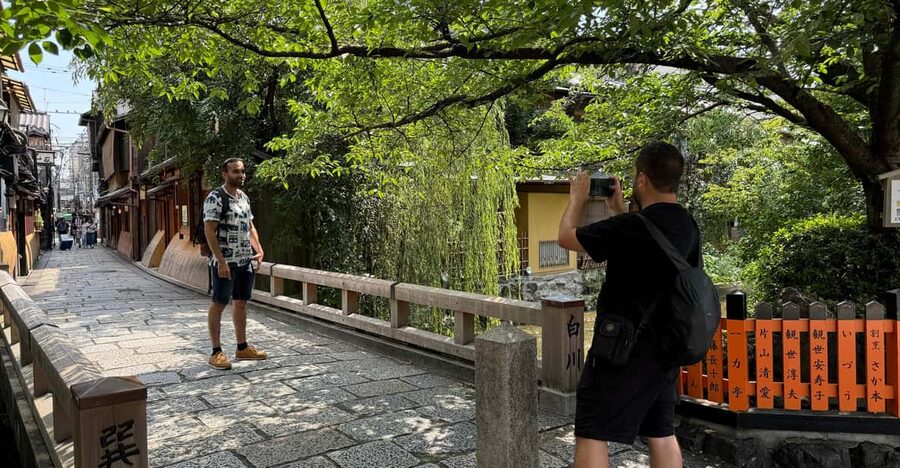
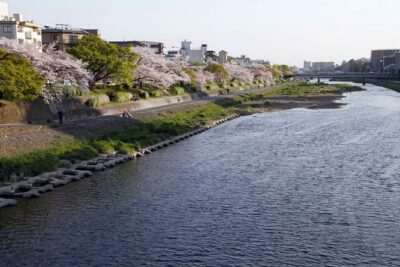
The walk continues to the Shirakawa Canal, one of the most appealing parts of the experience. Willow trees, small bridges, water, and preserved facades give this stretch a calmer feel than the busier parts of Gion.
This is where I would slow down mentally, even if the group keeps moving. The canal shows how much of Gion’s character comes from small relationships between buildings, water, plants, and narrow lanes. You are not looking at a single grand monument. You are reading a carefully maintained scene.
The canal also helps balance the busier reputation of Hanamikoji Street. If the main road feels formal and highly photographed, Shirakawa offers a quieter view of the district’s design. It is a good place to ask your guide about the relationship between Gion’s entertainment traditions and its physical setting.
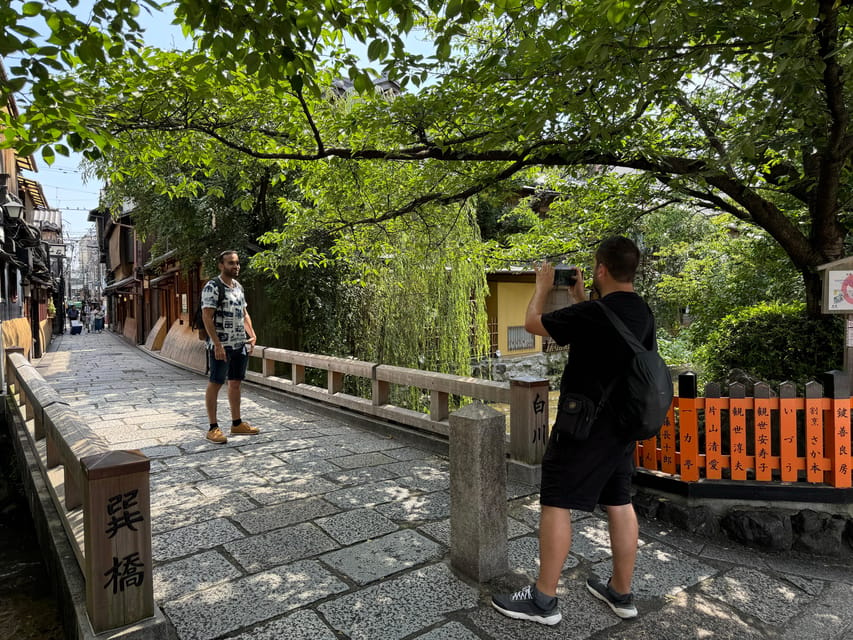
One useful detail from the tour experience is the attention to back streets. A guide such as Peco can take you along lanes you might otherwise miss, adding texture to the walk instead of keeping you on the most obvious route. That is a real benefit of paying for guidance in a neighborhood where the best details are often not marked with large signs.
Rain does not necessarily ruin this portion. One visitor found the walk worthwhile even in wet weather. Still, the canal is most enjoyable when you have shoes with a firm grip and clothing suited to the forecast. Those are simple preparations, but they matter on stone-paved streets.
Yasaka Shrine and the spiritual center of Gion
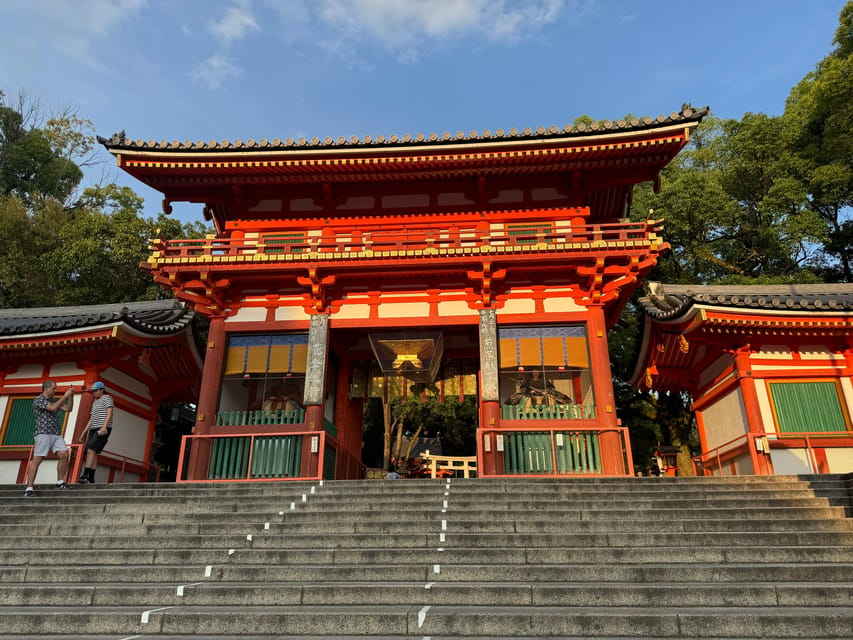
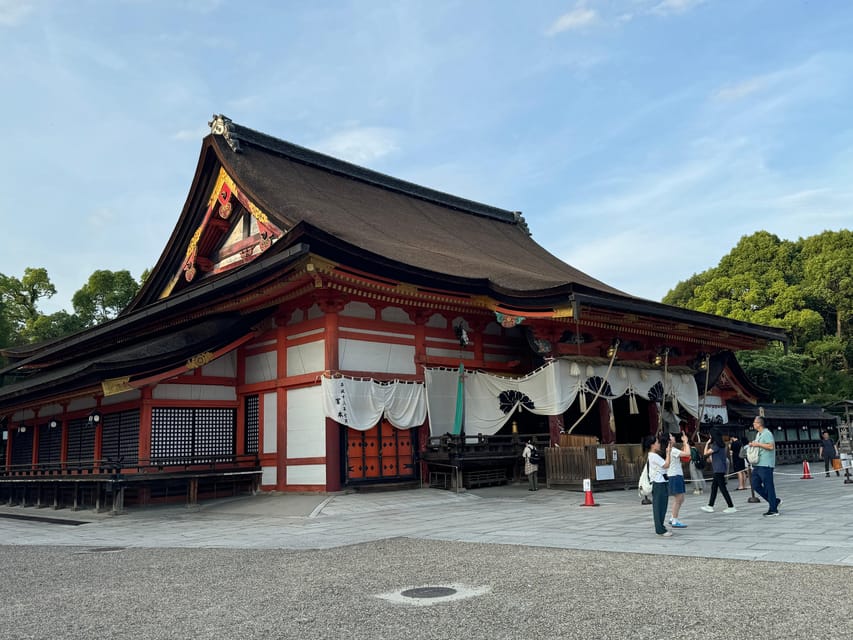
Yasaka Shrine gives the tour a different register. After the wooden tea houses and canal-side streets, you reach one of Kyoto’s major Shinto sites and a place closely tied to Gion’s identity.
The shrine has a history of more than a thousand years and remains linked to the Gion Matsuri, one of Kyoto’s best-known festivals. Your guide explains this connection, helping you see that Gion is not only an entertainment quarter. Religious life has long shaped the area as well.
I like this part because it keeps the tour from becoming a narrow lesson about geiko and maiko. Yasaka Shrine adds a broader view of how ritual, community, and neighborhood life overlap in Kyoto.
Do not expect a long religious tour or a specialist lecture on Shinto practice. The stop is part of a compact walking route, so the explanation is designed to give you context rather than cover every aspect of the shrine.
The shrine also gives you a clear sense of contrast. Gion’s tea houses depend on privacy and controlled access. Yasaka Shrine is a public spiritual center, tied to festivals and shared community traditions. Seeing both in one short walk makes the district easier to understand.
More geisha and maiko evenings in Kyoto:
- Best of Kyoto: Gion, Geisha, Pagodas & Cobblestones
★ 4.9 · 2,058 reviews - Night Walk in Gion: Kyoto’s Geisha District
★ 4.5 · 2,003 reviews - Kyoto Gion Geisha District Walking Tour – The Stories of Geisha
★ 5.0 · 1,441 reviews - Kyoto Gion: 2-Hour Geisha Culture & History Walking Tour
★ 5.0 · 1,186 reviews
What you learn about geiko and maiko
The terms geiko and maiko are often used loosely outside Kyoto. The tour gives you a clearer explanation of their place in the city’s cultural life.
Your guide discusses the traditions, discipline, and artistic training connected with these performers. The focus is not simply on costumes or appearances. You learn why music, dance, conversation, ceremony, and presentation require serious preparation.
That context is valuable because it changes the way you see Gion. Instead of treating a possible encounter as a lucky photograph, you gain a better sense of the work behind the public image.
The tour also avoids making sightings the central goal. That is a strength for anyone who wants a thoughtful introduction. You are not promised a particular encounter, and the experience remains worthwhile if you see no geiko or maiko at all.
Guides can make a large difference here. Peco was praised for friendly, clear explanations, while Yozo was described as easy to understand in English and attentive to the needs of an older group. Those details suggest the tour can work well for visitors who want questions answered in plain language rather than a memorized speech.
Guide assignments can change, so do not book on the assumption that a particular person will lead your walk. English and Japanese are available, and the guide provides cultural and historical commentary throughout.
What $38 is buying you
At $38 per person, the tour sits in the reasonable range for a private, guided introduction to one of Kyoto’s most important districts. The price is not paying for admission to a major attraction or a meal. It is paying for a local guide, a planned route, interpretation, and the ability to ask questions as you go.
That value depends on what you want. If you are comfortable wandering alone and have already read about Gion, you may prefer to explore independently. The streets are attractive without a guide, and you can take your time.
I think the price makes more sense during a first visit, especially if you have only a short stay in Kyoto. In 90 minutes, you connect three different parts of the neighborhood and get a framework for returning later on your own.
The private format is another advantage. You are not simply following a large crowd with no chance to ask about a detail that catches your eye. A private group can usually keep a more suitable pace and make the explanation more personal, although the exact meeting point depends on the option you book.
Food, drinks, personal expenses, and transportation to and from the meeting point are not included. Plan for the tour as a walking experience, not a package with refreshments or transfers.
Pace, weather, and practical comfort
The route lasts 90 minutes, so expect steady walking rather than a full-day outing. The surfaces include traditional streets and paths through an old neighborhood. Comfortable shoes will help, particularly if the weather is wet.
One guide adjusted the pace for a guest using a walking stick, carried a bag for another person, and helped with photographs. That is encouraging if you are traveling with older relatives or someone who needs a slower rhythm. Still, no formal accessibility details are provided, so you should discuss specific mobility needs when booking.
Daytime is a smart choice for seeing Gion’s architecture. You get clearer views of the townhouses and canal, and you can study details that may vanish after dark. On the other hand, if you want the atmospheric glow often associated with evening Gion, this tour will not provide that mood.
Weather is worth considering. A little rain does not automatically stop the walk, but it can affect comfort and photography. Bring suitable clothing and expect the tour to continue as a walking activity unless your provider gives different instructions.
Because the meeting point may vary by booking option, check your confirmation carefully. Do not assume every option begins at the same place.
Who should book this Gion walk
I would recommend it to first-time visitors who want a clear introduction without spending half a day on a formal lecture. It also suits you if you care about architecture, local customs, religious sites, or the performing arts.
Families and mixed-age groups may find the private format helpful. The guide can explain things at a pace that works for the group, and the experience does not depend on nightlife or late hours.
It is also a good choice for visitors who are uneasy about approaching a geisha district on their own. The guide gives you cultural boundaries and background, helping you look with respect.
I would be more cautious if you want extensive free time for photographs, a food experience, or a guaranteed encounter with geiko or maiko. None of those is the central offering. The tour gives you interpretation and a compact route through Gion.
Should you book the 90-minute Gion tour?
Book it if you want Gion to make sense, not just look pretty. The combination of Hanamikoji Street, Shirakawa Canal, and Yasaka Shrine gives you architecture, scenery, religion, and performing-arts culture in one manageable walk.
The strongest reasons to book are the private format, the focus on respectful cultural context, and the chance to see back streets that you might skip alone. Peco and Yozo are examples of guides who brought warmth, clear English, flexibility, and practical help to the experience.
Skip it if you prefer complete independence or want a longer, slower exploration. At $38, the value is best when you use the guide’s knowledge to understand what you are seeing. For a first look at Gion, that makes this a sensible and well-focused choice.
FAQ
How long is the Gion walking tour?
The tour lasts 90 minutes.
What places are included?
The route includes Hanamikoji Street, the Shirakawa Canal, and Yasaka Shrine.
Is the tour private?
Yes. It is offered as a private group experience.
What languages are available?
Live guides are available in English and Japanese.
Does the tour include a local guide?
Yes. The experience includes a private guided walking tour and an English-speaking local guide. Japanese-language guiding is also listed as available.
Does the tour include food or drinks?
No. Food and drinks are not included.
Is transportation included?
No. Transportation to and from the meeting point is not included.
Will I see a geiko or maiko?
A sighting is not promised. The tour focuses on the traditions, discipline, and cultural role of geiko and maiko rather than on seeking photographs.
Where does the tour meet?
The meeting point may vary depending on the option you book. Check the details for your selected option.
Can I cancel the tour for a refund?
You can cancel up to 24 hours in advance for a full refund. Reserve now and pay later is also available.
More Walking Tours in Kyoto
- Nishiki Market Brunch Walking Tour (7 Tastings + Brunch)
★ 5.0 · 1,355 reviews - Kyoto Arashiyama Walking Tour: Bamboo, Monkeys, Gardens & Secrets
★ 5.0 · 1,216 reviews - Kyoto: Izakaya Bars Guided Walking Tour
★ 4.9 · 815 reviews - Kyoto Gion Night Walk & Geisha District Guided Tour
★ 5.0 · 786 reviews
More Shrines in Kyoto
- Osaka/Kyoto: Arashiyama, Nara & Fushimi Inari Shrine w/Lunch
★ 4.4 · 754 reviews - KYOTO Tea Ceremony with kimono near by Imamiya Jinjya Shrine
★ 5.0 · 343 reviews - Kyoto: 3-Hour Fushimi Inari Shrine Hidden Hiking Tour
★ 4.9 · 270 reviews - Kyoto Magical Night English Tour: Gion & Fushimi Inari Shrine
★ 5.0 · 97 reviews
Newest Kyoto experiences on the site
- Treasures of Kyoto: Gion & historical Walking Tour★ 5.0 · 6 reviews
- Whisk Your Own Matcha: A Zen Matcha Experience at Temple★ 3.6 · 7 reviews
- Kyoto tea town for matcha lovers★ 5.0 · 16 reviews
- Uji: Private immersion into Kyoto’s tea and reglious culture★ 5.0 · 17 reviews
- Kyoto Matcha Green Tea Tour★ 4.5 · 23 reviews
- Uji and Wazuka Matcha Farm Half Day Private Guided Tour★ 5.0 · 21 reviews
- Utilising upcycled Matcha! Creating matcha incense (Uji, Kyoto)★ 5.0 · 6 reviews
- Sacred Temple Yoga Experience in Japan★ 5.0 · 3 reviews
Gion District Tours, compared.
Kyoto Geisha Walking Tour: Gion District & Hidden Gems
Read our review →
Gion Magical Night Walking Tour with Geisha Trivia
Read our review →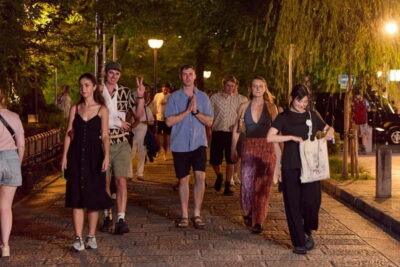
Gion Geisha District Walking Tour – Stories of Geisha
Read our review →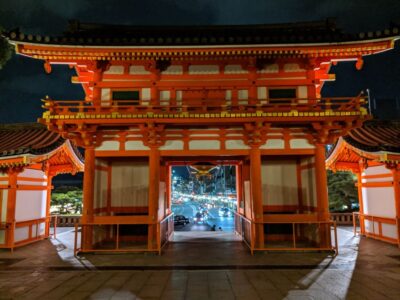
Best of Kyoto: Gion, Geisha, Pagodas & Cobblestones
Read our review →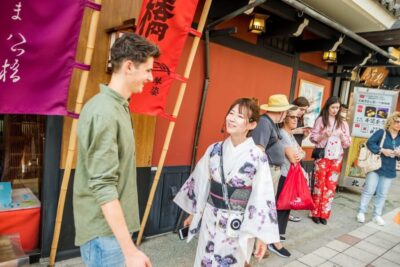
Kyoto Night Foodie Tour in Gion (9+ dishes + 6 Sake tastings)
Read our review →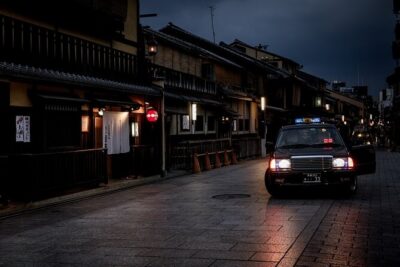
Kyoto Gion Geisha District Walking Tour – The Stories of Geisha
Read our review →
Kyoto Gion: 2-Hour Geisha Culture & History Walking Tour
Read our review →Browse the lists this tour appears in