
Reviewed · KYOTO EARLY MORNING TOURS
Kyoto Early Morning Private Tour with Government-Licensed Guide
Kyoto is at its best before the day gets loud. This private four-hour tour lets you meet a licensed local guide early, then focus on two or three places instead of racing through a long checklist. Fushimi Inari and Kiyomizu-dera are especially good morning choices, when their famous paths can feel far calmer.
I like the custom route and the chance to ask real questions about Japanese life, religion, and history. I also like the useful local help after the tour: guides such as Yasu and Bell have helped people navigate Kyoto after their time together, while Rie has even finished a morning by pointing guests toward a favorite sushi restaurant.
The catch is simple: four hours is not enough for the full menu of Kyoto. This is a walking tour with public transportation or taxis arranged at your expense, and entrance fees are generally extra, so choose your stops carefully.
Key points to know before booking
- Start early for Fushimi Inari and Kiyomizu-dera: The quiet morning hours are the main reason to book this tour.
- Choose two or three sights: You can follow a suggested route or select places that match your interests.
- Expect a private walking experience: Only your group joins the guide, with no shared coach or large tour party.
- Meet on foot: Pickup is offered within a designated Kyoto area, but there is no private vehicle.
- Plan for extra costs: Transportation, meals, personal expenses, and most admission fees are not included.
- Ask for practical Kyoto help: Guides can explain local customs and help you understand how to get around after the tour.
Why an early start makes Kyoto easier
The strongest feature here is timing. Kyoto’s famous temples and shrines can become crowded later in the morning, especially during cherry blossom season, autumn color, holidays, and busy Japanese travel periods.
A start around 6:30 or 7:00 a.m. gives you a better chance of walking through major sites before the day fills in. One guide began at 6:30 and took the group to Kiyomizu-dera and Fushimi Inari while both were unusually calm. Another morning tour began at 7:00 and ended at 11:00, leaving time for lunch afterward.
That early hour also helps in warm weather. Kyoto can be hot, and many of the sights involve stairs, slopes, or long walks. You get the harder sightseeing done before the worst heat.
The early schedule does require discipline. You must be ready to leave your hotel early, and four hours passes quickly. Still, I think the trade is worthwhile if Fushimi Inari, Kiyomizu-dera, or Arashiyama is high on your list.
More early starts in Kyoto:
- Kyoto Early Morning Tour with English-Speaking Guide
★ 5.0 · 1,427 reviews - Kyoto: Early Morning Tour with English-Speaking Guide
★ 4.9 · 1,128 reviews - Arashiyama Bamboo Forest & Hidden Gems Bike Tour (Early Bird)
★ 5.0 · 613 reviews
A private guide who adjusts to your interests
This is not a fixed sightseeing march. You can ask the guide to build a route around temples, traditional neighborhoods, food, photography, gardens, or Kyoto’s cultural background.
The stated format is two or three sites from a broad selection. That matters because the full list includes almost every major Kyoto district: Gion, Nishiki Market, Nijo Castle, the Imperial Palace, Ginkakuji, Kinkakuji, Ryoanji, Arashiyama, and more. You are not expected to see all of them in four hours.
The private format gives you room to pause and ask questions. Guides such as Tomy, Yasu, Nabet, Yoshi, Mayumi, Bell, and Rie have been praised for adapting their approach to different groups. Mayumi even added about half an hour when a guest had ankle trouble. That kind of flexibility is useful, though you should not assume an extension is guaranteed.
English ability is part of the service, and the guides explain the sites while you walk. The value is not only historical facts. You can ask about religion, etiquette, food, daily life, or how to move around Kyoto once the guided time ends.
Choosing the right two or three stops
The best route depends on what you want from Kyoto. Your guide can suggest a plan, but it helps to arrive with a clear priority.
Fushimi Inari Taisha
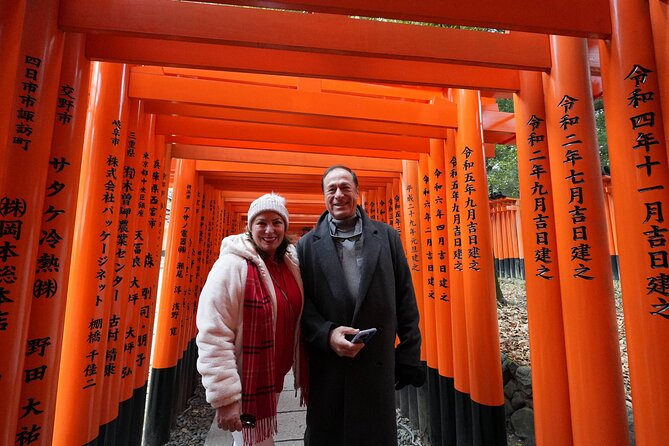
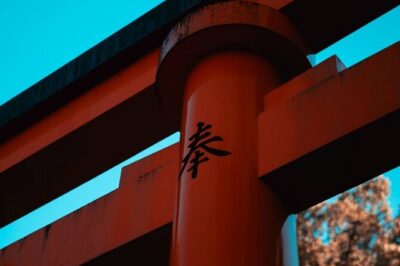
Fushimi Inari is famous for its thousands of vermilion torii gates climbing into the wooded hills. The first section is the most photographed, but the shrine is more than a tunnel for pictures. It is dedicated to Inari, a Shinto deity associated with rice, prosperity, and business, and fox images appear throughout the grounds as Inari’s messengers.
An early visit gives you the best chance of enjoying the gates without a wall of people in front of you. The site has no admission fee, but the walk can become strenuous if you continue far up the mountain. Ask your guide how much of the route suits your time and energy.
Fushimi Inari pairs well with one nearby or central stop. Combining it with Arashiyama is possible only with careful timing and transportation, and it may leave little time at either place.
Same city, a completely different kind of day:
- PERFECT KYOTO 1-Day Bus Tour
★ 5.0 · 13,518 reviews - Kyoto: Fushimi Inari, Kinkakuji, Bamboo Grove 1 Day Bus Tour
★ 4.8 · 4,316 reviews - Kyoto: Tea Ceremony in a Traditional Tea House in Kiyomizu
★ 4.9 · 3,519 reviews - Kyoto Geisha Walking Tour: Gion District & Hidden Gems
★ 4.7 · 3,273 reviews
Kiyomizu-dera Temple
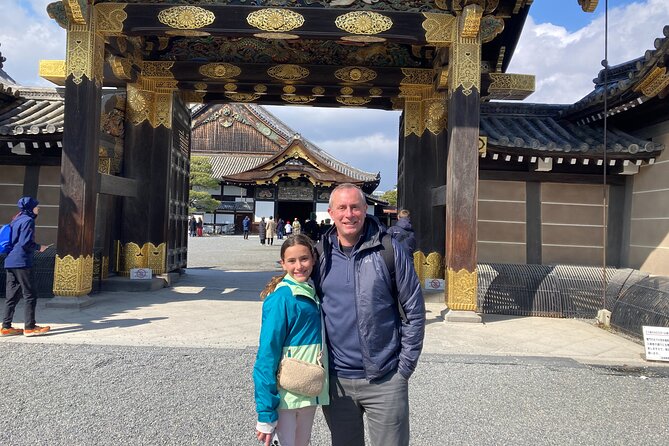
Kiyomizu-dera sits on Kyoto’s eastern hills and is one of the city’s essential temple visits. Its famous wooden stage gives you broad views across Kyoto, while the approach through Higashiyama adds old streets, shops, and traditional buildings.
The temple grounds involve walking and some slopes. Going early is especially useful here because the approach can become crowded later. Admission is not included, so budget for the entrance fee.
This is a strong choice if you want a classic Kyoto introduction: architecture, Buddhist practice, city views, and the old Higashiyama district in one area. A guide can also explain what you are seeing instead of leaving you with only a scenic photograph.
Gion and Higashiyama
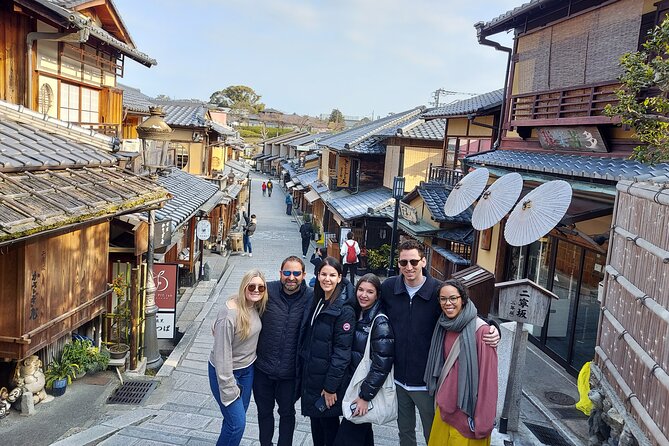
Gion is Kyoto’s best-known geisha district, with narrow lanes, wooden townhouses, restaurants, and traditional entertainment venues. It is a place for quiet observation, not a stage set for intrusive photographs.
Higashiyama gives you a broader historic district around the eastern foothills. Together, Gion and Kiyomizu-dera can form a sensible four-hour route, especially if you want streets and culture more than a long temple list.
The benefit of a guide here is orientation. The lanes can be confusing, and your guide can explain the difference between a public street, a temple approach, a restaurant area, and a private place. Remember that Gion is a living neighborhood, so respectful behavior matters.
Nishiki Market
Nishiki Market is a long, narrow shopping street known as Kyoto’s Kitchen. More than one hundred shops and restaurants sell food and kitchen goods along the covered passage.
Nishiki works best if you want to learn about local ingredients and food customs. It is not an ideal early-morning stop if your main goal is to see the market at its liveliest, since individual shops may keep their own hours. It can also become crowded in the middle of the day.
There is no general admission charge. Food purchases are your responsibility, so allow money and time if you want to taste something.
Arashiyama and the Bamboo Forest
Arashiyama is in western Kyoto, far from the eastern temple districts. Its main sights include the Bamboo Forest, Togetsukyo Bridge, Tenryu-ji, and the gardens and smaller temples around Saga.
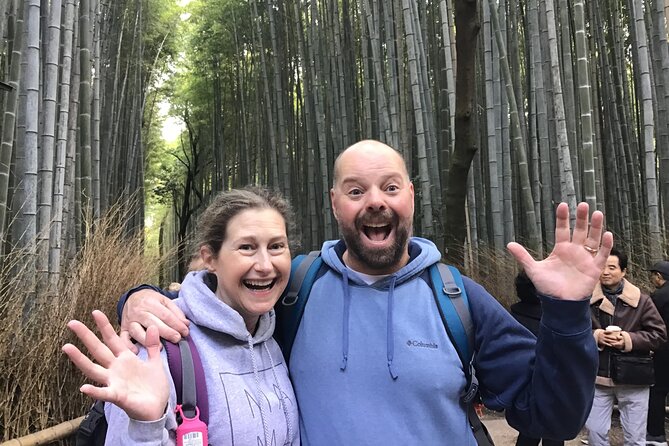
The Bamboo Forest is most peaceful early. The tall stalks and narrow paths create a memorable walk, but the area is not a secluded wilderness. It is a popular public route, and the morning start is what improves the experience.
If you choose Arashiyama, consider staying in that area rather than adding distant sights. You might select the Bamboo Forest and Tenryu-ji, or add Togetsukyo Bridge. Okochi Sanso Garden, Jojakkoji, Nisonin, Gioji, Adashino Nenbutsuji, and Otagi Nenbutsuji offer quieter alternatives, but entrance fees and walking time add up.
One guide took a family to the Bamboo Forest, the Monkey Park, and Fushimi Inari. That shows the tour can be adapted, but it also shows why you should discuss distances before finalizing the route.
Kinkakuji and Ryoanji
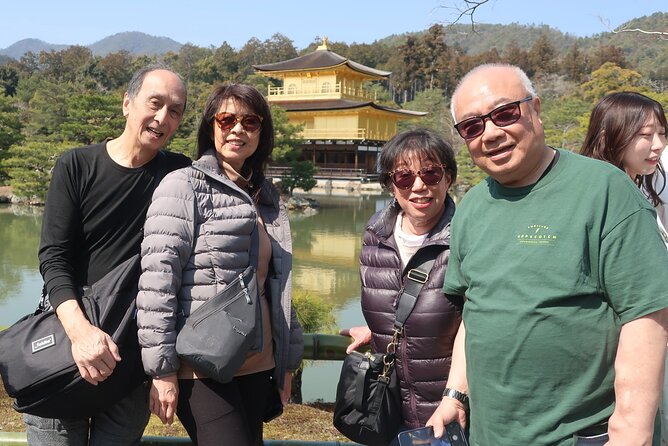
Kinkakuji, the Golden Pavilion, is one of Kyoto’s most recognizable sights. Its upper floors are covered in gold leaf, and the building reflects in the surrounding pond. The visit is primarily visual, with a set path through the grounds and an admission fee.
Nearby Ryoanji is known for Japan’s most famous dry rock garden. Its appeal is quieter and more contemplative. You look at the arrangement of rocks and gravel, then decide what it means to you. Both sites are in northern Kyoto, so they make more sense together than combined with Fushimi Inari or Arashiyama.
A private guide can provide context, but these sites still require you to slow down. Do not expect a four-hour tour to cover several far-flung districts and leave time for thoughtful visits.
Nijo Castle and the Imperial Palace
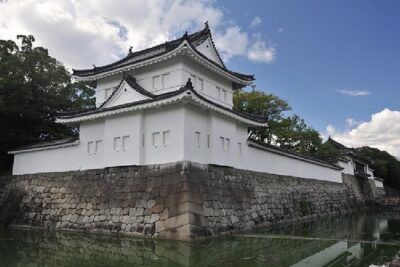
Nijo Castle was built in 1603 as the Kyoto residence of Tokugawa Ieyasu, the first shogun of the Edo period. It offers a different view of Kyoto from the temples: political power, shogun-era interiors, gardens, and the famous nightingale floors.
The Kyoto Imperial Palace served as the Imperial Family’s residence until the capital moved to Tokyo in 1868. Its broad grounds offer a spacious contrast to Kyoto’s narrow lanes and compact temple compounds.
Both sites charge admission, and they require enough time to appreciate. If you prefer Japan’s political and imperial past to religious sites, this is a sensible direction. If you want to visit both properly, I would avoid adding distant Fushimi Inari or Arashiyama.
Ginkakuji, Nanzenji, and Tofukuji
Ginkakuji, the Silver Pavilion, began as the retirement villa of shogun Ashikaga Yoshimasa. Despite its name, it is not covered in silver. Its gardens and restrained Zen design are the real attraction.
Nanzenji has broad temple grounds at the foot of the Higashiyama mountains, along with the striking brick Suirokaku aqueduct. Tofukuji is a large Zen temple in southeastern Kyoto, especially admired for autumn foliage.
These are good choices for visitors who want temple grounds and gardens without focusing only on Kyoto’s most famous photographs. Admission fees apply at several of these sites, and the distances mean you should select one or two rather than attempt all three.
The northern mountains and quieter options
The tour’s menu reaches beyond central Kyoto. Shugakuin Imperial Villa, Katsura Imperial Villa, Kibune, Kurama-dera, Yoshimine-dera, and Daikaku-ji all offer a slower side of the city.
Kibune is a forested mountain town built around Kifune Shrine. Kurama is a rural northern settlement known for Kurama-dera and its hot spring. These places can feel far removed from central Kyoto, but they are poor choices for a rushed four-hour plan unless transportation and timing are carefully arranged.
The Imperial villas are important for gardens and architecture, but they are not casual drop-in sights in the same way as a free neighborhood walk. Confirm access and timing with the guide before building your morning around one.
What the four hours really include
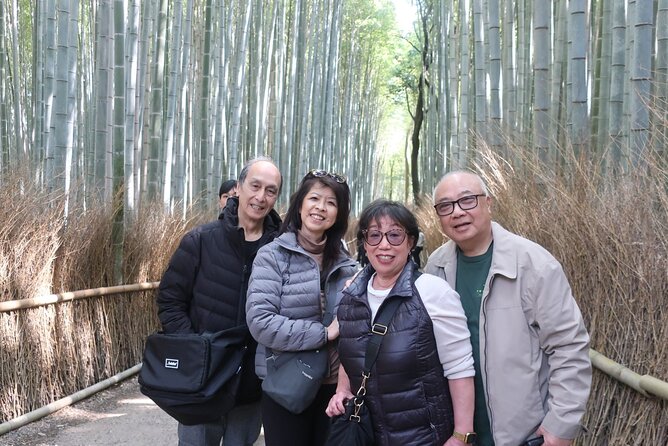
The advertised duration is about four hours, but that includes walking, transfers, explanations, photographs, and time spent entering sites. If you choose three distant places, transportation can consume a large share of the morning.
This tour does not include a private car. Pickup is on foot within a designated area, and you may use public transportation or a taxi at your own cost. One guide successfully took a group of four around Kyoto by public transportation, but routes and traffic conditions vary.
I would plan one compact area or two nearby major sights. Here are practical combinations:
- Fushimi Inari and Tofukuji
- Kiyomizu-dera, Higashiyama, and Gion
- Kinkakuji and Ryoanji
- Arashiyama, the Bamboo Forest, and Tenryu-ji
- Nijo Castle, Nishiki Market, and Pontocho
Pontocho is a narrow dining lane near the Kamogawa River. It is atmospheric, but its restaurants are more relevant later in the day than during an early morning tour. Use it as a walking stop, not the centerpiece of your morning.
Price, admissions, and overall value
At $101.82 per person, the price is reasonable for a private four-hour guide if you are traveling with two or more people and care about personal attention. A solo visitor pays more per person for the same service, while group discounts may improve the value for larger private groups.
The price does not cover private transportation, entrance fees, lunch, or personal purchases. That is important because several major choices, including Kiyomizu-dera, Kinkakuji, Ryoanji, Nijo Castle, Ginkakuji, and Tenryu-ji, may require admission.
You are paying mainly for the guide’s time, planning help, English commentary, and route flexibility. I think the value is strongest on a first Kyoto visit, when you want a quick cultural orientation and help choosing what deserves more time later.
It is less attractive if you already know Kyoto well or prefer to move slowly by yourself. In that case, use the early morning to visit one temple independently and save the guide fee for a longer, more specialized experience.
Who should book this Kyoto morning tour
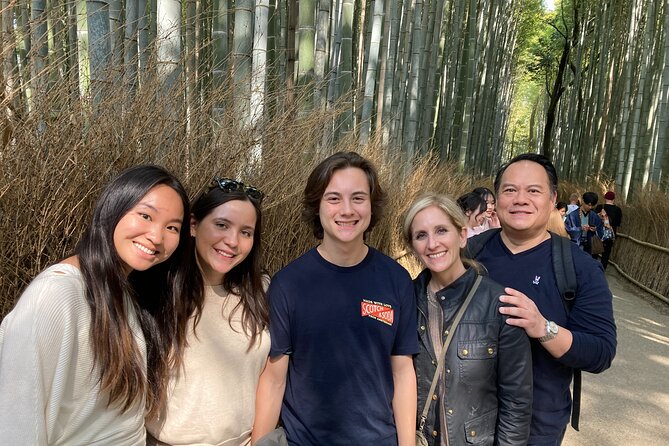
This tour suits first-time visitors, families, couples, and small groups who want a private introduction without joining a large party. It also fits people who need help with Kyoto’s layout or want to ask questions that a standard group tour cannot accommodate.
It is a good match for photographers because early light and lighter crowds can improve the experience at Fushimi Inari, Kiyomizu-dera, and the Bamboo Forest. It also works well for visitors who want a guide to take photos, as Kay did for a couple visiting the Bamboo Forest and Fushimi Inari.
You should think twice if you dislike early starts, have difficulty with extended walking, or expect a vehicle to carry you between every sight. The tour is flexible, but it is still a walking experience with stairs, slopes, and public transportation.
Free cancellation is available up to 24 hours before the start time. Changes or cancellations inside that window are not accepted for a refund.
Should you book it?
Book this tour if you want to see two or three important Kyoto sights before the crowds arrive and you value a local guide who can adjust the morning to your interests. Ask for a compact route, confirm which admissions and transport you will pay, and choose one part of Kyoto rather than trying to conquer the whole city.
I would especially recommend it for Fushimi Inari and Kiyomizu-dera, or for an early Arashiyama visit. Skip it if you want a fully self-guided day, a private car, or a slow stay at one temple. For most first visits, the early start and personal guidance make this a useful way to get your bearings fast.
FAQ
How long is the Kyoto private tour?
The tour lasts approximately four hours.
How many sights can I choose?
The included format allows you to customize the tour around two or three sites from the available selection.
Is this a private tour?
Yes. Only your group participates, and you do not join another tour group.
Is hotel pickup included?
Meetup is offered on foot within a designated area of Kyoto. The tour does not include a private vehicle.
Are entrance fees included?
Transportation, entrance fees, lunch, and personal expenses are not included. The tour information also notes that guide entry fees are covered only for sights listed under the experience details.
Can I choose Fushimi Inari, Kiyomizu-dera, or the Bamboo Forest?
Yes. These are among the available choices, along with places such as Gion, Nijo Castle, Kinkakuji, Ryoanji, Nishiki Market, and Arashiyama.
What happens if I need to cancel?
You can receive a full refund if you cancel at least 24 hours before the experience start time. Cancellations or changes made less than 24 hours before the start time are not accepted for a refund.
Newest Kyoto experiences on the site
- Treasures of Kyoto: Gion & historical Walking Tour★ 5.0 · 6 reviews
- Whisk Your Own Matcha: A Zen Matcha Experience at Temple★ 3.6 · 7 reviews
- Kyoto tea town for matcha lovers★ 5.0 · 16 reviews
- Uji: Private immersion into Kyoto’s tea and reglious culture★ 5.0 · 17 reviews
- Kyoto Matcha Green Tea Tour★ 4.5 · 23 reviews
- Uji and Wazuka Matcha Farm Half Day Private Guided Tour★ 5.0 · 21 reviews
- Utilising upcycled Matcha! Creating matcha incense (Uji, Kyoto)★ 5.0 · 6 reviews
- Sacred Temple Yoga Experience in Japan★ 5.0 · 3 reviews
Kyoto Early Morning Tours, compared.
Kyoto Early Morning Tour with English-Speaking Guide
Read our review →Early Morning Tour with English-Speaking Guide
Read our review →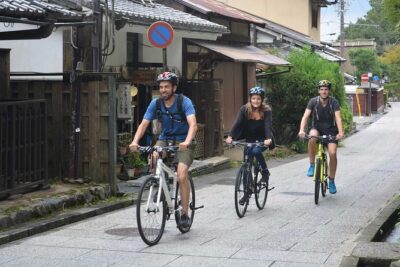
Arashiyama Bamboo Forest & Hidden Gems Bike Tour (Early Bird)
Read our review →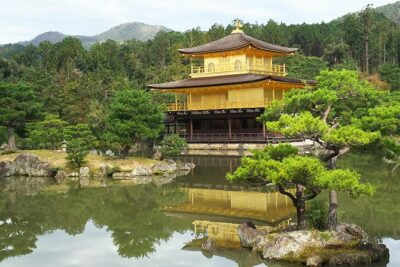
Kyoto Early Bird English Tour: Fushimi-Inari and Arashiyama
Read our review →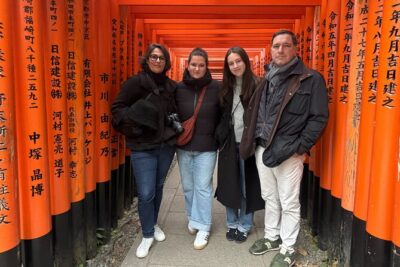
Kyoto Early Bird English Tour: Fushimi Inari & Gion(Private opt)
Read our review →Browse the lists this tour appears in