
Reviewed · KYOTO EARLY MORNING TOURS
Kyoto Morning Tour from Kyoto or Osaka
Kyoto packs centuries of power, art, and ceremony into a small area, and this half-day bus tour gives you three major sights before lunch. You move from the shogun’s Nijo Castle to the gold-covered Kinkakuji Temple, then to the former imperial residence.
I like the efficient route and the fact that entrance fees and transport are included. I also like the chance to hear the story behind the buildings from an English-speaking guide, with especially strong praise for guides such as KC, Casey, Jun, and Mr. Harada. The trade-off is a quick pace, and crowds can make it hard to hear.
Key points
- Three major Kyoto sights in 4 hours 40 minutes: Nijo Castle, Kinkakuji Temple, and Kyoto Imperial Palace form a strong first look at the city.
- A bus saves valuable time: Air-conditioned transport links the stops, which is useful when Kyoto traffic and summer heat make independent hopping tiring.
- Nijo Castle is more than a pretty exterior: Its Ninomaru Palace contains elaborate carvings, gold decoration, guard rooms, kitchens, and famous gardens.
- Kinkakuji is a brief but striking visit: You see the Golden Pavilion beside its pond and follow a one-way route through the grounds.
- Closures matter: The Imperial Palace may be replaced by Kitano Tenmangu Shrine or Nishi Hongan-ji Temple, while Nijo Castle may be replaced by Ryoan-ji Temple.
- The meeting point requires care: Start at Kyoto Avanti across from Kyoto Station’s Hachijo Exit, and confirm the exact location in your booking details.
Three Kyoto icons before lunch
This tour is built for a simple purpose: show you the essential Kyoto sights when you have limited time. In one morning, you see the castle of the Tokugawa shoguns, Japan’s most photographed pavilion, and the palace used by the emperor before the capital moved to Tokyo in 1868.
That combination gives you three different views of old Japan. Nijo Castle represents military rule and shogunal authority. Kinkakuji offers refined temple design and garden scenery. Kyoto Imperial Palace presents the formal world of the imperial court.
I like that the tour does not spend the entire morning at one site. You get a broad introduction, then still have time afterward for lunch or independent exploring. The catch is that this is an introduction, not a slow, reflective visit. You should expect a guided walk, some commentary, photographs, and a move to the next stop.
The tour lasts about 4 hours and 40 minutes. Activity order and arrival times can change with road conditions, traffic, and congestion at the sights. Seats on the vehicle may not be assigned, so arrive ready to follow the group and pay attention to the meeting instructions.
More days that pair Kyoto with Osaka:
- Osaka/Kyoto:Kinkakuji,Arashiyama,FushimiInariShrine,NaraPark
★ 4.1 · 1,596 reviews - Kyoto/Osaka: Nara, Fushimi Inari Taisha, Arashiyama Bus Tour
★ 4.7 · 1,275 reviews - One-Day Tour of Kyoto’s Highlights from Osaka/Kyoto
★ 4.5 · 1,092 reviews
Nijo Castle and the Tokugawa shoguns
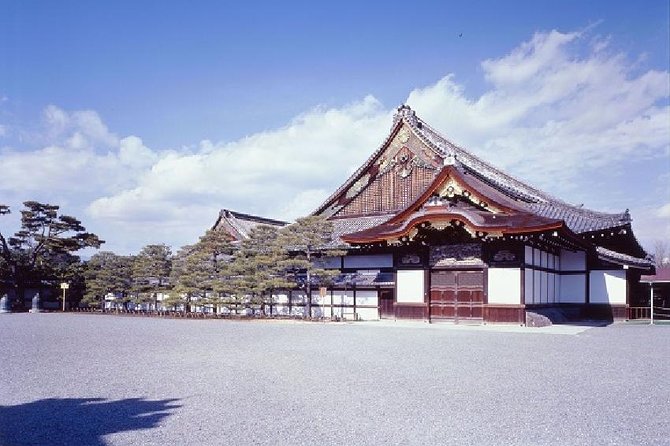
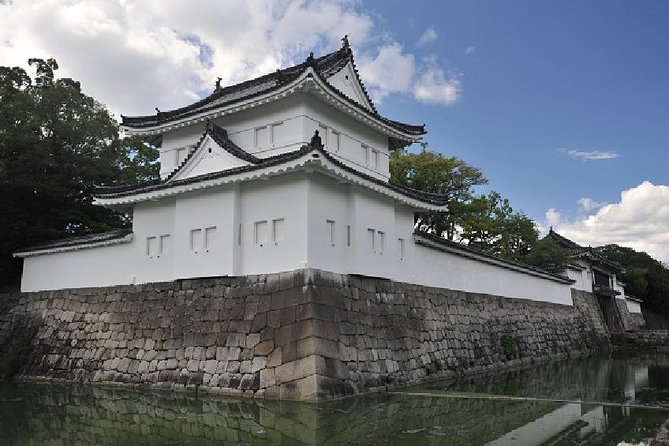
The first stop is Nijo Castle, built in 1603 on the orders of Tokugawa Ieyasu, the first shogun of the Tokugawa shogunate. It is a World Heritage site and one of the best places in Kyoto to understand how military power shaped Japan.
The castle complex contains five connected Cypress wood buildings. Inside the Ninomaru Palace, look for elaborate carvings, painted decoration, and gold-covered rooms. The former kitchens, guardhouse, and living quarters help make the site feel like a working seat of power rather than a single photogenic structure.
You have about 50 minutes here, with admission included. That is enough to see the main palace interiors and gardens, but not enough for an unhurried study of every room and path. If Nijo Castle is your main reason for booking, an independent visit could give you more freedom.
There is also a calendar issue. Nijo Castle closes on Tuesdays in January, July, August, and December, as well as from December 26 through January 3. If a closure falls on a Tuesday holiday, the following day is also affected. The replacement stop is Ryoan-ji Temple, and no refund is issued when the itinerary changes.
That policy matters because the title and main description naturally make the castle sound guaranteed. Check the operating dates before you pay, especially if you have already visited Ryoan-ji or are choosing the tour mainly for Nijo Castle.
Kinkakuji Temple and the Golden Pavilion
Next comes Kinkakuji Temple, usually called the Golden Pavilion. The wooden structure is covered in thin layers of pure gold and sits beside a pond, with Japanese gardens surrounding it.
You get about 45 minutes at the temple. The pavilion itself is the visual prize, but the setting is what makes the stop work: still water, carefully arranged plantings, and a walk that frames the building from changing angles.
This is also the stop where sensible footwear matters most. The route follows a one-way system and includes uneven rocky steps and a climb. The walk is not described as difficult for most people, but anyone with limited mobility should know that the ground is not uniformly flat.
Kinkakuji is one of Kyoto’s most popular sights, so the short visit can feel crowded. The practical goal is not solitude. It is to see the pavilion, hear the basic story, take your photographs, and keep moving with the group.
I like the contrast with Nijo Castle. At the castle, you focus on interiors, political power, and craftsmanship. At Kinkakuji, the experience is mainly visual, with the gold facade and garden design doing most of the work.
Kyoto Imperial Palace and the former court
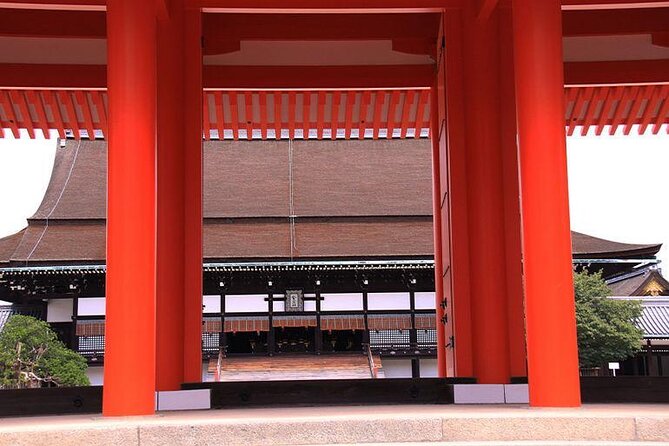
The final main stop is Kyoto Imperial Palace, once the emperor’s residence until the capital moved to Tokyo in 1868. You see the former site of imperial enthronement ceremonies and the restrained architecture associated with the imperial court.
The scheduled visit lasts about 40 minutes and has no separate admission charge. Compared with the gold decoration at Nijo Castle and Kinkakuji, the palace offers a quieter lesson in ceremony, proportion, and formal design.
This stop is especially important to check before booking. Kyoto Imperial Palace is closed on Mondays, or on the following day when Monday is a holiday. It can also close when an Imperial Household Agency event is taking place.
When the palace is closed, the tour visits Kitano Tenmangu Shrine instead. If the closure falls on the 25th, the replacement is Nishi Hongan-ji Temple. The tour also changes the stop when access is restricted for other listed reasons, and refunds are not issued simply because an alternate attraction replaces the palace.
That arrangement is practical for the operator, but it can disappoint you if the palace is your central reason for booking. Read the operating calendar carefully and treat the palace as subject to availability, not as an absolute guarantee.
More early starts in Kyoto:
- Kyoto Early Morning Tour with English-Speaking Guide
★ 5.0 · 1,427 reviews - Kyoto: Early Morning Tour with English-Speaking Guide
★ 4.9 · 1,128 reviews - Arashiyama Bamboo Forest & Hidden Gems Bike Tour (Early Bird)
★ 5.0 · 613 reviews - Kyoto Early Bird Walking Tour
★ 5.0 · 377 reviews
What the guide adds to a fast morning
The guide is the part of this tour that can turn a sequence of famous buildings into a useful history lesson. You hear about the emperor, the shogun, Japanese ceremonies, and the purpose of the rooms and gardens instead of simply walking past them.
Several guides have received strong praise for their style. KC and Casey are described as lively, polite, and full of detail. Jun is noted for explaining Japanese history clearly, while Mr. Harada is praised for being entertaining, witty, kind, and ready for questions.
The guide quality can vary, as it does on any scheduled group tour. English may be harder to hear or follow for some people, especially when another group is speaking nearby. A few participants found the guide spoke too quickly, while others found the explanations both funny and informative.
A wireless microphone and headphone system is not guaranteed. One person specifically noted that no microphone system was used, and another suggested earpieces because it was difficult to hear when walking behind the group. Stay close during commentary, and do not assume you can hear every word from the back.
The maximum group size is 40 people. That is not a tiny private tour, so the guide may need to keep moving. The bus makes the group manageable between stops, but the sites themselves can feel crowded.
Air-conditioned transport and the Kyoto Station meeting point
The vehicle is one of the tour’s strongest practical features. Kyoto’s main attractions are spread across the city, and air-conditioned transport saves you from figuring out several bus or rail connections during a short morning.
The tour begins at Kyoto Avanti, at 31 Higashikujō Nishisannōchō, across from Kyoto Station’s Hachijo Exit. It ends in front of Kyoto Avanti, in the same general area. This is convenient for a day based in Kyoto, especially if you want to continue exploring near Kyoto Station afterward.
The meeting point deserves extra attention. Some participants had trouble finding it because the address and map instructions were not immediately clear. Open the full booking details, scroll to the exact pickup information, and allow time to locate Kyoto Avanti. Do not rely only on a general Google Maps pin.
If you are coming from Osaka, the arrangement needs careful reading. The tour includes an English-speaking assistant on the outbound trip from Hotel Granvia Osaka to the Sunrise Tours Desk in Kyoto Avanti’s basement level. The Kyoto sightseeing tour then proceeds from there.
The return from Kyoto to Osaka is not included, and no assistant service is provided for that return journey. You need to arrange and pay for your own transportation after the tour ends. This is an important cost and timing point for an Osaka-based day trip.
Is $87.19 a fair price?
At $87.19 per person, the price is reasonable if you value structure, transport, and an English-speaking guide. Admission to Nijo Castle and Kinkakuji is included, as are transportation costs and the guide interpreter fee. You avoid paying separate fares and working out a route between three busy sights.
The value is strongest for a first visit or a short stay. You see a castle, temple, gardens, and palace in one morning, then have the afternoon free. A self-guided plan may cost less, but it requires more planning and gives you less historical context.
The price is less attractive if you want long visits or already know Kyoto well. The stops are short, the group can be large, and you cannot adjust the schedule around the parts that interest you most.
Food and drinks are not included. After the Imperial Palace portion, the bus may stop at the lunch venue used by the one-day tour before dropping participants at Kyoto Station. You should not assume lunch is part of this morning package.
Free cancellation is available if you cancel at least 24 hours before the start time. Changes or cancellations made less than 24 hours ahead are not refunded.
Who should book this morning tour?
I would choose this tour if you have one morning in Kyoto, are staying near Kyoto Station, or are making a day trip from Osaka and want a planned route. It suits first-time visitors who prefer historical explanation and included transport over independent navigation.
It also works well for families who want a fixed schedule. Children up to age five may join free, but they do not receive a bus seat unless booked at the child rate. Anyone under 18 needs written parental permission, and participants under 15, or those not yet in middle school, must be accompanied by a parent or guardian.
You should think twice if you want quiet garden time, detailed photography, or a private guide. The pace is brisk, the group may contain up to 40 people, and the most popular sites can be crowded.
Mobility also deserves a look. Most people can participate, but Kinkakuji includes uneven rocky steps and a climb. Nijo Castle and Kyoto Imperial Palace are mainly on flatter ground according to the tour information, but the full morning still involves walking.
Should you book it?
Book this tour for efficient coverage and useful historical context, especially if Kyoto time is short. The route gives you a strong first look at three major sights, and the included vehicle makes the morning much easier than arranging each connection yourself.
Do not book it solely for Kyoto Imperial Palace or Nijo Castle without checking the closure dates. The replacement stops can still be worthwhile, but the tour price is not refunded when a scheduled site is unavailable.
For most first-time visitors, the combination of transport, admissions, and a lively guide makes the price fair. Just arrive early at the correct Kyoto Avanti entrance, stay close enough to hear the guide, wear shoes suited to uneven ground, and plan your own return to Osaka.
FAQ
How long does the Kyoto morning tour last?
The tour lasts approximately 4 hours and 40 minutes.
Which attractions are included?
The main itinerary includes Nijo Castle, Kinkakuji Temple, also called the Golden Pavilion, and Kyoto Imperial Palace.
Is transportation included?
Yes. Transportation between the sightseeing stops is included in an air-conditioned vehicle.
Are entrance fees included?
Admission fees for Nijo Castle and Kinkakuji Temple are included. Kyoto Imperial Palace has no separate admission fee for this tour.
Where does the tour start and finish?
The tour starts at Kyoto Avanti, across from Kyoto Station’s Hachijo Exit. It ends in front of Kyoto Avanti in the same area.
Is transportation back to Osaka included?
No. The tour ends at Kyoto Station, and transportation back to Osaka is not included. Return transportation costs and assistant service are also excluded.
What happens if Kyoto Imperial Palace is closed?
The tour visits Kitano Tenmangu Shrine instead. If the closure falls on the 25th, the replacement is Nishi Hongan-ji Temple.
What happens if Nijo Castle is closed?
Ryoan-ji Temple is visited instead. No refund is issued when one of these alternate destinations replaces the scheduled stop.
Are food and drinks included?
No. Food and drinks are not included in the tour price.
Can children join the tour?
Children up to five years old may join free, but they do not receive a bus seat unless you book them under the child rate. Participants under 18 need written parental permission, and anyone under 15 or not yet in middle school must join with a parent or guardian.
Newest Kyoto experiences on the site
- Treasures of Kyoto: Gion & historical Walking Tour★ 5.0 · 6 reviews
- Whisk Your Own Matcha: A Zen Matcha Experience at Temple★ 3.6 · 7 reviews
- Kyoto tea town for matcha lovers★ 5.0 · 16 reviews
- Uji: Private immersion into Kyoto’s tea and reglious culture★ 5.0 · 17 reviews
- Kyoto Matcha Green Tea Tour★ 4.5 · 23 reviews
- Uji and Wazuka Matcha Farm Half Day Private Guided Tour★ 5.0 · 21 reviews
- Utilising upcycled Matcha! Creating matcha incense (Uji, Kyoto)★ 5.0 · 6 reviews
- Sacred Temple Yoga Experience in Japan★ 5.0 · 3 reviews
Kyoto Early Morning Tours, compared.
Kyoto Early Morning Tour with English-Speaking Guide
Read our review →Early Morning Tour with English-Speaking Guide
Read our review →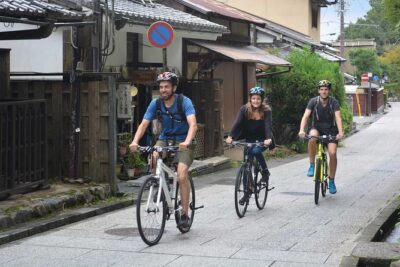
Arashiyama Bamboo Forest & Hidden Gems Bike Tour (Early Bird)
Read our review →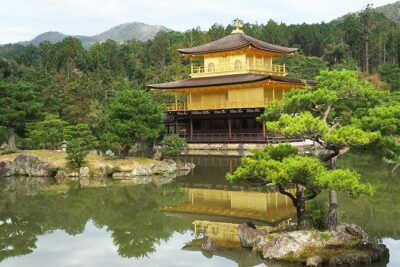
Kyoto Early Bird English Tour: Fushimi-Inari and Arashiyama
Read our review →
Kyoto Early Bird English Tour: Fushimi Inari & Gion(Private opt)
Read our review →
Browse the lists this tour appears in