
Reviewed · KYOTO GEISHA & MAIKO EXPERIENCES
Simple Plan with Maiko
Kyoto’s Maiko culture is easiest to understand when you can ask questions directly, and that is the heart of this 90-minute program. You watch a tea ceremony, see two graceful dances, join a playful game, and take a photo beside the Maiko. I especially like the open question-and-answer session and the chance to receive a Senjafuda lucky charm. The main drawback is that tea-making is not included, and people seated at the back may have trouble seeing the dance.
I also like the low $38 price, which gives you a personal introduction without the cost of a full premium tea ceremony. The room is in an ordinary building rather than a traditional tea house, so you should expect a friendly, informal setting instead of an old Kyoto townhouse. Depending on the date, a Geiko may appear instead of a Maiko.
Key points to know before booking
- Ask questions directly: The question-and-answer session is the clearest way to learn about daily life, clothing, training, and customs.
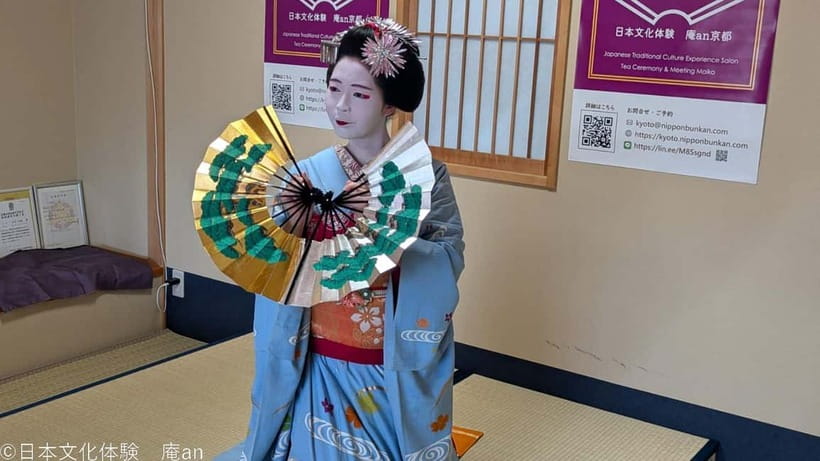
- See two traditional dances: The dances may express the seasons, romance, or ordinary life through precise, controlled movement.
- Tea is demonstrated, not prepared by you: Choose the premium program if making your own matcha matters.
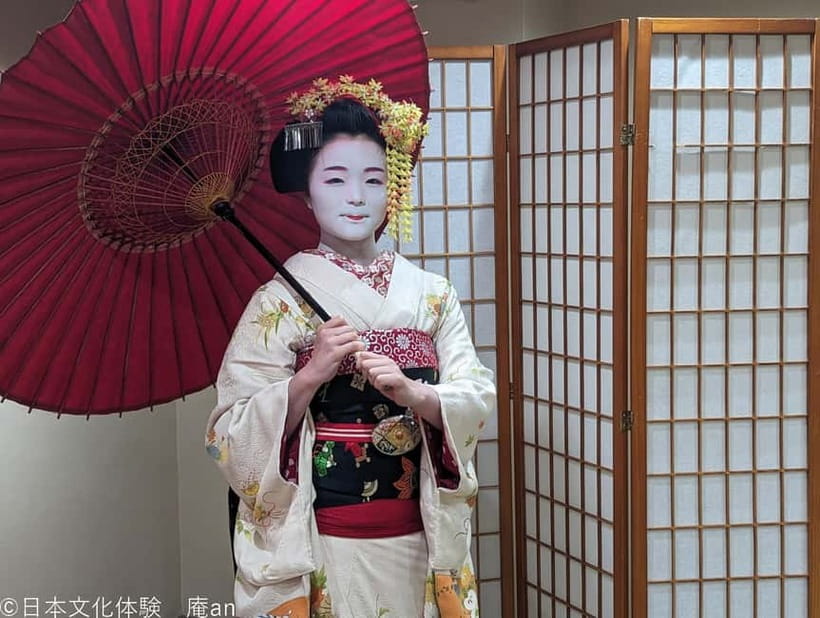
- Photos and a Senjafuda are included: You can take a commemorative photo beside the Maiko and receive a small lucky charm.
- The setting is informal: The venue is in a building near Gojo Station, not an ochaya or traditional Japanese house.
- Seat choice affects the view: First, second, and third-row upgrades cost extra, and the room setup can make back-row viewing less clear.
Meeting a Maiko near Gojo Station
The experience takes place in central Kyoto, a one-minute walk from Exit 1 of Gojo Station on the Subway Karasuma Line. The entrance faces Gojo-dori, the main street, so the location is straightforward once you come out of the station.
That easy access matters. You do not need to build a full afternoon around transport, and the 90-minute length fits neatly between other Kyoto plans. Operation hours are 10:00 to 17:00, though the actual start time depends on availability. Reservations received after 17:00 are processed the following day.
The room is not an ochaya, which is a traditional establishment associated with Geiko and Maiko entertainment. It is located in a regular building, with a relaxed atmosphere and friendly staff. That makes the experience less formal and easier for first-time visitors, but it also means you should not expect tatami rooms, old wooden architecture, or a private Kyoto residence.
There is no elevator, and you need to use stairs to reach the venue. The activity is listed as wheelchair accessible, so contact the provider before booking if stairs could be a problem. The practical details are important here: accessibility may depend on your specific needs and the room being used.
More geisha and maiko evenings in Kyoto:
- Kyoto Geisha Walking Tour: Gion District & Hidden Gems
★ 4.7 · 3,273 reviews - Kyoto: Gion Magical Night Walking Tour with Geisha Trivia
★ 4.9 · 2,393 reviews - Kyoto: Gion Geisha District Walking Tour – Stories of Geisha
★ 4.7 · 2,187 reviews
What the tea ceremony demonstration shows you
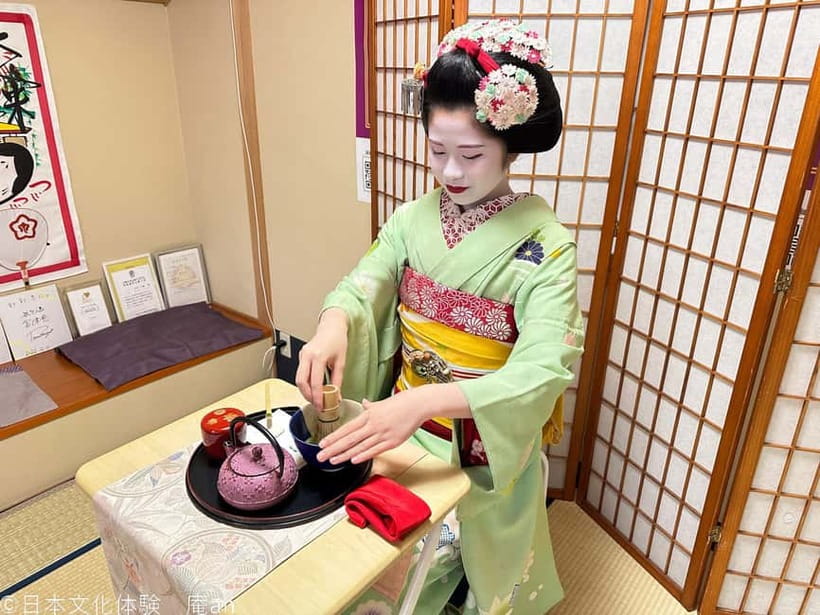
The program begins with a greeting from the Maiko, followed by a tea ceremony demonstration. You watch her prepare and present tea while following the careful etiquette that gives the ceremony its quiet rhythm.
This is a demonstration, not a hands-on class. You do not make matcha yourself under the Simple Plan, and the basic price does not include a snack or drink. That distinction deserves attention because tea ceremony is often used as a broad label for several different experiences in Kyoto.
If you want to prepare your own tea, choose the Tea Ceremony with Maiko Premium program instead. If you mainly want to watch the Maiko, learn about her life, and enjoy the performance, the simpler plan keeps the price lower.
The tea segment is valuable because it gives context to the Maiko’s work. Her presentation is not only about an attractive kimono or a polished performance. It shows the care, posture, timing, and hospitality connected with traditional Japanese arts.
You may find the demonstration brief compared with a full tea lesson. That is a fair trade for the lower price and the broader program, which also includes dancing, photographs, questions, and a game.
The question-and-answer session is the real highlight
After the tea demonstration, you can ask the Maiko questions directly. This is the part I would prioritize when deciding if the activity suits you.
A Maiko represents a traditional way of life that still exists in Kyoto today. Her clothing, hairstyle, makeup, etiquette, schedule, and training all have stories behind them. Seeing her for a few minutes is interesting. Hearing her answer questions helps you understand what you are actually looking at.
The instructor language is Japanese, with English translation provided as much as possible. If you need English assistance, contact the provider in advance and request it. The quality of the experience depends partly on how clearly the translation is handled, so this is worth arranging before you arrive.
Prepare a few questions before the program. You might ask about her daily routine, the meaning of her hairstyle, how she wears the kimono, the training involved, or the difference between a Maiko and a Geiko. The supplied information does not promise a fixed question list, so your own preparation gives this section more value.
The atmosphere is informal enough that you do not need special knowledge or preparation. You are not expected to understand every rule before entering. The staff help keep the session moving and encourage participation.
A close photo and the Senjafuda gift
The photo opportunity comes after the questions. You can take a commemorative picture beside the Maiko, giving you a clear record of the encounter rather than only distant performance photographs.
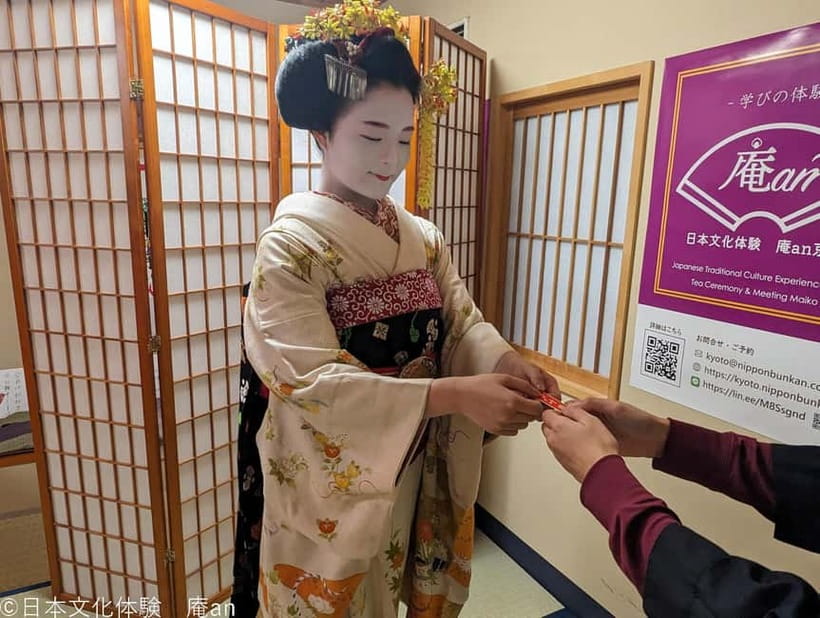
A Senjafuda is also presented as a special gift. These small name or lucky charms are associated with Japanese tradition, and receiving one gives the visit a personal souvenir that costs nothing extra.
The photo portion is especially useful for people who want a direct encounter but do not want to book a more expensive private program. At the same time, remember that this is a scheduled group activity. You should expect a set photo opportunity rather than unlimited private time.
Those who are not participating cannot enter the experience. If someone in your party wants to wait elsewhere and only join for a photograph, that is not allowed under the stated rules.
A few more Kyoto tours worth putting on the shortlist
- PERFECT KYOTO 1-Day Bus Tour
★ 5.0 · 13,518 reviews - Kyoto: Fushimi Inari, Kinkakuji, Bamboo Grove 1 Day Bus Tour
★ 4.8 · 4,316 reviews - Kyoto: Tea Ceremony in a Traditional Tea House in Kiyomizu
★ 4.9 · 3,519 reviews - Kyoto: Tea Ceremony Ju-An at Jotokuji Temple
★ 4.9 · 3,207 reviews
Two dances, with a practical seating warning
The Maiko performs two traditional dances. Their subjects may include the beauty of the seasons, love stories, or everyday life. The appeal is in the controlled movement: a small turn of the head, the position of a sleeve, or a carefully timed step can carry as much meaning as a large gesture.
This is not a long stage show. The dance is one part of a compact program, so it works best as an introduction to Maiko performance rather than a full evening of theater.
Your seat matters. Premium seating is available for an additional charge:
- SS seat, first row: 3,300 JPY
- S2 seat, second row: 2,200 JPY
- S3 seat, third row: 1,100 JPY
The standard arrangement may put tables covered in red cloth between some people and the performance. From the back, the view can be less clear, especially if the room is full. If seeing the dance well is a top priority, paying for a closer seat is sensible. If your budget is tight, arrive knowing that your view may not be ideal.
The seating issue does not ruin the program, but it changes its value. The basic $38 price is attractive for the question session and personal contact. The calculation becomes different if you add a premium seat, a snack, and a drink.
The game adds warmth and a little nerve
After the dance, the Maiko leads an interactive game. Guests may volunteer to play, while everyone else claps and cheers.
This is a simple part of the program, but it helps prevent the experience from becoming stiff or overly ceremonial. You see the Maiko’s hospitality in a social setting, and the room becomes more relaxed. The activity is not only a performance where you sit quietly and watch.
You do not have to volunteer. If you are shy, watching can be just as entertaining. Still, participation seems to be one of the best ways to enjoy this section. If you want to play, speak up early, since the number of participants and the format can vary.
The game also makes the program suitable for families and mixed-age groups, though children must have a paid seat unless they are under two and sit on a parent’s lap. Children younger than two are free, but a fee applies if a seat or meal is required.
What the $38 price really includes
At about $38 per person, the Simple Plan offers several different elements in one short visit:
- Maiko greeting
- Tea ceremony demonstration
- Question-and-answer session
- Photo beside the Maiko
- Senjafuda gift
- Two traditional dances
- Interactive game
That is a fair price if your goal is a broad introduction to Maiko culture. The strongest value comes from the direct questions, the photograph, and the chance to see a live dance at close range.
The price is less compelling if you expect a complete tea ceremony lesson with tea and sweets. The basic plan includes neither your own tea preparation nor a complimentary drink or small sweet. A snack and drink option costs 500 JPY.
That missing refreshment surprised some people, especially those who expected the tea portion to include something to consume. Read the inclusions carefully before booking. The program is about watching and interacting, not sitting down for a full tea service.
You can also be having lunch or dinner in the same venue or room, depending on the setup. That may add energy to the atmosphere, but it can also make the event feel less private or focused. If you want a quieter setting, ask the provider what arrangement applies on your date.
Maiko, Geiko, and the living tradition behind the program
The terms matter. A Maiko is a young apprentice in Kyoto’s traditional entertainment culture, while Geiko refers to a fully trained performer. The program is advertised with a Maiko, but a Geiko may be invited instead depending on the situation.
That substitution should not be treated as a failure. It changes the experience, but both represent the same continuing tradition in different stages. The activity gives you a chance to ask about that world directly rather than relying only on costumes seen from a distance in Kyoto streets.
The appeal lies in seeing a tradition that remains part of modern Kyoto life. Samurai culture belongs largely to the past, but Maiko and Geiko culture continues through training, performance, hospitality, clothing, and strict daily routines.
You should approach the encounter with respect. The program is designed to explain and share the culture, not to treat the Maiko as a decorative photo prop. The question session helps keep the meeting human and informative.
Who will enjoy this Kyoto activity most
I would recommend the Simple Plan to you if you want a short, affordable introduction and have not attended a Maiko program before. It also suits people who have already done a formal tea ceremony and want the questions, dance, photograph, and game instead of repeating a full tea lesson.
It is a good match for:
- First-time visitors curious about Maiko and Geiko culture
- People who prefer interaction to a long stage performance
- Visitors with only 90 minutes to spare
- Families and groups who enjoy a light participatory game
- Anyone who wants a photo and small cultural souvenir
- Visitors who want to keep the base cost modest
I would choose another program if making matcha yourself is essential, if you want a traditional house setting, or if a clear, close view of the dance matters more than the question session. In those cases, the premium tea ceremony option or a program with guaranteed front seating may suit you better.
Booking details worth checking
Free cancellation is available up to eight days in advance for a full refund. After that point, cancellation charges apply, and changing the date or time after a fee has been incurred can bring another specified charge.
The provider cannot reimburse your transport costs if you cancel, so give yourself enough time to reach Gojo Station. The building is easy to find, but allow time for the stairs and check the entrance on Gojo-dori.
The program is conducted in Japanese. English translation is provided as much as possible, but you should contact the provider if you need added translation support. The experience provider is B.B.Advisors Inc. AN KYOTO.
Should you book the Simple Plan with Maiko?
Book it if you want direct access to a Maiko, a question session, two dances, a photograph, and a playful game at a reasonable base price. The personal questions are the strongest reason to come, and the 90-minute format makes this easy to fit into a Kyoto day.
Go in with clear expectations. You are watching a tea demonstration, not making tea. You are in a modern building, not an ochaya. Snacks and drinks cost extra, and a back-row seat may not give you the best view.
For the best value, prepare questions in advance and consider the third-row upgrade if you want a better look at the dancing without paying for the first row. If tea-making is your main goal, choose the premium program instead. If understanding Maiko culture through conversation sounds more appealing, this Simple Plan is a sensible and approachable choice.
FAQ
How long does the Simple Plan with Maiko last?
The full experience lasts 90 minutes. The Maiko portion ends at about 75 minutes, followed by chatting time before you leave the room at 90 minutes.
Where does the experience meet?
The venue is a one-minute walk from Exit 1 of Gojo Station on Kyoto’s Subway Karasuma Line. The entrance faces Gojo-dori.
Is tea-making included?
No. The program includes a tea ceremony demonstration, but you do not prepare your own tea. Choose the Tea Ceremony with Maiko Premium program if you want to make tea yourself.
Are snacks and drinks included?
No. A snack and drink option is available for an additional 500 JPY.
Will the program definitely feature a Maiko?
A Maiko is scheduled for the experience, but a Geiko may be invited instead depending on the situation.
Is English available?
The instructor language is Japanese. English translation is provided as much as possible, and you should contact the provider if you would like to request additional translation.
Can children attend for free?
Children under two are free when sitting on a parent’s lap. If a seat or meal is required, the same fee as one person applies. Those who do not participate in the experience cannot enter.
Newest Kyoto experiences on the site
- Whisk Your Own Matcha: A Zen Matcha Experience at Temple★ 3.6 · 7 reviews
- Treasures of Kyoto: Gion & historical Walking Tour★ 5.0 · 6 reviews
- Kyoto tea town for matcha lovers★ 5.0 · 16 reviews
- Uji: Private immersion into Kyoto’s tea and reglious culture★ 5.0 · 17 reviews
- Kyoto Matcha Green Tea Tour★ 4.5 · 23 reviews
- Uji and Wazuka Matcha Farm Half Day Private Guided Tour★ 5.0 · 21 reviews
- Utilising upcycled Matcha! Creating matcha incense (Uji, Kyoto)★ 5.0 · 6 reviews
- Sacred Temple Yoga Experience in Japan★ 5.0 · 3 reviews
Kyoto Geisha & Maiko Experiences, compared.

Kyoto Geisha Walking Tour: Gion District & Hidden Gems
Read our review →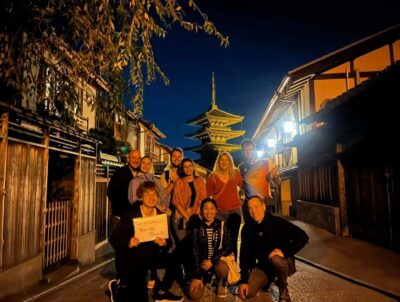
Gion Magical Night Walking Tour with Geisha Trivia
Read our review →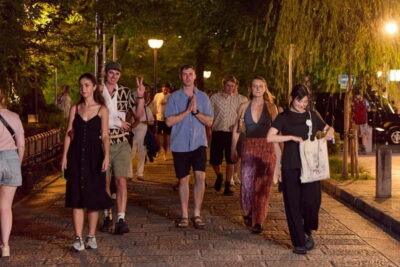
Gion Geisha District Walking Tour – Stories of Geisha
Read our review →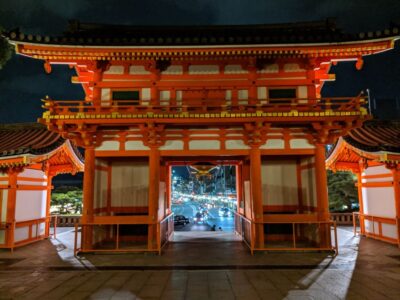
Best of Kyoto: Gion, Geisha, Pagodas & Cobblestones
Read our review →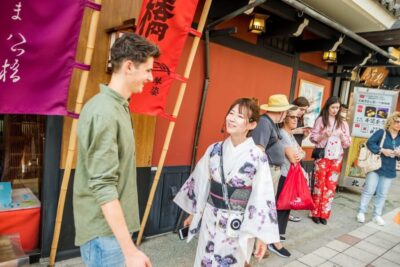

Kyoto Gion Geisha District Walking Tour – The Stories of Geisha
Read our review →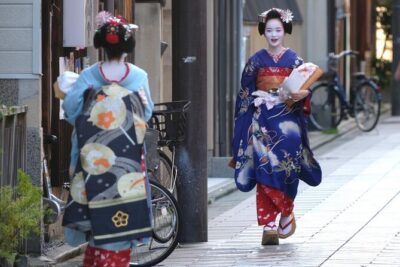
Kyoto Gion: 2-Hour Geisha Culture & History Walking Tour
Read our review →
Kyoto Gion Night Walk & Geisha District Guided Tour
Read our review →Browse the lists this tour appears in