
Reviewed · GOLDEN PAVILION TOURS
Kyoto: Kinkaku-ji Temple & Serene Garden Guided Tour with Tickets
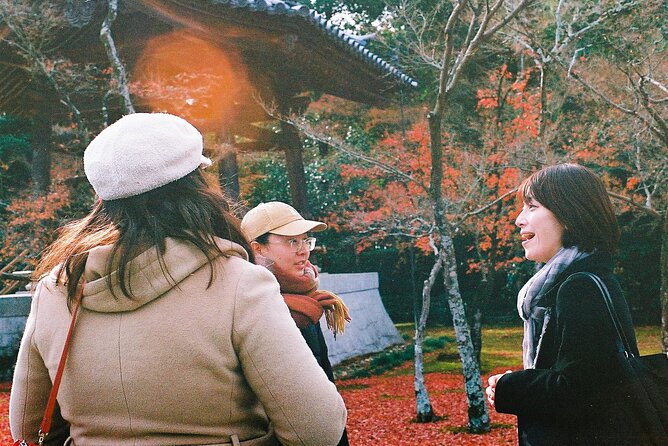
The unusual heart of this Kyoto tour is not the famous gold. It is the chance to enter a normally restricted hall at Ninna-ji, listen to a monk lead a chanting session, ask questions, and handle a rotating sutra shelf. Kinkaku-ji gives you the postcard view, while Ninna-ji offers a closer look at living Buddhist practice.
I like the small maximum of seven people, which makes it easier to hear your guide and ask questions. I also like the contrast between Kinkaku-ji’s samurai-era glamour and Ninna-ji’s imperial and religious traditions. Guides named Ellie, Eri, and Eriko have been praised for clear English, warmth, and useful explanations.
The main consideration is timing. Three hours passes quickly, and Ninna-ji’s special access can change because of temple circumstances. You also finish at Ninna-ji rather than returning to the starting point, so plan the rest of your day from western Kyoto.
Key points at a glance
- Rare access at Ninna-ji: Enter the Main Hall, sometimes called the Kondo Hall, for a monk-led chanting session and Q&A.
- Two UNESCO temples: Compare Kinkaku-ji’s polished gold pavilion with Ninna-ji’s quieter imperial setting.
- A seven-person maximum: Expect a more personal tour than a large bus or headset group.
- A useful temple-to-temple route: The guide may take the group by taxi from Kinkaku-ji to Ninna-ji, saving time and effort.
- Specific garden highlights: See the pond, gates, waterfall, teahouse, Fudo Hall, pagoda, and other important features.
- Good value at $48.86: Admission to both temples and a guide are included, along with access that is difficult to arrange on your own.
Why this Kyoto tour feels different
Kinkaku-ji and Ninna-ji are close enough to visit in one outing, but they offer very different impressions of Kyoto. One is a bright, carefully framed symbol of power. The other feels more connected to court life, Buddhist ritual, and quiet temple space.
That contrast gives the tour a clear purpose. You are not simply checking off two famous places. You are seeing how religion, politics, art, and personal devotion shaped Kyoto in different periods.
The biggest draw is Ninna-ji’s special access. The Main Hall is not always open to ordinary visitors, and this tour includes a chanting session led by a monk. You also have time for a Q&A, which turns the visit from a sightseeing stop into a chance to ask about Buddhist customs and spiritual traditions.
I would not book this only for a quick photo at the Golden Pavilion. You can see Kinkaku-ji without a guide. I would book it if you want someone to explain what you are looking at and help you make sense of the less obvious parts of temple life.
More trips out to the Golden Pavilion:
- Kyoto: Fushimi Inari, Kinkakuji, Bamboo Grove 1 Day Bus Tour
★ 4.8 · 4,316 reviews - Osaka/Kyoto:Kinkakuji,Arashiyama,FushimiInariShrine,NaraPark
★ 4.1 · 1,596 reviews - Kyoto: Nijo, Kinkaku-ji, Arashiyama, Kiyomizu & Fushimi Inari
★ 5.0 · 699 reviews
Kinkaku-ji: Kyoto’s golden showstopper
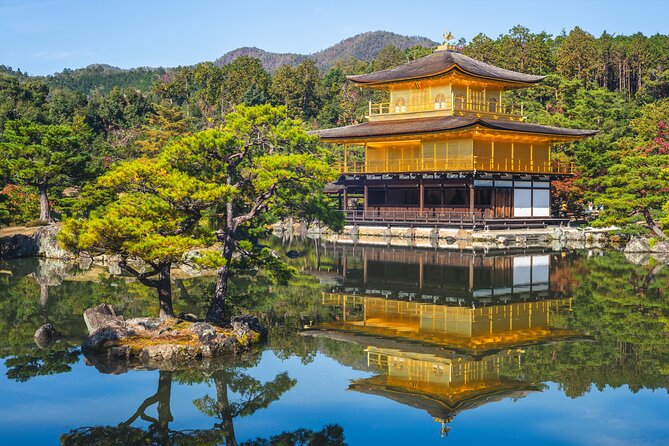
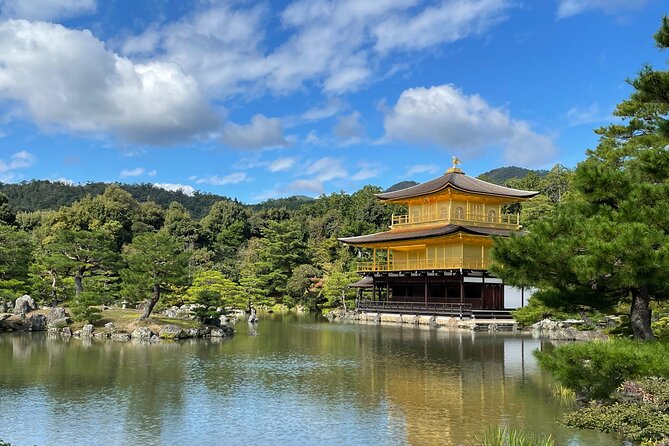
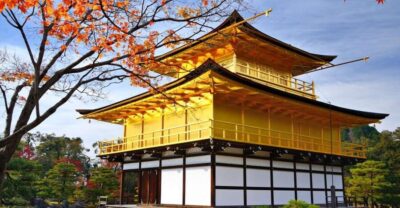
The tour begins at Kinkaku-ji, also called the Golden Pavilion. The building was first created as a retirement villa for shogun Ashikaga Yoshimitsu and later became a Zen Buddhist temple.
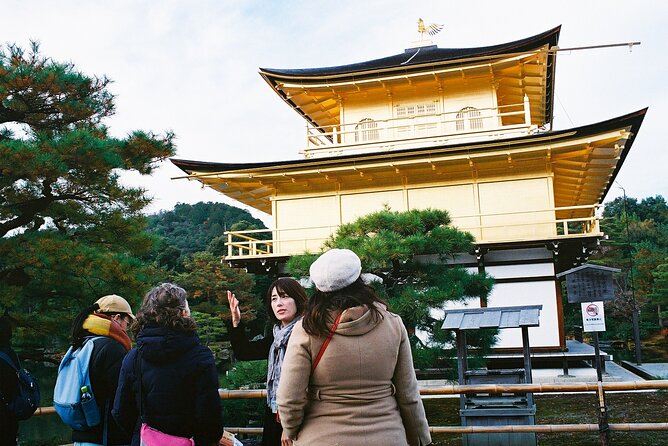
Its upper floors are covered in gold leaf, which gives the pavilion its famous glow. The building sits beside a pond, and the reflection is part of the design. Your guide can help you see the pavilion as more than a pretty building, explaining how samurai authority, religious purpose, and garden design meet in one carefully arranged view.
You have about one hour here. That is enough to follow the main path and see the major features, but it is not enough for a slow, solitary wander through every corner. The guide keeps the visit focused, which helps if you have limited time in Kyoto.
The route includes Shariden, the pavilion’s central sacred structure, and Karamon Gate. You will also see Rikushu-no-taki waterfall, Anmintaku Pond, Hakujanotsuka, Yukatei Teahouse, and Fudo Hall.
Some of these names may mean little before you arrive. That is where a good guide earns the fee. Instead of looking at a pond, gate, or small religious building as background scenery, you get an explanation of why it belongs in the temple grounds.
The garden is especially important. Kinkaku-ji is not just a gold building placed beside water. The pond, islands, trees, rocks, and borrowed views work together to frame the pavilion from different points along the path. One guide described the garden’s borrowed scenery as a key reason the temple feels so balanced, and that is a useful way to look at the grounds.
The drawback is that Kinkaku-ji is one of Kyoto’s most photographed sights. The gold pavilion can feel less serene than its pictures suggest, especially when many people gather along the viewing area. A guide cannot remove the crowds, but a timed visit and a clear explanation help you get more from the short stop.
Bring a phone or camera if you want a photograph, but do not let the photo become the whole visit. The best part is noticing how the building changes as you move around the pond.
Moving from the Golden Pavilion to Ninna-ji
The published meeting point is Yamazaki-an25, at 25 Kinugasa Babacho in Kyoto’s Kita Ward. The tour ends at Ninna-ji Temple, at 33 Omuro Ouchi in Ukyo Ward, so this is a one-way experience.
That arrangement makes sense geographically. Ninna-ji is not as easy to fold into a central Kyoto day as Kinkaku-ji, and the guide may bring the group from one temple to the other by taxi. This was a useful part of the experience for one participant, who found the transfer comfortable and appreciated not having to work out the connection alone.
The taxi transfer is also one reason the small group matters. With no more than seven people, moving between the sites should be simpler than with a large tour group. The supplied details do not promise that every transfer is included in the price, so check the current booking terms if transport costs matter to your budget.
The end point is an advantage if you plan to continue around western Kyoto. It is less convenient if your next stop is elsewhere in the city and you were expecting to return to the starting point. I would look at your evening plans before booking.
Ninna-ji: the more personal half
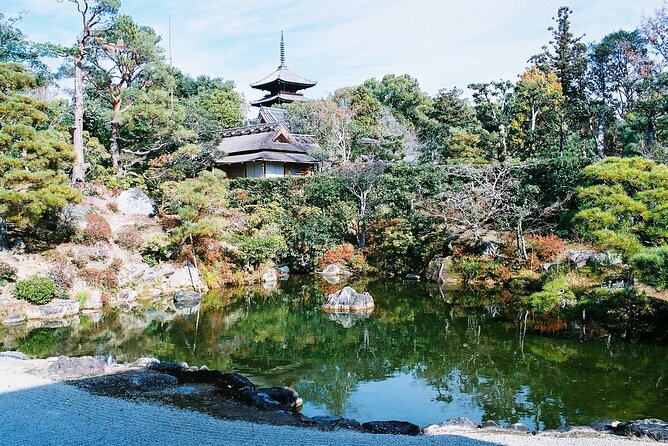
Ninna-ji was founded in 888 by Emperor Uda. It is a UNESCO World Heritage site and the head temple of the Omuro school of Shingon Buddhism.
The temple is known for its five-story pagoda, gardens, and Omuro cherry trees. Its imperial connection gives the complex a different character from Kinkaku-ji, which began as a shogun’s retirement villa.
You have about one hour and 45 minutes here, nearly twice as long as at Kinkaku-ji. That extra time matters because Ninna-ji is not only a place for a single famous view. You have room to absorb the buildings, learn about the temple’s religious role, and take part in the special activities arranged for the group.
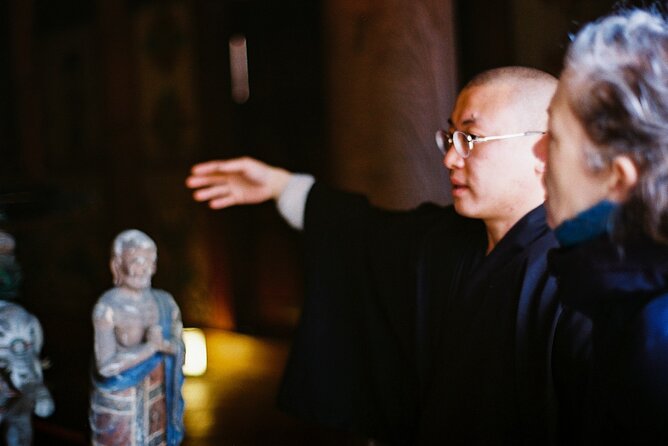
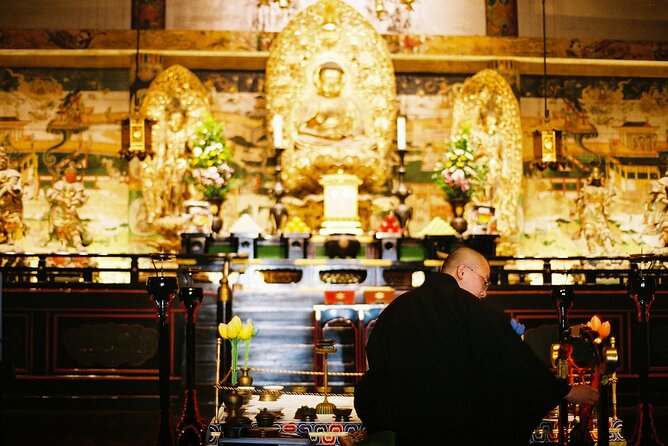
The most meaningful moment is the visit to the Main Hall. The group can enter for a sacred chanting session led by a monk. Afterward, you can ask questions directly. This is a rare chance to hear about Buddhist practice in a setting connected to that practice, rather than receiving only a general explanation outside a building.
The tone is likely to be more formal than a standard sightseeing stop. Keep your voice low, follow the guide’s directions, and treat the chanting as a religious ceremony rather than a performance. The details supplied for the tour do not promise that the same program will happen every time, since the Ninna-ji portion may change according to temple circumstances.
You also visit the Sutra Hall, where a rotating sutra shelf can be seen and used. This small action has ritual meaning, and your guide can explain why it matters. It is the kind of detail that is easy to miss if you visit the temple alone.
The experience may also include a photograph with the monk before you continue to the Imperial Residence. The residence provides a graceful finish, linking Ninna-ji’s Buddhist identity with its long connection to the imperial court.
I especially like the order of this visit. You start with the public beauty of Kinkaku-ji, then move toward a more intimate encounter with Ninna-ji’s religious life. The tour becomes less about scenery and more about understanding how the temple functions.
More temples worth an hour in Kyoto:
- Kyoto: Tea Ceremony Ju-An at Jotokuji Temple
★ 4.9 · 3,207 reviews - Arashiyama Bamboo, Temple, Monkeys, or Secret Sake Brewery
★ 4.8 · 886 reviews - Kyoto: Arashiyama Bamboo Forest, Monkeys, Matcha & Temple Tour
★ 5.0 · 759 reviews - Kyoto Zen Meditation & Garden Tour at a Zen Temple with Lunch
★ 5.0 · 441 reviews
The guides make the difference
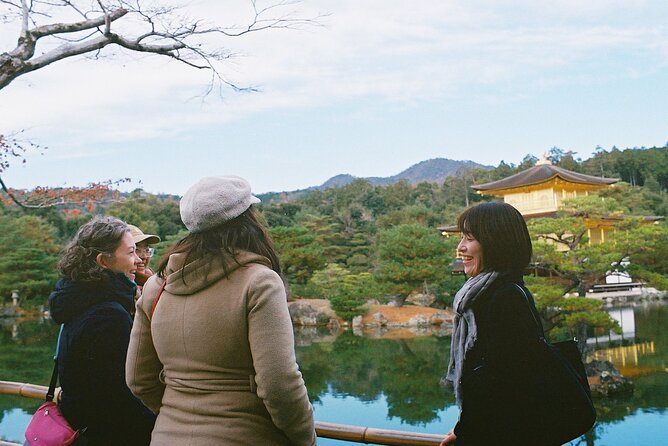
The quality of this experience depends heavily on the guide. Names connected with the tour include Ellie, Eri, and Eriko. The strongest descriptions focus on friendly manner, enthusiasm, preparation, and clear English.
That matters at Kinkaku-ji, where it is easy to spend ten minutes photographing the pavilion and leave without understanding its purpose. A guide can connect the building to Ashikaga Yoshimitsu, Zen Buddhism, and the garden’s design.
At Ninna-ji, the guide has an even bigger role. You need help with temple etiquette, context for the chanting, and interpretation during the monk’s Q&A. A warm guide also makes it easier to ask a simple question without feeling that you are interrupting a formal setting.
This is not a self-guided audio walk. You are paying for interpretation and access as much as for admission. If you already know a great deal about Japanese Buddhist history, the tour may feel brisk. For most visitors, though, the small group and direct explanations add real value.
Is $48.86 a fair price?
At $48.86 per person, the price is reasonable if you would otherwise pay separate admissions, arrange transport, and try to find reliable explanations at both temples. Tickets to Kinkaku-ji and Ninna-ji are included, and the guide adds structure to a visit that could otherwise feel scattered.
The strongest value comes from Ninna-ji. Ordinary entry does not necessarily give you the same access to the Main Hall, chanting session, monk interaction, and Sutra Hall activity. Since those elements depend on temple circumstances, you should not treat them as an absolute guarantee, but they explain why this costs more than simply walking through two temple grounds.
I would also put a price on time. Kyoto’s sights are spread across the city, and figuring out the route between Kinkaku-ji and Ninna-ji can take attention away from the temples themselves. A guide-led transfer, potentially by taxi, keeps the visit compact.
Still, the tour is not a bargain for someone who wants only the famous Golden Pavilion. You can visit Kinkaku-ji independently, and the advertised three hours leaves little room for unplanned wandering. The value is strongest for visitors who want cultural background and a special Ninna-ji visit.
Who should book this experience?
I would recommend it to first-time Kyoto visitors who want two major temples explained in plain English. It also suits anyone interested in Buddhism, imperial history, garden design, or the connection between religious buildings and political power.
The seven-person limit makes it a good choice if you dislike large group tours. It is also useful for solo visitors or couples who want a guide but do not want a full-day bus excursion.
Families with older children may find the contrast between the gold pavilion, the pagoda, the pond, and the monk-led session engaging. The tour details say most people can participate, but the experience includes temple walking and time spent inside religious buildings, so anyone with mobility concerns should confirm the current arrangements before booking.
I would skip it if you prefer to set your own pace, spend a long time taking photographs, or return to the starting point. Kinkaku-ji receives much of the attention in ordinary Kyoto sightseeing, while this tour asks you to give Ninna-ji nearly two hours and take its religious setting seriously.
Free cancellation is available up to 24 hours before the start time. Changes or cancellations inside that window are not accepted for a refund, and the cut-off uses local Kyoto time.
My verdict on the three-hour route
I like this tour because it gives you two very different Kyoto experiences without pretending they are the same. Kinkaku-ji supplies the grand visual moment, while Ninna-ji provides the quieter and more unusual encounter.
The special access at Ninna-ji is the deciding factor. If the monk-led chanting, Q&A, rotating sutra shelf, and restricted hall visit go ahead, you receive something well beyond a standard temple walk.
Book it when you want context, a small group, and help connecting two western Kyoto sites. Skip it when you want complete independence or a slow photography session. For many visitors, the Golden Pavilion gets them to the tour, but Ninna-ji is what makes the $48.86 worthwhile.
FAQ
How long does the Kyoto temple tour last?
The tour lasts approximately three hours. About one hour is allocated to Kinkaku-ji and about one hour and 45 minutes to Ninna-ji.
Where does the tour start?
The meeting point is Yamazaki-an25, 25 Kinugasa Babacho, Kita Ward, Kyoto, 603-8362, Japan.
Where does the tour end?
The tour ends at Ninna-ji Temple, 33 Omuro Ouchi, Ukyo Ward, Kyoto, 616-8092, Japan.
Are admission tickets included?
Yes. Admission tickets for both Kinkaku-ji and Ninna-ji are included.
How many people can join the tour?
The tour has a maximum of seven travelers.
Is transportation between the temples provided?
The tour information indicates that the guide may take the group by taxi from Kinkaku-ji to Ninna-ji. Check the current booking details for the exact transport arrangements and any related cost.
Can I enter a restricted area at Ninna-ji?
The experience includes access to the Main Hall, also referred to as the Kondo Hall, for a chanting session led by a monk. The Ninna-ji program can change because of temple circumstances.
Is the tour suitable for most people?
The activity information says most travelers can participate. It takes place at two temple complexes and includes walking, so confirm current arrangements if you have specific mobility needs.
What is the cancellation policy?
You can cancel up to 24 hours before the experience starts for a full refund. Cancellations or changes made less than 24 hours before the start time are not accepted for a refund.
Newest Kyoto experiences on the site
- Treasures of Kyoto: Gion & historical Walking Tour★ 5.0 · 6 reviews
- Whisk Your Own Matcha: A Zen Matcha Experience at Temple★ 3.6 · 7 reviews
- Kyoto tea town for matcha lovers★ 5.0 · 16 reviews
- Uji: Private immersion into Kyoto’s tea and reglious culture★ 5.0 · 17 reviews
- Kyoto Matcha Green Tea Tour★ 4.5 · 23 reviews
- Uji and Wazuka Matcha Farm Half Day Private Guided Tour★ 5.0 · 21 reviews
- Utilising upcycled Matcha! Creating matcha incense (Uji, Kyoto)★ 5.0 · 6 reviews
- Sacred Temple Yoga Experience in Japan★ 5.0 · 3 reviews
Golden Pavilion Tours, compared.
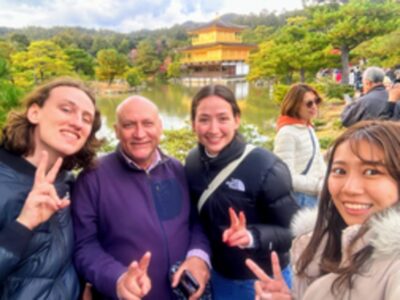
Fushimi Inari, Kinkakuji, Bamboo Grove 1 Day Bus Tour
Read our review →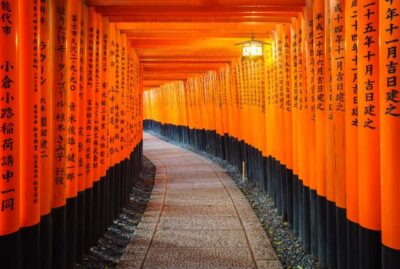
Kinkakuji,Arashiyama,FushimiInariShrine,NaraPark
Read our review →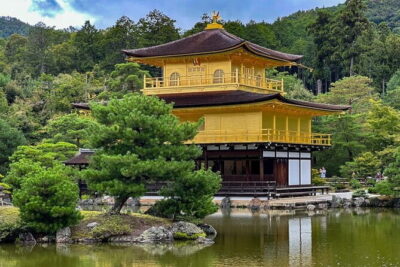
Nijo, Kinkaku-ji, Arashiyama, Kiyomizu & Fushimi Inari
Read our review →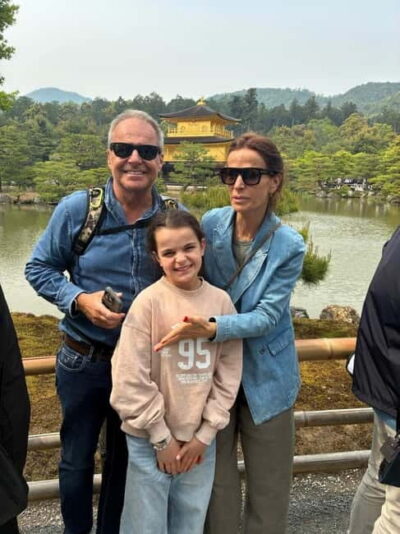
Kyoto top must-see Golden pavilion and Bamboo forest half-day Private tour
Read our review →
Kyoto Bamboo Forest & Golden Pavilion E-Bike Tour
Read our review →
Golden Pavilion, Nijo Castle, & Nishiki Market Half day tour
Read our review →Browse the lists this tour appears in