Reviewed · MORNING
Traditional Japanese Washi Papermaking- Kyoto morning
Making paper by hand is a fine way to slow down in Kyoto. At kamitowa kyoto, you work with raw materials, arrange seasonal flowers and leaves, and leave with something you made yourself. Hiro and Junko guide the process in Japanese and English, with patience and plenty of hands-on help.
I like the tiny class size, capped at four, and the useful finished souvenir. I also like that the workshop explains the full paper-making process, not just the decorative part. The main consideration is time: one hour goes quickly, especially if you choose a lamp or larger item instead of the standard postcard set.
Key points
- A four-person class: You get close guidance rather than a crowded craft demonstration.
- Seasonal decoration: Use cherry blossoms, maple leaves, grasses, and paper cut-outs in your design.
- Several finished projects: Choose postcards, a table mat, a wraparound lampshade, or a tapestry panel.
- Hiro and Junko teach in Japanese and English: Instructions are clear and patient.
- A quiet Kyoto pause: The class takes place in a traditional Japanese-style house near major stations.
- Optional extra time: Add one more hour of unlimited paper making at your own expense.
A quiet craft class near central Kyoto
This workshop takes place at 345 Sanjōchō in Kyoto’s Nakagyo Ward, inside a traditional Japanese-style house. It is close to public transportation, about six minutes from Exit 6 of Karasuma Oike Station and nine minutes from Exit 24 of Shijo Station or Karasuma Station on the Hankyu Line.
That location makes the class easy to fit into a central Kyoto day. It is also near the covered market, so you can pair the workshop with lunch or shopping. You make your own way there, since transportation to and from the studio is not included.
The setting matters. This is not a large production with rows of people watching a staged demonstration. The group is limited to four, which gives the instructors room to watch your technique, answer questions, and help you make design choices.
More early starts in Kyoto:
- Kyoto Early Morning Tour with English-Speaking Guide
★ 5.0 · 1,427 reviews - Kyoto: Early Morning Tour with English-Speaking Guide
★ 4.9 · 1,128 reviews - From Kyoto: Nara Guided Morning Tour
★ 4.6 · 335 reviews
From raw fibers to handmade paper
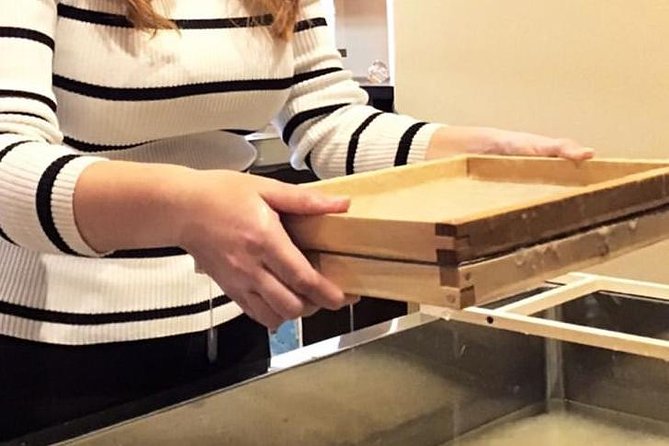
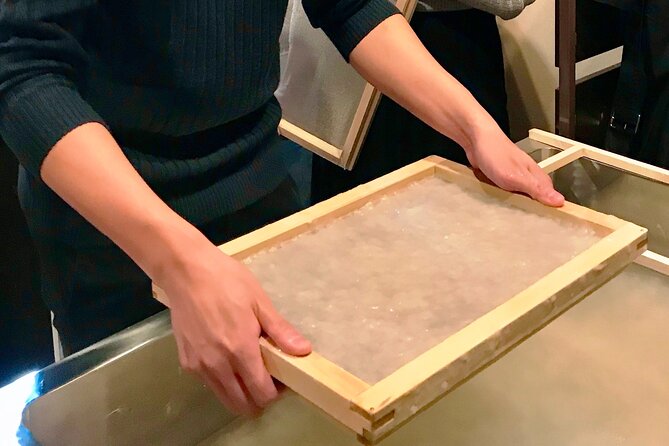
After introductions, the instructors explain the basic steps of traditional washi papermaking. You then work with the paper material and form your own sheets. The process has many small stages, but the class keeps things manageable by guiding you through each one.
The lesson covers more than decoration. You get a sense of how paper is formed, dried, and turned into a useful object. A short educational video may be shown during drying time, giving you a broader look at the traditional process while your own work sets.
That balance is one of the class’s strongest points. You are not simply sticking flowers onto a ready-made card. You make the paper, design it, and see the project through to its finished form. The result is a better appreciation for the care behind Japanese paper goods.
The instructors, including Hiro, are known for patient explanations. The workshop is conducted in Japanese and English, and the class is designed for direct participation rather than advanced art skills.
Choosing flowers, leaves, and paper cut-outs
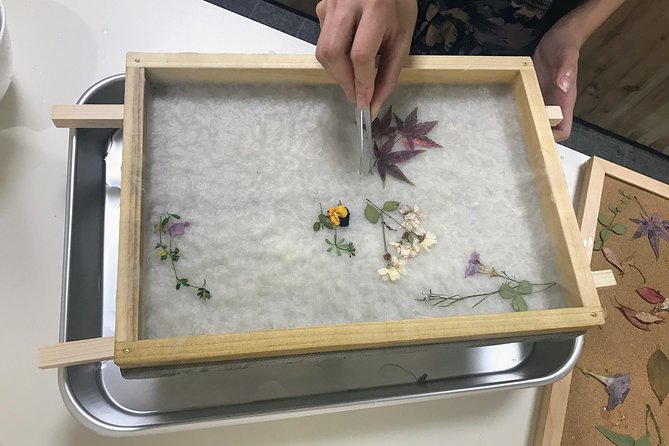
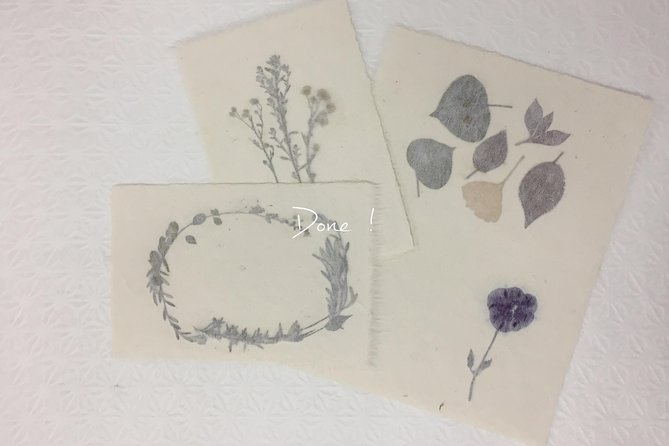
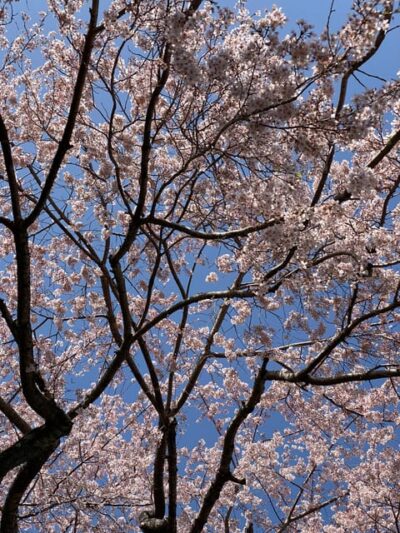
The most personal part of the class is the design stage. You can use seasonal materials such as cherry blossoms and maple leaves, along with grasses and paper cut-outs. Place them carefully, since the arrangement becomes part of the finished pattern.
This is where your choices shape the souvenir. A simple layout may look clean and calm, while a fuller arrangement gives the paper a more decorative feel. You do not need to arrive with a design plan. The instructors help you understand the options and guide you as you work.
The seasonal materials also give the paper a clear connection to Japan. Cherry blossoms suggest spring, maple leaves point to autumn, and the handmade surface gives each piece a slightly different character. You leave with something more personal than a shop-bought souvenir.
The workshop is suitable for children with adult supervision. Families have used it successfully with children as young as seven, as well as teenagers. Younger children may need help with careful placement and the step-by-step process, but the activity is hands-on and easy to understand.
Four project choices, four different souvenirs
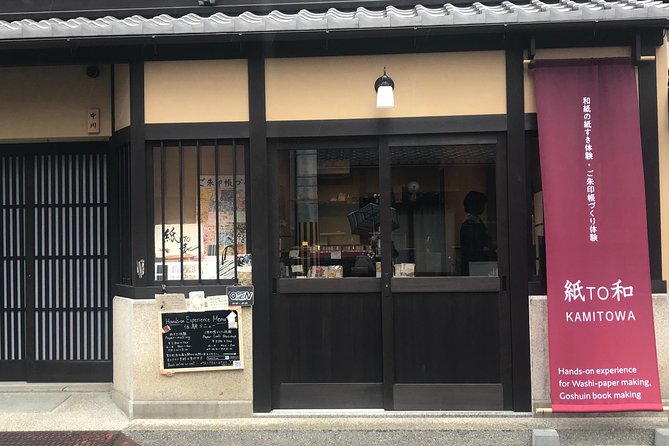
The standard option includes a set of four regular postcards. This is a good choice if you want a compact keepsake or need something easy to pack. The postcards also let you create several designs rather than putting all your effort into one larger piece.
You can also choose a table mat, wraparound lampshade, or tapestry panel. These options create a larger finished object and give you more room to arrange the flowers and paper pieces. Some choices require an additional fee, so confirm the price before selecting an upgrade.
The lampshade is especially appealing if you want a display piece for your home. It takes more care than a postcard, but the handmade paper gives it a personal look. One participant chose a lamp for a small supplement and was happy with the result.
The class lasts about one hour, so your choice affects how relaxed the session feels. Postcards fit comfortably into the basic time. A larger project may feel more hurried unless you pay for the additional hour of unlimited paper making.
A few more Kyoto tours worth putting on the shortlist
- PERFECT KYOTO 1-Day Bus Tour
★ 5.0 · 13,518 reviews - Kyoto: Fushimi Inari, Kinkakuji, Bamboo Grove 1 Day Bus Tour
★ 4.8 · 4,316 reviews - Kyoto: Tea Ceremony in a Traditional Tea House in Kiyomizu
★ 4.9 · 3,519 reviews - Kyoto Geisha Walking Tour: Gion District & Hidden Gems
★ 4.7 · 3,273 reviews
Why the small group makes a difference
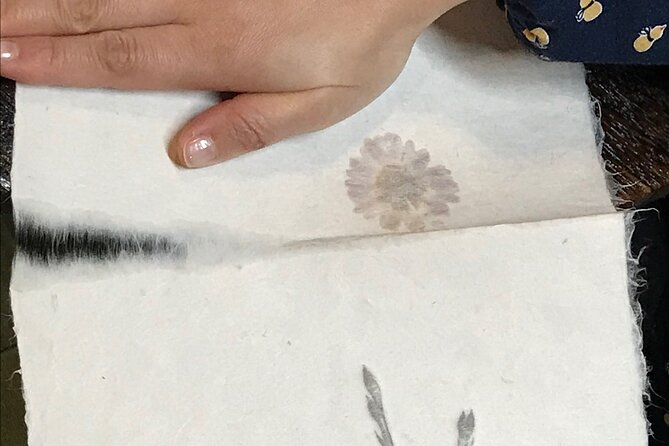
A maximum of four people is a major benefit here. Paper making involves several steps, and you want an instructor nearby when you are handling the material or deciding how to arrange your design.
The small format also keeps the class calm. Kyoto sightseeing can mean busy streets, packed buses, and a steady list of temples and markets. This workshop gives you a quiet indoor hour with a clear task and no pressure to rush through a crowded room.
Hiro and Junko run the experience with a personal touch. They help families, explain the process carefully, and make room for questions. Their English instruction is intended to be clear enough for first-time crafters, while Japanese speakers can take part comfortably as well.
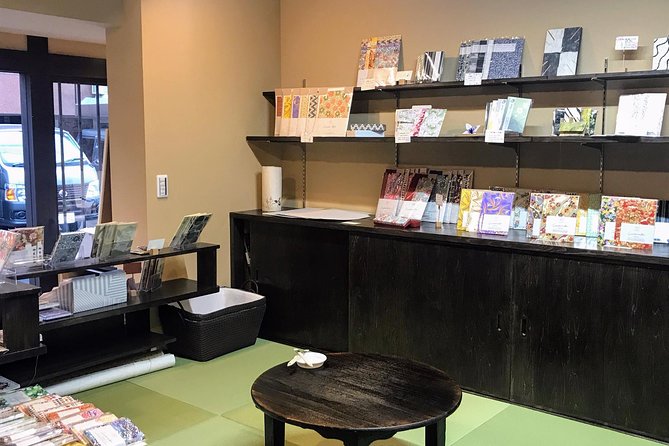
The studio also has paper goods and other local creations for sale. You can browse after class, but there is no pressure to buy. That makes the shop a pleasant extension of the workshop rather than an extra sales stop.
What the one-hour schedule feels like
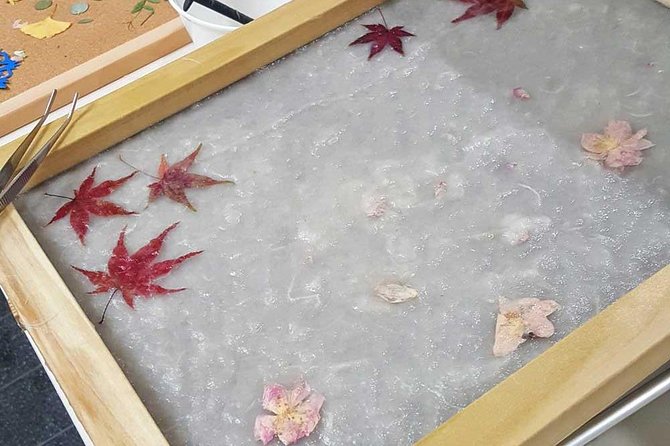
The class moves through a simple sequence:
- You arrive at the meeting point and receive introductions.
- The instructor explains traditional washi making and the materials.
- You form your paper under guidance.
- You arrange flowers, leaves, grasses, or paper cut-outs.
- Your work dries while you learn more about the process.
- You finish with handmade paper or your selected project to take home.
The hour is short but useful. You get the satisfaction of completing a real object without giving up half a day of sightseeing.
Still, do not expect a long technical apprenticeship. The class introduces the craft and lets you make a finished piece, but it cannot cover every detail of traditional production in sixty minutes. If you want to make extra gifts, you can add an additional hour for unlimited paper making at your own expense.
That extra time makes sense for families, creative people, or anyone who wants several souvenirs. If you only want one personal keepsake, the basic hour should be enough.
What makes the price worthwhile
At about $33.03 per person, the workshop costs more than buying a packet of Japanese postcards. That comparison misses the main point. You are paying for instruction, materials, a small class, and the chance to make the item yourself.
The price includes taxes, fees, and handling charges. Transportation is not included, but the central location keeps the journey simple if you are already sightseeing around Shijo, Karasuma Oike, or the covered market.
Value depends on what you want from Kyoto. If your priority is seeing as many famous sights as possible, an hour indoors may seem expensive. If you want a cultural activity that gives you a physical reminder of the city, the cost is reasonable.
The handmade result is also more meaningful than a generic souvenir. You choose the arrangement, make the paper, and carry the finished piece home. That personal work is what gives the activity its value.
Packing and carrying your finished work
You should plan how you will carry your paper after class. The finished pieces are packaged well, but handmade paper can still be awkward to protect inside a full daypack or suitcase.
Postcards are the easiest option. A table mat or tapestry panel needs more care, while a wraparound lampshade may take more room. If you are leaving Kyoto soon, consider making the workshop one of your last central activities so you do not have to carry the piece around all day.
The finished work may be available to take with you at the end of the session. The practical details can vary depending on the object and drying time, so listen to the instructor’s advice before leaving.
Best for families, creative people, and rainy mornings
This is a strong choice for anyone who likes making things with their hands. You do not need previous craft experience, and the instructions are designed for beginners.
Families should note that children must be accompanied by an adult. The small group and calm pace work well for children who can follow several simple steps. A seven-year-old may need hands-on help, while older children and teenagers can take more control of the design.
It also suits couples, friends, and solo visitors who want a quieter morning. The workshop does not depend on good weather, so it is useful on a rainy day. It gives you a break from temple visits without feeling disconnected from Japanese culture.
You may want to skip it if you dislike crafts, have very little time between fixed reservations, or want a large-scale historical tour. The main activity is making paper, not touring a museum or watching a long demonstration.
Getting there and planning your morning
The workshop is easy to reach by subway or train. It is about a six-minute walk from Exit 6 of Karasuma Oike Station on the Kyoto Metro Karasuma Line. From Exit 24 of Shijo Station on the same line, or Karasuma Station on the Hankyu Line, allow about nine minutes on foot.
The class ends back at the meeting point. Since there is no included transportation, build in enough time to find the address and arrive without hurrying.
A morning booking works well. You can make paper first, then continue toward the covered market or another central Kyoto sight. You can also place it between other activities when you want a quiet indoor break.
The experience is mobile-ticket friendly, and confirmation is provided at booking. Free cancellation is available up to 24 hours before the local start time. Cancellations or changes made later are not accepted for a refund.
Should you book kamitowa kyoto?
I would book this workshop if you want a small, personal activity and a souvenir with a story behind it. The best reasons are the four-person limit, patient bilingual instruction, seasonal design materials, and the chance to make the paper yourself from start to finish.
Choose the regular postcard option if you want a simple one-hour class. Pay for extra time if you want several gifts or a larger object such as a lampshade or tapestry panel.
You should think twice if your schedule is packed or if you prefer passive sightseeing. But for families, craft lovers, rainy-day planners, and anyone seeking a calmer side of Kyoto, this is an easy activity to recommend.
FAQ
Where does the washi papermaking class take place?
The class takes place at 345 Sanjōchō, Nakagyo Ward, Kyoto, 604-8205, Japan, at a traditional Japanese-style house.
How long does the experience last?
The standard experience lasts about one hour.
How many people can join the class?
The activity has a maximum of four participants.
Is the class taught in English?
Yes. The instructors operate in Japanese and English.
What can I make during the workshop?
You can make a set of postcards, a table mat, a wraparound lampshade, or a tapestry panel from handmade washi paper.
What materials can I use to decorate the paper?
The workshop provides seasonal materials such as cherry blossoms, maple leaves, and paper cut-outs. Reviews also refer to flowers, grasses, and dried plant materials.
Is transportation included?
No. You make your own way to the workshop, and transportation to and from the location is not included.
Can children take part?
Yes. Children can participate, but they must be accompanied by an adult.
What is the cancellation policy?
You can cancel up to 24 hours before the experience’s local start time for a full refund. Cancellations or changes made less than 24 hours before the start time are not accepted.
Newest Kyoto experiences on the site
- Treasures of Kyoto: Gion & historical Walking Tour★ 5.0 · 6 reviews
- Whisk Your Own Matcha: A Zen Matcha Experience at Temple★ 3.6 · 7 reviews
- Kyoto tea town for matcha lovers★ 5.0 · 16 reviews
- Uji: Private immersion into Kyoto’s tea and reglious culture★ 5.0 · 17 reviews
- Kyoto Matcha Green Tea Tour★ 4.5 · 23 reviews
- Uji and Wazuka Matcha Farm Half Day Private Guided Tour★ 5.0 · 21 reviews
- Utilising upcycled Matcha! Creating matcha incense (Uji, Kyoto)★ 5.0 · 6 reviews
- Sacred Temple Yoga Experience in Japan★ 5.0 · 3 reviews
Morning, compared.
Kyoto Early Morning Tour with English-Speaking Guide
Read our review →Early Morning Tour with English-Speaking Guide
Read our review →
Explore Hidden Alleyway with a Local Expert (Morning tour)
Read our review →