
Reviewed · ARASHIYAMA BAMBOO GROVE TOURS
Kyoto: Avoid the Crowds at the Hidden Gems of Arashiyama
Arashiyama is famous for its bamboo, but the best part of this walk comes after you leave the thickest crowds behind. You’ll see Togetsu Bridge and the bamboo forest, then continue into quieter temple grounds and old streets where the area feels more local and less like a photo stop.
I like the unusual temple sequence, especially Otagi Nenbutsuji’s 1,200 comic stone statues and Adashino Nenbutsuji’s solemn field of 8,000 stone images. I also like the human touch: guides such as Yoshi, Megumi, Kana, and Juraj have helped guests understand Buddhist ideas, Japanese customs, food, and daily life.
The tradeoff is simple: this is a walking tour, not a short sightseeing loop. You’ll cover a moderate amount of ground over four hours, with hills and temple paths, so comfortable shoes and water matter. It is not suitable for wheelchair users or people with mobility impairments.
Key points to know before you book
- The bamboo forest is only one part of the walk: You’ll also visit two very different temples and the preserved streets of Saga Toriimoto.
- Otagi Nenbutsuji is the playful stop: Its 1,200 weathered statues have individual faces and expressions, making this more than a standard temple visit.
- Adashino Nenbutsuji is quieter and more reflective: Around 8,000 stone images and pagodas fill the grounds.
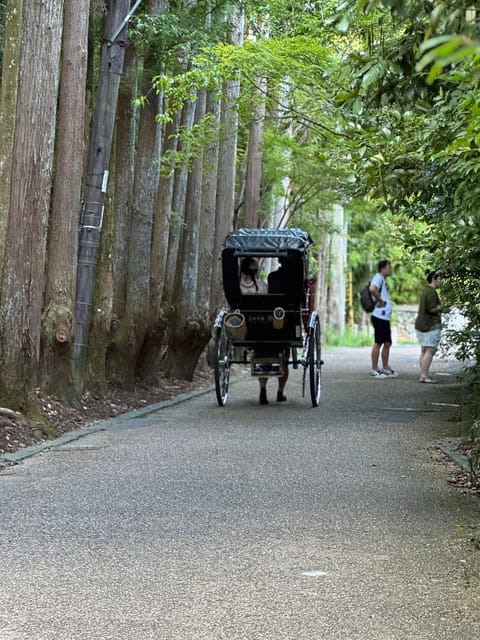
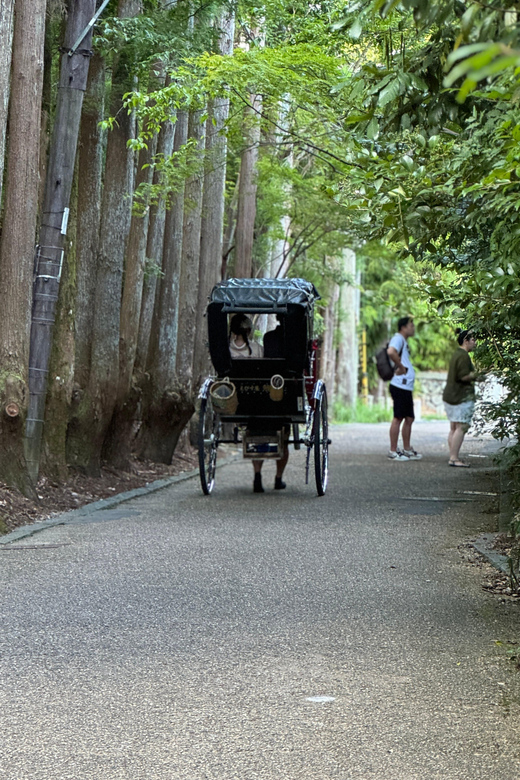
- Saga Toriimoto adds old Kyoto character: Traditional houses, a cocoon doll shop, and a Washi paper shop give the walk a local craft angle.
- The guide shapes the experience: English and Japanese tours are available, with private and small-group options.
- Expect a real half-day walk: The tour lasts four hours and returns to Saga Arashiyama Station.
Starting at Saga Arashiyama Station
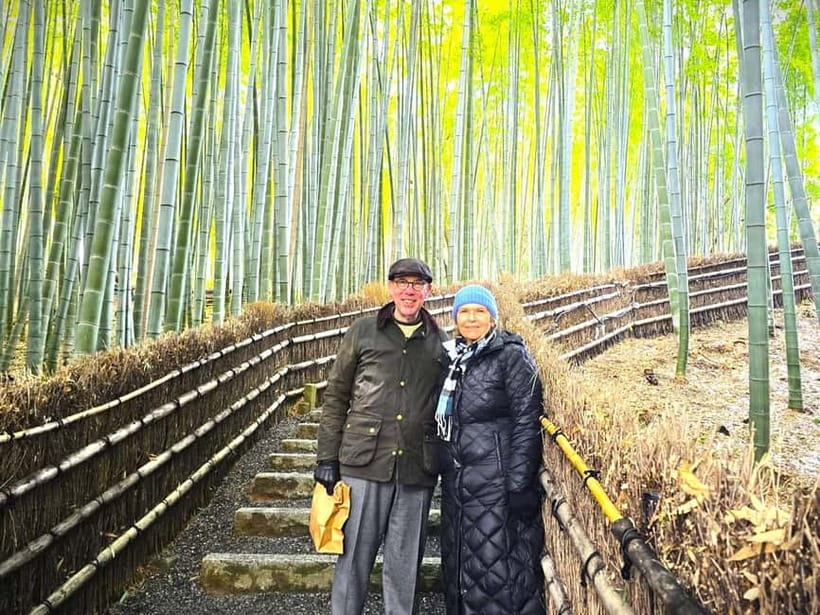
You meet your guide in front of the ticket gate at Saga Arashiyama Station. Look for the yellow sign with the DeepExperience logo. This is a useful starting point because the station sits close to the western side of Arashiyama, away from Kyoto’s central sights.
The tour finishes at the same station, which keeps the day tidy. You do not need to arrange a complicated pickup or work out where to go after the final temple. Still, arrive ready to walk. Bring water, wear shoes with a firm sole, and keep your camera handy.
The guide speaks English or Japanese. The private and small-group choices are important here. A guide can explain a temple’s symbols in a small setting far better than someone trying to address a large crowd. Several guides connected with this experience have received especially warm praise, including Yoshi for his explanations of Buddhist philosophy and Japanese culture, and Megumi for her friendly, easygoing manner.
Other named guides include Kana and Juraj. Kana has been praised for making the walk comfortable for families, including parents with teenage and adult children. Juraj has helped explain Buddhist sects and philosophy and has also assisted with practical Japanese communication. You may not receive a particular guide, but these examples give you a good sense of the intended style: personal, conversational, and open to questions.
More mornings in Arashiyama and the bamboo grove:
- Kyoto: Fushimi Inari, Kinkakuji, Bamboo Grove 1 Day Bus Tour
★ 4.8 · 4,316 reviews - Osaka/Kyoto:Kinkakuji,Arashiyama,FushimiInariShrine,NaraPark
★ 4.1 · 1,596 reviews - Kyoto/Osaka: Nara, Fushimi Inari Taisha, Arashiyama Bus Tour
★ 4.7 · 1,275 reviews
Togetsu Bridge and the first Arashiyama views
The walk begins with Togetsu Bridge, the area’s best-known landmark. The stop itself is brief, about five minutes, but the bridge gives you an immediate sense of why Arashiyama attracts so many people. It crosses the Katsura River and opens a broad view toward the surrounding hills.
Do not expect a long lecture here. This is more of a visual introduction before the walking route turns toward the quieter side of the district. You’ll have time to take photographs, but the bridge can be crowded, especially during popular sightseeing hours.
From the bridge, the group continues toward Arashiyama Park and its observatory. The route includes roughly ten minutes of scenic walking. The park stop gives you a higher view and a little breathing room after the bridge. It is a good point to ask your guide how the river, hills, temples, and old settlement fit together.
The bamboo forest, with realistic expectations
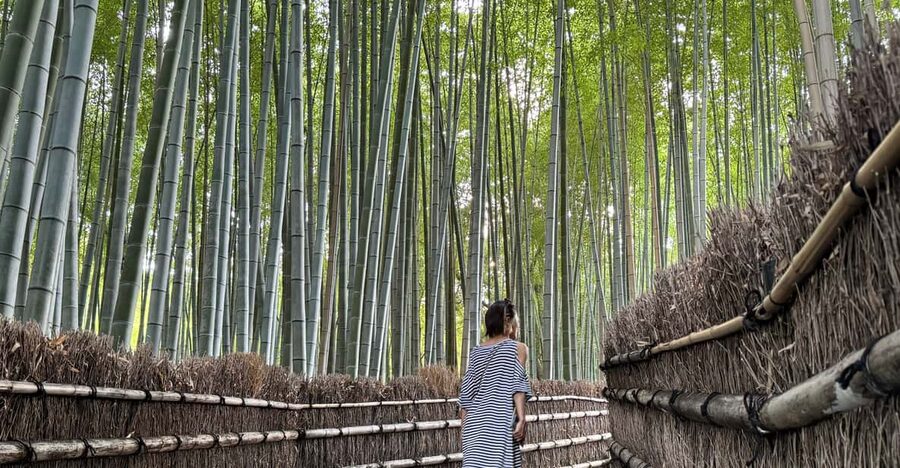
The bamboo forest is one of Kyoto’s most photographed sights, and this tour includes a short photo stop of about five minutes. You’ll have a chance to take the familiar picture among the tall bamboo stalks, but the stop is not designed as a long solo wander through every path.
That short timing is worth understanding before you book. If your main aim is to spend an hour photographing bamboo, this tour may feel too fast. If you want to see the bamboo as one part of a larger Arashiyama walk, the format works well.
The guide can also put the bamboo area in context instead of leaving you with only a picture. The larger point of this route is that Arashiyama has more to offer than its most famous corridor. Once you move toward the temples and Saga Toriimoto, the mood changes quickly.
Otagi Nenbutsuji and its 1,200 expressive statues
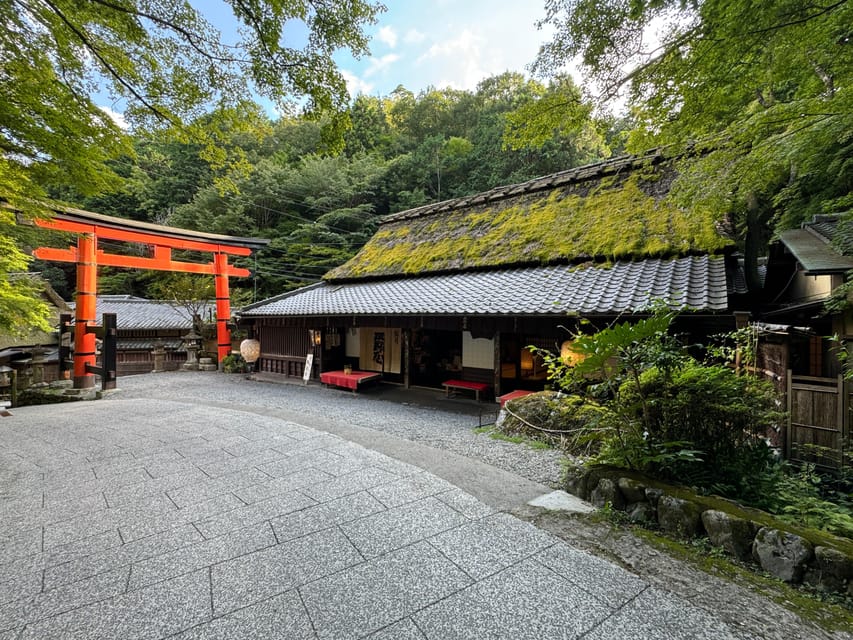
Otagi Nenbutsuji is the first major temple visit and lasts about 30 minutes. It is one of the most memorable stops because the grounds contain around 1,200 stone statues, each with a different expression and character.
Some figures look cheerful, some mischievous, and some oddly human. The collection invites you to slow down and look closely. You are not simply checking off another temple gate. You are comparing faces, spotting small details, and asking why the figures were made this way.
This is where a guide adds real value. Without explanation, the statues are fun and photogenic. With context, you can better understand how they fit into Japanese Buddhist practice and temple art. The guide can also answer questions about customs, religious ideas, and the differences between the temples on the route.
Thirty minutes is enough for a good introduction, though not enough to inspect every statue. That is a fair compromise in a four-hour tour. You get the character of Otagi Nenbutsuji without turning the whole afternoon into a single temple visit.
A few more Kyoto tours worth putting on the shortlist
- PERFECT KYOTO 1-Day Bus Tour
★ 5.0 · 13,518 reviews - Kyoto: Tea Ceremony in a Traditional Tea House in Kiyomizu
★ 4.9 · 3,519 reviews - Kyoto Geisha Walking Tour: Gion District & Hidden Gems
★ 4.7 · 3,273 reviews - Kyoto: Tea Ceremony Ju-An at Jotokuji Temple
★ 4.9 · 3,207 reviews
Adashino Nenbutsuji and the field of stone images
The next temple is Adashino Nenbutsuji, another 30-minute stop. Its character is completely different from Otagi Nenbutsuji. Instead of playful individual faces, you’ll find around 8,000 stone images and pagodas gathered across the temple grounds.
The effect is more serious and contemplative. The stones recall the dead and create a strong sense of time passing. This is the stop that gives the walk emotional weight, and it is one reason I prefer this route to a simple bridge-and-bamboo outing.
The large number of stone images can be hard to take in at first. Your guide helps explain what you are seeing and why the site matters. This is especially useful if Japanese Buddhist temples are new to you. The experience is not just about architecture. It is about memory, ritual, and the way religious places mark human lives.
Photography may be appealing, but this is a place to keep your voice low and pay attention to the setting. The tour’s pace allows you to see the grounds without rushing straight through.
Saga Toriimoto and old Kyoto streets
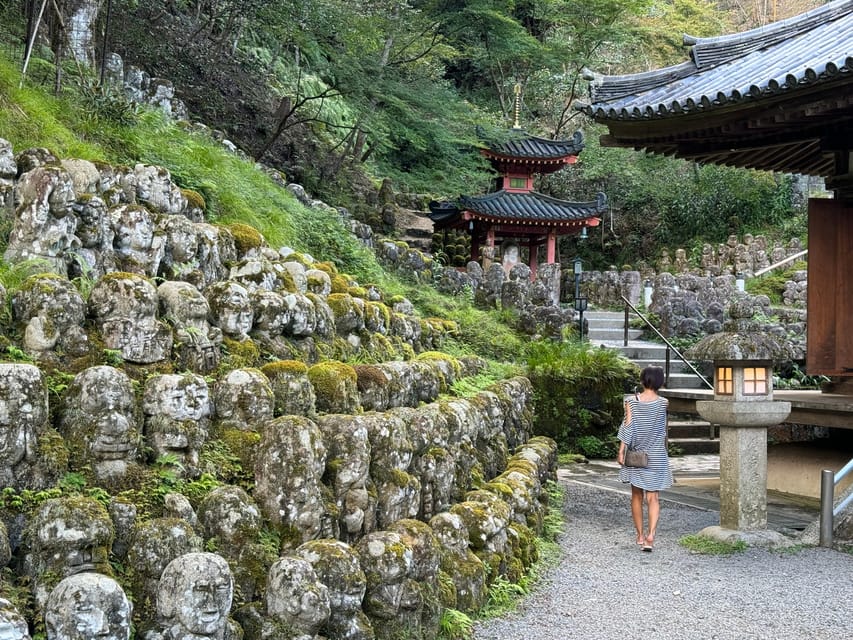
After the temples, the walk passes through Saga Toriimoto Preserved Street. This section lasts about 30 minutes and changes the focus from temple grounds to ordinary buildings, shops, and street design.
You’ll see traditional Japanese houses along the route. Their wooden fronts and restrained design offer a useful contrast with the crowded sightseeing areas closer to central Arashiyama. This is the kind of stretch where you can understand how the district looked and functioned beyond its major landmarks.
The tour may also include local shops, including a cocoon dolls shop and a Washi paper shop. These details give the walk a hands-on craft element, even if you are only browsing. Cocoon dolls and handmade paper connect the area to older forms of Japanese making, and they offer more distinctive souvenirs than generic tourist goods.
You should not expect a shopping excursion. Food, drinks, and souvenirs are not included, and the tour is mainly about walking and interpretation. Still, the shops make the route feel less like a parade of famous sites. They show you how local craft traditions remain part of the streetscape.
Seiryoji Temple and the return to the station
The final named temple stop is Seiryoji, with about 15 minutes set aside for a visit. By this point, you have seen a bridge, a river view, bamboo, two very different temples, and an old preserved street. Seiryoji rounds out the religious side of the walk before you head back to Saga Arashiyama Station.
The visit is brief, so think of it as a final look rather than a full temple study. The advantage is that the tour does not drag late into the day. After Seiryoji, you return to the station, completing a route that combines major Arashiyama sights with quieter corners of Okusaga.
The exact amount of time spent at each stop can vary with the group and guide. The listed schedule gives you a useful framework, but it is not a promise that every stop will run to the minute.
What the guide adds to the experience
This tour is worth considering mainly because of the guide, not because Arashiyama lacks sights you can reach alone. You can visit the bridge and bamboo area without help. The harder part is understanding what makes the less famous temples and streets significant.
A good guide turns the walk into a conversation. You can ask about Buddhist philosophy, religious sects, temple customs, Japanese food, language, or local history. The comments connected with Yoshi, Juraj, Kana, and Megumi suggest that guides are encouraged to do more than recite dates.
One especially useful feature is help with everyday communication. A guide has assisted with Japanese taxi arrangements and restaurant recommendations, including a curry restaurant. That kind of help can be valuable when you are tired after walking and want a practical next step.
Guide quality can never be guaranteed by name unless you book a specific person, so I would choose the small-group or private format if personal attention matters to you. Families, curious first-time visitors, and anyone who likes asking questions will get the most from this style of tour.
Is $83 a fair price?
At $83 per person, the cost is reasonable if you value interpretation and a planned route. The price includes the local guide and admission to Otagi Nenbutsuji and Adashino Nenbutsuji. Food, drinks, and souvenirs cost extra.
You are paying for four hours of direction, temple entry, and cultural explanation. You are also avoiding the work of planning the sequence yourself. That has real value in Arashiyama, where it is easy to spend too much time in the most crowded areas and miss the streets and temples farther out.
The value is weaker if you only want the bamboo forest and Togetsu Bridge. Those sights are easy to visit independently, and the bamboo stop is short. The tour makes better financial sense if you want to understand the temples, learn about Okusaga, and see more than the standard photo stops.
Private and small-group choices may affect the final price, so check the available option before booking. The reserve-now-and-pay-later feature also gives you some flexibility, and cancellation is free up to 24 hours in advance for a full refund.
Walking conditions and who should book
You should be comfortable walking for four hours with a moderate amount of walking between stops. The route includes streets, park paths, temple grounds, and possibly uneven surfaces. The information provided does not give an exact distance, so I would not book this expecting a gentle, stationary sightseeing program.
Bring:
- Comfortable walking shoes
- Water
- A camera
Smoking is not allowed during the activity. The tour is not suitable for wheelchair users or people with mobility impairments.
I would recommend it to first-time visitors who want Arashiyama’s major sights plus a more thoughtful look at the area. It also suits families with older children and adults, especially if everyone enjoys history, religion, photography, or local crafts.
I would hesitate to recommend it to anyone who dislikes walking, needs a fully accessible route, or wants a slow photography session in the bamboo forest. It is also less suitable if your schedule allows only a quick visit to Arashiyama.
Should you book this Arashiyama walk?
Book this tour if you want the famous bridge and bamboo, but also want the unusual details that many short visits miss. Otagi Nenbutsuji’s expressive statues, Adashino Nenbutsuji’s field of stone images, and Saga Toriimoto’s old houses give the afternoon much more range than a standard Arashiyama photo walk.
The best reason to book is the guide. You’ll have someone to explain Buddhist ideas, local customs, and the story of Okusaga while keeping the route moving. At $83, it is good value for a four-hour guided walk with two temple admissions, provided you are ready for the physical effort.
Skip it if you want to move at your own pace or spend most of your time in the bamboo forest. For everyone else, this is a well-shaped way to see Arashiyama’s headline sights and its quieter, more characterful side in one half-day.
FAQ
Where does the tour meet?
Meet your guide in front of the ticket gate at Saga Arashiyama Station. The guide will hold a yellow sign with the DeepExperience logo.
Where does the tour finish?
The tour finishes back at Saga Arashiyama Station.
How long does the tour last?
The activity lasts four hours.
What languages are available?
The tour is available in English and Japanese.
Is the tour private or shared?
Private and small-group options are available.
Is admission to the temples included?
Admission to Otagi Nenbutsuji Temple and Adashino Nenbutsuji Temple is included.
Are food, drinks, and souvenirs included?
No. Food, drinks, and souvenirs are not included.
What should I bring?
Bring comfortable walking shoes, water, and a camera.
Is the tour suitable for wheelchair users?
No. The activity is not suitable for wheelchair users or people with mobility impairments.
Can I cancel for a full refund?
Yes. You can cancel up to 24 hours in advance for a full refund.
Newest Kyoto experiences on the site
- Treasures of Kyoto: Gion & historical Walking Tour★ 5.0 · 6 reviews
- Whisk Your Own Matcha: A Zen Matcha Experience at Temple★ 3.6 · 7 reviews
- Kyoto tea town for matcha lovers★ 5.0 · 16 reviews
- Uji: Private immersion into Kyoto’s tea and reglious culture★ 5.0 · 17 reviews
- Kyoto Matcha Green Tea Tour★ 4.5 · 23 reviews
- Uji and Wazuka Matcha Farm Half Day Private Guided Tour★ 5.0 · 21 reviews
- Utilising upcycled Matcha! Creating matcha incense (Uji, Kyoto)★ 5.0 · 6 reviews
- Sacred Temple Yoga Experience in Japan★ 5.0 · 3 reviews
Arashiyama Bamboo Grove Tours, compared.
Fushimi Inari, Kinkakuji, Bamboo Grove 1 Day Bus Tour
Read our review →
Kinkakuji,Arashiyama,FushimiInariShrine,NaraPark
Read our review →
Nara, Fushimi Inari Taisha, Arashiyama Bus Tour
Read our review →
Kyoto Arashiyama Walking Tour: Bamboo, Monkeys, Gardens & Secrets
Read our review →
Arashiyama Bamboo, Temple, Monkeys, or Secret Sake Brewery
Read our review →
Arashiyama Bamboo Forest, Monkeys, Matcha & Temple Tour
Read our review →
Arashiyama, Nara & Fushimi Inari Shrine w/Lunch
Read our review →
Nijo, Kinkaku-ji, Arashiyama, Kiyomizu & Fushimi Inari
Read our review →Browse the lists this tour appears in