
Reviewed · KYOTO GEISHA & MAIKO EXPERIENCES
Kyoto Samurai and Geisha Town Private Walking Tour
Kyoto’s samurai story comes alive on this seven-hour route, from the shogun’s Kyoto residence at Nijo Castle to the golden pavilion of Kinkakuji and the traditional streets of Gion. It connects political power, Zen Buddhism, and geisha culture in one full day.
I like two things here: your private guide can explain details you might miss on your own, and the route uses public transportation, so you are not stuck in a tour bus. The early 8 a.m. start is also smart for Kyoto’s most popular sights.
The tradeoff is pace. Four major stops in seven hours require steady walking and transfers, and the tour does not include food or drinks. If you prefer long, quiet visits at each temple, this may feel brisk.
Key points to know before booking
- Four very different Kyoto sights: Move from shogun-era castle rooms to Zen temple gardens, a golden pavilion, and the geisha district of Gion.
- A private experience: Only your group participates, giving you room to ask questions and adjust the conversation to your interests.
- An early 8 a.m. start: The morning departure is designed to help you reach the busiest sights before crowds build.
- Public transportation included: The guide handles the route between locations, while you experience Kyoto’s normal city movement.
- Admission fees are covered: Nijo Castle, Kinkakuji, and Kennin-ji entrance costs are included in the tour price.
- Seven hours on your feet: A moderate fitness level is recommended, and the tour is not stroller accessible.
Why this route gives Kyoto a clear storyline
Kyoto can feel like a collection of famous places unless someone explains how they fit together. This tour gives you a useful thread: the city’s role as Japan’s imperial capital, its ties to samurai rulers, the growth of Zen Buddhism, and the traditions preserved in Gion.
The route begins at Kyoto Station at 8 a.m. and ends back at the same meeting point. That makes the tour easy to fit into a larger Kyoto plan, especially if you want a guided introduction on your first full day.
I also like the way the stops balance famous sights with a closer look at local tradition. Nijo Castle and Kinkakuji are major attractions, while Gion and Kennin-ji offer a more textured view of Kyoto. You are not spending seven hours at castles alone.
Because this is a private tour, your guide can spend more time on topics that interest you. You can ask about shoguns, temple design, geisha training, or the town houses lining Kyoto’s older districts. A private format also means the guide does not have to manage a large group at every crossing or entrance.
More geisha and maiko evenings in Kyoto:
- Kyoto Geisha Walking Tour: Gion District & Hidden Gems
★ 4.7 · 3,273 reviews - Kyoto: Gion Magical Night Walking Tour with Geisha Trivia
★ 4.9 · 2,393 reviews - Kyoto: Gion Geisha District Walking Tour – Stories of Geisha
★ 4.7 · 2,187 reviews
Nijo Castle, where the shogun met Kyoto
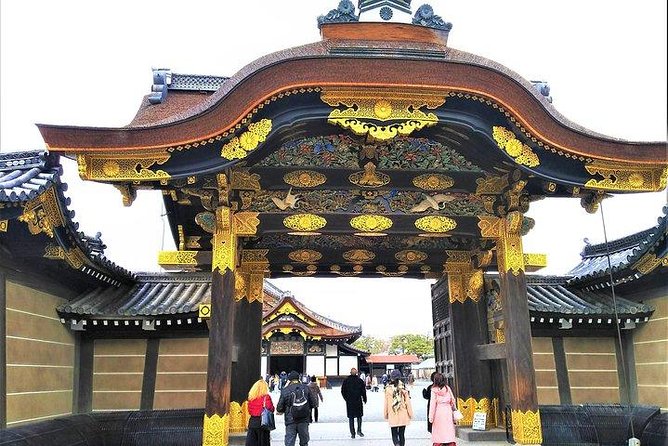
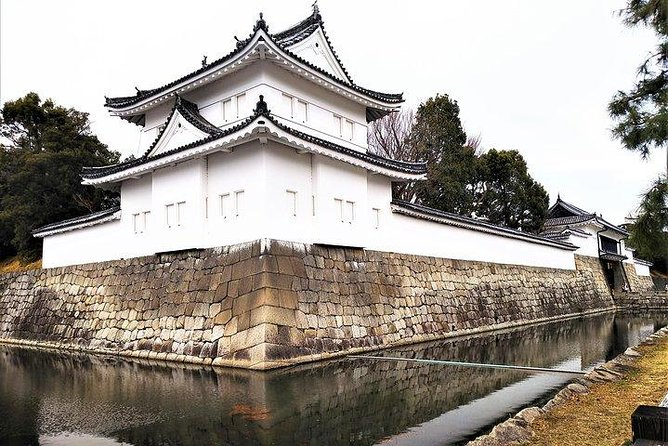
The first stop is Nijo Castle, built in 1603 after the shogun established his government in Edo, now Tokyo. Kyoto remained the imperial capital, so the castle served as the shogun’s residence during visits to the city.
That detail makes Nijo Castle more than a pretty fortification. It shows the careful balance between imperial Kyoto and military power based elsewhere. Your guide can help explain why a shogun needed a residence in Kyoto and how the castle fit into Japan’s political structure.
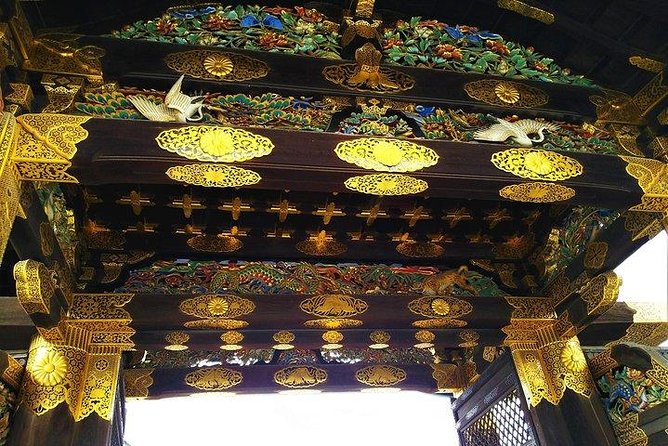
Inside are more than 1,000 rooms and lavish decorations. The castle is known for its grand interiors, where design and display helped communicate authority. This is a place where the setting matters as much as the objects you see.
Allow about an hour here. The visit is a strong opening because it gives you the political background for the rest of the day. You begin with the samurai class and the shogunate before moving toward temples and traditional entertainment districts.
The possible drawback is that Nijo Castle can feel substantial rather than quick. With only an hour scheduled, you will want to stay with your guide and keep moving. If you hope to inspect every room or linger over every decoration, you may want a separate visit.
Kinkakuji and the famous golden reflection
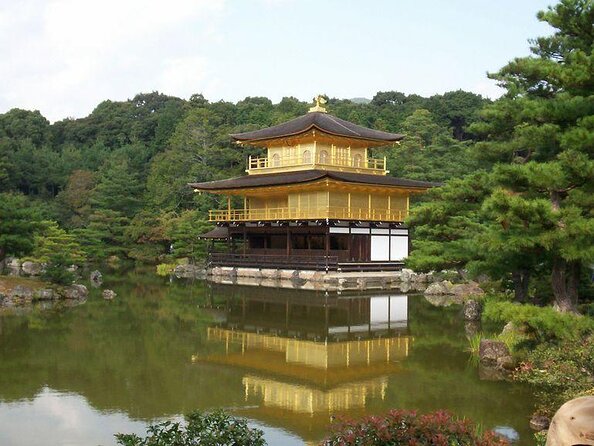
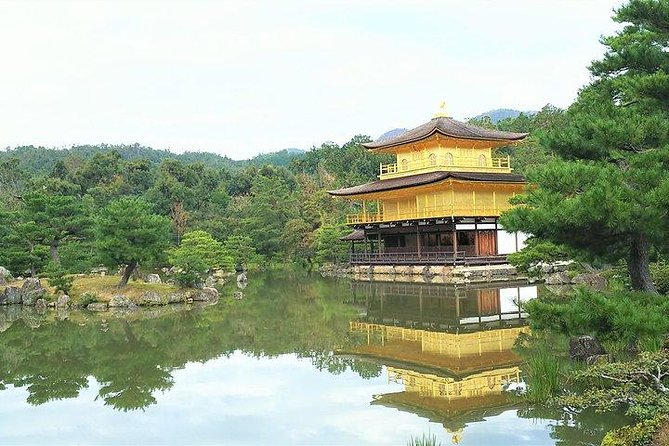
Kinkakuji, also called the Golden Pavilion, was built in 1397 by the third shogun of the Ashikaga shogunate. Its bright gold exterior and reflection in the pond have made it one of Kyoto’s most recognizable sights.
The setting is designed for a visual pause. After the formal rooms and political story of Nijo Castle, Kinkakuji gives you a scene centered on water, architecture, and carefully arranged grounds. The pavilion itself is the focus, but the reflection is what makes the view memorable.
Your visit here lasts about an hour, with admission included. That is enough time to see the main view and hear how the temple connects to samurai culture and the Ashikaga rulers.
Kinkakuji is one of the stops where an early start matters most. The pavilion is famous for good reason, but fame also brings crowds. Arriving in the morning gives you a better chance of seeing the pond and pavilion without the thickest flow of people.
Still, keep expectations realistic. This is not a quiet private temple visit. Kinkakuji is a must-see for many people in Kyoto, and the route is designed to show you the key view rather than give you hours of unhurried garden wandering.
Gion, Kyoto’s traditional entertainment district
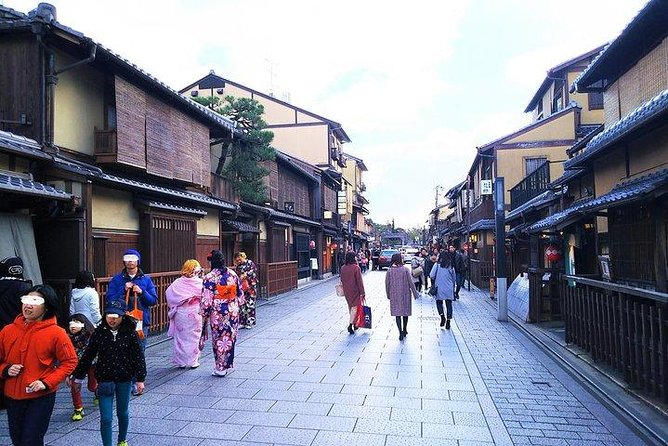
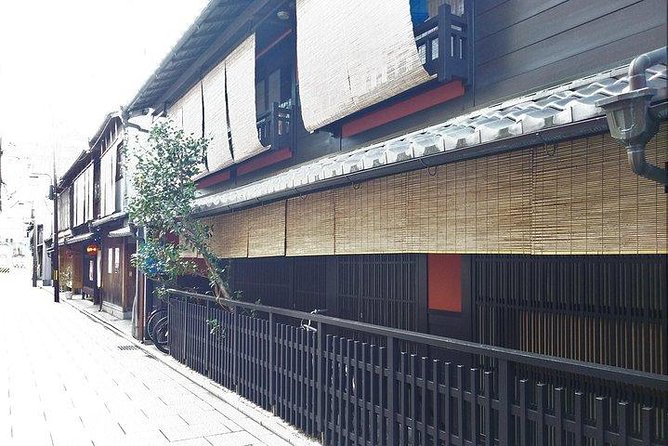
The tour then shifts from shogun residences and temple grounds to Gion, Kyoto’s best-known geisha district. Kyoto has five kagai, or geisha districts, and Gion is the largest.
The term geisha refers to highly trained professional performers and successors to a long tradition of Japanese arts. A walk through Gion gives you a chance to see the streets and town houses connected with that culture, rather than treating geisha life as a stage show made for tourists.
About 40 minutes are set aside for Gion. That is enough for an introduction and a walk through the area, but not a lengthy exploration of every lane. The value here comes from context. Your guide can explain what you are seeing and point out features you might pass without understanding.
Gion is also a useful counterpoint to the earlier stops. Nijo Castle presents official power. Kinkakuji presents religious and political prestige. Gion shows how traditional arts and neighborhood life remained part of Kyoto’s identity.
Please approach this part of the tour with respect. Geishas are working professionals, not public attractions. Listen to your guide about appropriate behavior, and treat the streets as a lived cultural district rather than a photo set.
The tour’s early timing may help here too. You can walk through Gion before the day reaches its busiest point. The listed stop is short, so you should not expect a long meal, performance, or formal geisha encounter. Food and drinks are not included.
More samurai experiences in Kyoto:
- Kyoto Samurai Experience
★ 5.0 · 1,294 reviews - Kyoto: Kendo and Samurai Experience with Uniform and Gear
★ 4.9 · 815 reviews - Kyoto: Samurai Sword Class by Experts in Traditional Arts
★ 4.9 · 657 reviews - Skip the lines Basic Ticket at SAMURAI NINJA MUSEUM KYOTO
★ 4.5 · 632 reviews
Kennin-ji, a quieter Zen finish in Gion
Kennin-ji is also in the Gion area and dates to 1202. It was founded by the third shogun of the Kamakura shogunate as Kyoto’s first Zen temple.
This stop adds a different layer to the samurai story. Zen Buddhism and warrior culture have long been linked in popular accounts of Japan, but the important point for you is simpler: Kennin-ji lets you see how religious ideas, temple design, and military-era patronage met in Kyoto.
Two features are singled out at the temple: its dry garden and another major artistic detail on the grounds. The available description identifies the dry garden but does not provide the full details of the second feature, so your guide is the person to ask about what to look for once you arrive.
The visit lasts about 40 minutes and admission is included. That is enough time for the main highlights, especially if your guide directs your attention to the garden’s layout and the temple’s place in Kyoto’s Zen tradition.
Kennin-ji is a good final stop because it slows the subject matter down. You have already seen the shogun’s formal residence, the Ashikaga pavilion, and Gion’s traditional streets. Here, the focus turns to space, restraint, and contemplation.
Do not expect a long period of silent meditation. The schedule is still active, and you must return to Kyoto Station at the end. Think of Kennin-ji as a focused introduction, not a full temple study.
What the private guide adds
The guide is the main reason to choose this tour instead of visiting the four locations alone. Kyoto’s signs can tell you names and dates, but they do not always explain how the shogunate, imperial court, Zen temples, and geisha districts relate to one another.
A strong guide can also keep the day efficient. One person who took this tour described moving between sites without feeling rushed and learning details that are easy to miss on a standard route. The same account noted that the guide included less obvious sights along the way.
That is exactly what you should hope to get from a private format: clear explanations, practical movement through the city, and room for questions. The tour is not just a checklist of famous buildings.
No guide’s name is provided, so you cannot request a particular person based on the booking details. The quality of the day will depend heavily on the individual guide assigned to your group. You can improve the experience by arriving with a few questions of your own.
Ask about the difference between an emperor and a shogun, how Gion’s kagai function, why dry gardens use rocks and gravel, or how Kyoto remained important after the shogunate moved to Edo. Specific questions usually lead to a more personal and useful tour.
Seven hours, public transit, and the $135.59 price
The price is $135.59 per person. That is not a budget walking tour, but it includes the guide, admission fees, and public transportation. Since Nijo Castle, Kinkakuji, and Kennin-ji all charge admission, the included tickets reduce the extra costs you would face on your own.
The private format is the other major part of the value. You are paying for a guide dedicated to your group rather than joining a large shared walk. For a couple, family, or small group with a strong interest in Japanese history, that can make the price reasonable.
Group discounts are available, though the exact discount is not specified. Check the price for your party before booking, since the per-person cost may work better for a larger private group.
Public transportation is included, which is useful in Kyoto. The tour is not designed around a private coach or taxi. You will move through the city as people who live there do, with the guide managing the route.
The meeting point is Kyoto Station Building, at 901 Higashishiokoji-cho in Shimogyo Ward. The tour begins at 8 a.m. and returns there after roughly seven hours. Plan to eat before you start, since food and drinks are not included.
The schedule calls for a moderate fitness level. You will be walking through castle and temple grounds, standing during explanations, and using public transit. The tour is accessible for people with limited eyesight and limited mobility according to the supplied booking information, but it is not stroller accessible.
There is also conflicting information about animals. The details say animals or pets are allowed, but they also say the experience is not suitable for pets. If this matters to you, ask KAMNAVI Tours for a clear answer before booking.
Who will get the most from this Kyoto day
I would recommend this tour to anyone visiting Kyoto for the first time who wants the major samurai and geisha themes explained in one day. It is especially useful if you want a guide to connect places that might otherwise feel unrelated.
It also suits people who value a private experience and want to ask questions as they go. Families and small groups may appreciate the ability to keep the discussion at their own level, though the walking and seven-hour length may be tiring for young children.
History fans will enjoy the sequence from the Ashikaga and Kamakura shogunates to the Tokugawa period. Architecture and garden lovers will get the most from Kinkakuji and Kennin-ji. Anyone interested in traditional performing arts will find Gion more meaningful with an explanation of the kagai system.
I would think twice if you dislike early starts, need long breaks, or want to spend half a day at one temple. The itinerary is full. It gives you breadth, not an exhaustive study of any single site.
You should also avoid booking this as a food tour or evening geisha experience. Meals, drinks, and performances are not included. Gion is part of the cultural route, but the focus is a guided walk through the district.
Cancellation and planning details
You receive confirmation when you book, and free cancellation is available up to 24 hours before the 8 a.m. start time for a full refund. Changes made less than 24 hours before departure are not accepted, and cancellations inside that period are not refunded.
The experience requires good weather. If poor weather causes cancellation, you will be offered another date or a full refund.
Because the tour is often booked well ahead, with an average booking time of 53 days in advance, reserve early if your Kyoto dates are fixed. The mobile ticket makes the practical side simple, but you still need to arrive at the station meeting point on time.
Should you book this tour?
Book it if you want one private day that explains Kyoto through four strong examples: the shogun’s castle, an Ashikaga temple, the streets of Gion, and a major Zen temple. The guide, included admissions, public transit, and early start give the day a useful structure.
Skip it if your ideal Kyoto day means moving slowly, eating along the way, or spending hours at one temple. At $135.59 per person, the value depends on how much you want personal guidance and historical context.
For a first visit, I like the balance. You see famous places, learn why they matter, and get a glimpse of Kyoto’s traditional districts without spending the day on a bus. Just start rested, eat breakfast first, and wear comfortable shoes.
FAQ
Where does the Kyoto Samurai and Geisha Town Private Walking Tour start?
It starts at Kyoto Station Building, 901 Higashishiokoji-cho, Shimogyo Ward, Kyoto, 600-8216, Japan.
What time does the tour begin?
The tour begins at 8 a.m.
How long does the tour last?
The experience lasts approximately seven hours and ends back at the meeting point.
Which places are included?
The tour visits Nijo Castle, Kinkakuji Temple, Gion, and Kennin-ji Temple.
Are admission fees and transportation included?
Yes. Admission fees, the guide fare, and public transportation are included. Food and drinks are not included.
Is this a private tour?
Yes. Only your group participates in the activity.
More Walking Tours in Kyoto
- Night Walk in Gion: Kyoto’s Geisha District
★ 4.5 · 2,003 reviews - Kyoto Gion Geisha District Walking Tour – The Stories of Geisha
★ 5.0 · 1,441 reviews - Nishiki Market Brunch Walking Tour (7 Tastings + Brunch)
★ 5.0 · 1,355 reviews - Kyoto Arashiyama Walking Tour: Bamboo, Monkeys, Gardens & Secrets
★ 5.0 · 1,216 reviews
Newest Kyoto experiences on the site
- Treasures of Kyoto: Gion & historical Walking Tour★ 5.0 · 6 reviews
- Whisk Your Own Matcha: A Zen Matcha Experience at Temple★ 3.6 · 7 reviews
- Kyoto tea town for matcha lovers★ 5.0 · 16 reviews
- Uji: Private immersion into Kyoto’s tea and reglious culture★ 5.0 · 17 reviews
- Kyoto Matcha Green Tea Tour★ 4.5 · 23 reviews
- Uji and Wazuka Matcha Farm Half Day Private Guided Tour★ 5.0 · 21 reviews
- Utilising upcycled Matcha! Creating matcha incense (Uji, Kyoto)★ 5.0 · 6 reviews
- Sacred Temple Yoga Experience in Japan★ 5.0 · 3 reviews
Kyoto Geisha & Maiko Experiences, compared.
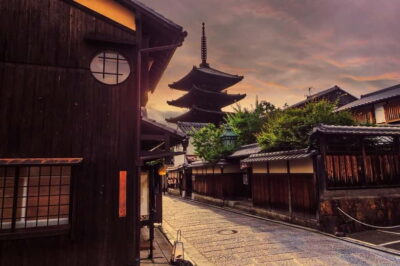
Kyoto Geisha Walking Tour: Gion District & Hidden Gems
Read our review →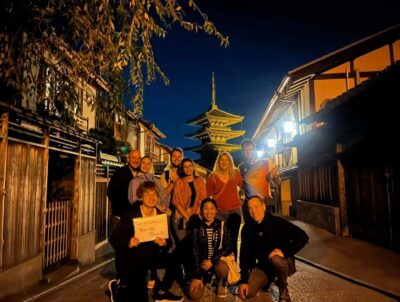
Gion Magical Night Walking Tour with Geisha Trivia
Read our review →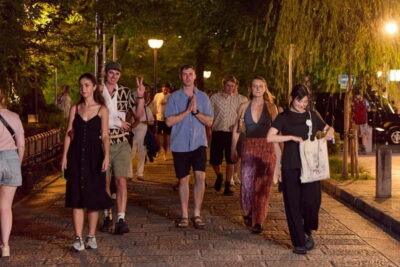
Gion Geisha District Walking Tour – Stories of Geisha
Read our review →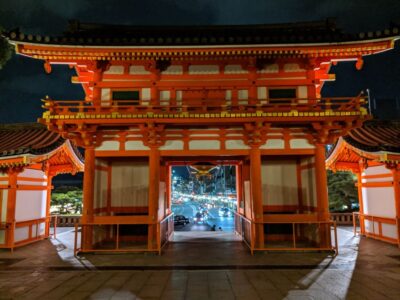
Best of Kyoto: Gion, Geisha, Pagodas & Cobblestones
Read our review →
Kyoto Gion Geisha District Walking Tour – The Stories of Geisha
Read our review →
Kyoto Gion: 2-Hour Geisha Culture & History Walking Tour
Read our review →
Kyoto Gion Night Walk & Geisha District Guided Tour
Read our review →Browse the lists this tour appears in