
Reviewed · GION DISTRICT TOURS
Kyoto Gion Night Tour: Discover Geisha District and Hidden Gems
Gion is at its most atmospheric after sunset, when lanterns glow along wooden machiya houses and the narrow streets feel far removed from modern Kyoto. You might even spot a geisha or maiko, though that is luck, not a promise. Guide Ikki is one named guide for this experience and is described as easy to talk with while explaining Japanese culture.
I like the route’s compact mix of Gion’s old streets and major shrines, and I like that the guide takes photos during the walk. The main consideration is simple: this is a steady walking tour, and being late means you cannot join or receive a refund.
Key points before you book
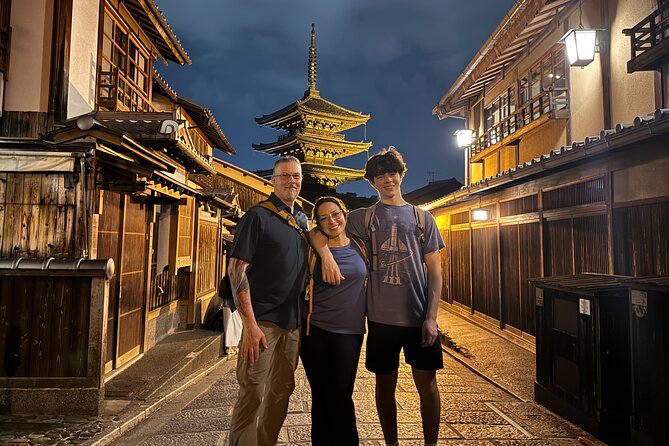
- Gion after dark: See Hanamikoji Street, wooden houses, teahouses, and lantern-lit lanes when the district takes on a quieter mood.
- Six well-chosen stops: The route links Gion with Yasui-Konpiragu, Yasaka Pagoda, Ninenzaka, and Yasaka Shrine in about 90 minutes.
- A chance, not a guarantee: You may see a geisha or maiko, but the tour should be booked for its streets, shrines, and cultural setting rather than a sighting.
- Local English-speaking guide: Guide Ikki is specifically named, and the tour includes explanations of Japanese culture.
- Photos included: Professional photos are taken during the walk, useful if you want a record of the evening without constantly holding up your phone.
- Small-group format: The group can include up to 20 people, small enough for a guide-led walk but not a private tour.
Why Gion works so well after sunset
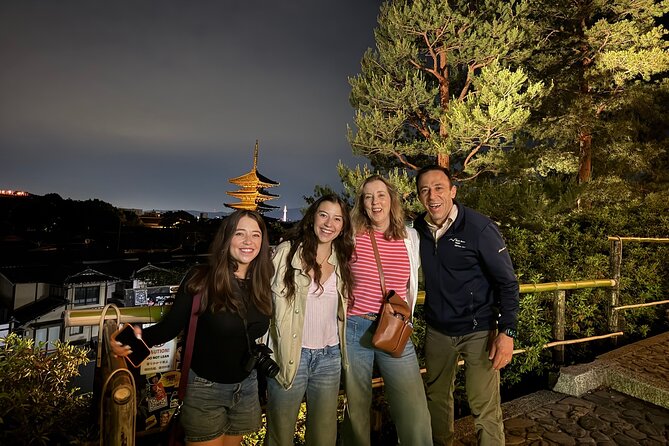
Gion is Kyoto’s best-known geisha district, but it is more than a place to hunt for a quick photograph. Its appeal comes from the setting: traditional wooden machiya houses, teahouses, preserved lanes, and the soft light from old-style lanterns.
At night, you get a different view of the district than you would during the day. The lighting draws attention to doorways, rooflines, stone paths, and the careful design of the old buildings. It also gives the walk a clear mood without requiring a long evening commitment.
A possible geisha or maiko sighting adds excitement, but you should keep your expectations in check. Their working routes and schedules are not arranged for this tour. The stronger reason to book is the chance to walk through one of Kyoto’s most recognizable cultural districts with context from a local guide.
The tour starts at 6:30 pm and lasts about an hour and a half. That timing gives you an evening activity without taking over the night. You can continue with dinner or another plan afterward, although the tour itself does not include food or drinks.
More ways to walk Gion:
- Kyoto Geisha Walking Tour: Gion District & Hidden Gems
★ 4.7 · 3,273 reviews - Kyoto: Gion Magical Night Walking Tour with Geisha Trivia
★ 4.9 · 2,393 reviews - Kyoto: Gion Geisha District Walking Tour – Stories of Geisha
★ 4.7 · 2,187 reviews
Starting at the Izumo-no-Okuni statue
The meeting point is the Statue of Izumo-no-Okuni in Kawabatacho, Higashiyama Ward. You should arrive early. The operator is strict about the start time, and if you miss the meeting, you cannot join later or receive a refund.
This matters more than it might seem. A walking tour through Gion depends on the group moving together. There is no indication that the guide can wait at each stop for late arrivals, so build in enough time to reach the statue and identify the meeting point.
The route ends back at the meeting point. That makes the evening easier to plan, particularly if you are using public transportation or have dinner arranged nearby. The meeting area is near public transportation, but specific train or bus directions are not provided, so check your route before setting out.
Hanamikoji Street: the first look at old Kyoto
The first stop is Hanamikoji Street, with about 10 minutes here. This is one of the most recognizable streets in Gion, lined with traditional wooden buildings and associated with teahouses, geisha, and maiko.
Ten minutes is enough for an introduction and some photographs, but it is not a long architectural study. The value comes from seeing the street in the evening and learning how it fits into Gion’s traditional entertainment district.
This is also where you should set your behavior for the rest of the walk. A possible geisha or maiko sighting is exciting, but the district is also a working neighborhood. Keep your distance, listen to the guide, and avoid treating anyone you see as a public attraction.
The street is free to visit, and no admission ticket is required. Your payment covers the guided experience rather than entry to a paid site.
Gion’s wooden lanes and teahouse district
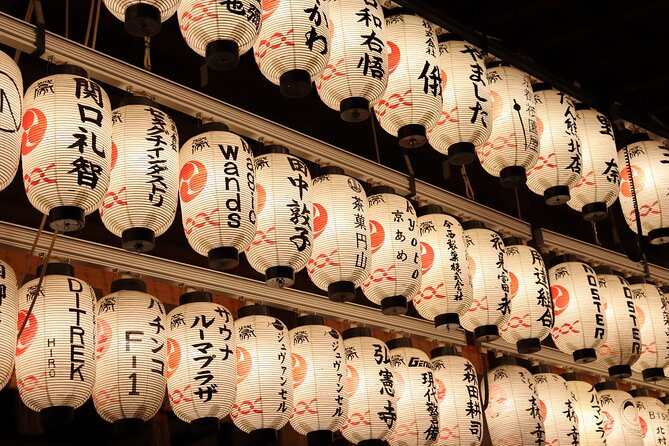
The tour then gives Gion about 20 minutes, the longest stop on the route. That extra time allows the guide to explain the district beyond one famous street.
You can expect more traditional wooden houses, teahouse exteriors, and preserved streets. The pleasure here is in noticing small details: the close-set buildings, the lanterns, and the way the old streets are still part of modern Kyoto.
I like this section because it provides the cultural setting for the rest of the route. Without it, Yasaka Pagoda and the shrines would feel like disconnected photo stops. With it, you get a clearer sense of how Kyoto’s older neighborhoods connect religious sites, traditional buildings, and evening life.
The route is not presented as a private or slow photography walk. A group of up to 20 people may join, so your time at any one viewpoint can be limited. If you want long pauses for night photography, this may feel brisk.
More geisha and maiko evenings in Kyoto:
- Best of Kyoto: Gion, Geisha, Pagodas & Cobblestones
★ 4.9 · 2,058 reviews - Night Walk in Gion: Kyoto’s Geisha District
★ 4.5 · 2,003 reviews - Kyoto Gion Geisha District Walking Tour – The Stories of Geisha
★ 5.0 · 1,441 reviews - Kyoto Gion: 2-Hour Geisha Culture & History Walking Tour
★ 5.0 · 1,186 reviews
Yasui-Konpiragu and the meaning of cutting ties
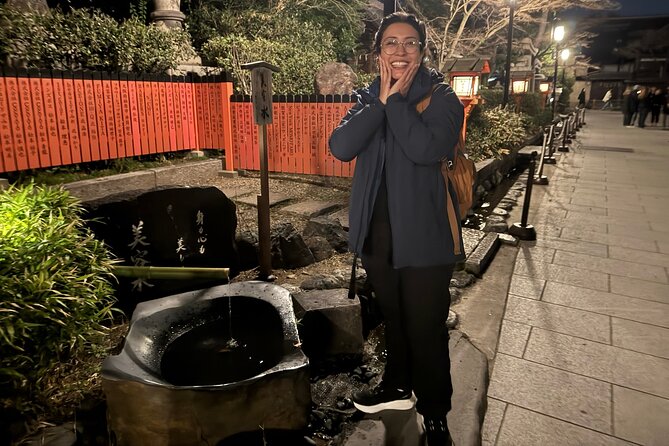
The next stop is Yasui-Konpiragu, visited for about 10 minutes. This shrine is known for prayers to end harmful relationships and sever negative ties, while also seeking better connections.
That purpose gives the stop a different tone from the architecture-focused sections. You are not simply looking at an old religious site. The shrine has a direct place in personal Japanese religious practice, centered on change, separation, and hope for a better direction.
The tour includes admission fees for temples and shrines, although the listed stops are described as free to enter. You do not need to budget for an extra ticket at this point.
Ten minutes is enough for the guide to explain the shrine’s role and for you to look around. It is not enough for a long personal visit or extended prayer, so think of this as a guided introduction rather than a private spiritual stop.
Yasaka Pagoda: the route’s strongest visual moment
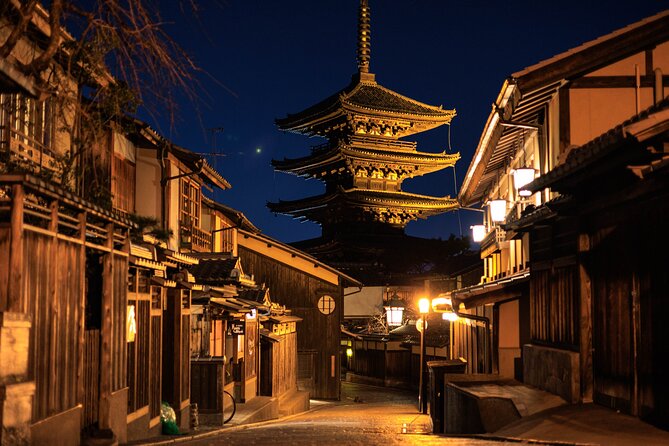
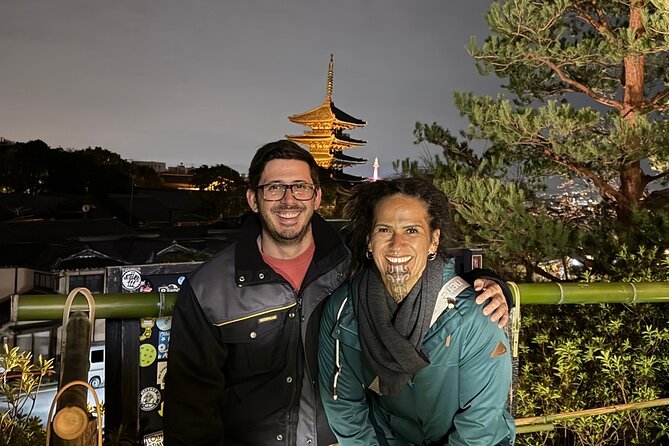
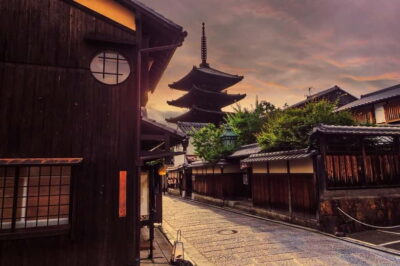
Yasaka Pagoda, also called Hokanji Temple, receives about 15 minutes. It is described as one of Japan’s oldest wooden structures and a symbol of Kyoto.
The pagoda is the sort of sight that makes the walk feel larger than a simple neighborhood stroll. Its scale rises above the surrounding streets, and the contrast between the wooden tower, dark sky, and nearby buildings creates one of the clearest photo opportunities of the evening.
The description notes that it was built without nails, a detail that adds to the sense of traditional craftsmanship. Your time here is still fairly short, so do not expect a full temple visit or an extended architectural lecture. The stop is mainly about seeing the pagoda in its historic setting and understanding why it matters to Kyoto.
Because the tour is on foot, you approach the site as part of the neighborhood rather than arriving by vehicle and leaving immediately. That gradual change in scenery is one of the route’s strengths.
Ninenzaka and Sannenzaka: stone paths and old storefronts
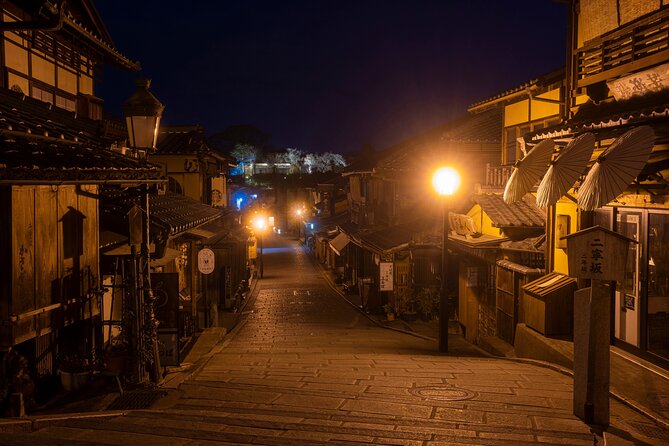
The route continues to Ninenzaka and Sannenzaka for about 20 minutes. These traditional stone-paved paths are lined with souvenir shops and restaurants in historic wooden buildings.
This is a good place to see how Kyoto’s old streets function as a visitor district. The setting feels like an earlier version of the city, but the shops and restaurants make it practical and active rather than frozen in time.
You should wear comfortable shoes. The tour is specifically designed as a walking experience, and the route includes stone-paved streets along with several other historic lanes. The provided information does not mention steep sections or accessibility limits, so anyone with mobility concerns should ask the operator before booking.
Twenty minutes gives you time to take in the street and hear the guide’s explanation, but not necessarily time to shop. If you see something you want to buy, remember that the group will keep to its schedule and the tour does not include personal shopping time.
This section also helps spread the sights across the evening. After the quiet focus of Yasui-Konpiragu and the tall silhouette of Yasaka Pagoda, Ninenzaka and Sannenzaka bring you back to Kyoto’s streets, storefronts, and everyday movement.
Yasaka Shrine closes the evening
The final stop is Yasaka Shrine, with about 15 minutes. It is described as the headquarters of roughly 2,300 related shrines throughout Japan and is associated with prosperity and protection.
Ending here gives the route a strong sense of place. You finish not in a random side street but at one of Kyoto’s major religious sites. The shrine also gives the guide a chance to connect the evening’s themes: Gion’s traditional culture, Kyoto’s old neighborhoods, and the continuing role of shrines in Japanese life.
As with the other stops, you should expect an introduction rather than an extended visit. The full tour is only about 90 minutes, and six stops require the guide to keep moving.
After the shrine, you return to the original meeting point. That is useful if you have made dinner plans nearby, though food and drinks are not included in the tour price.
What the $26.06 price really covers
At $26.06 per person, this is a reasonably priced introduction to Gion at night. You are paying for a local English-speaking guide, a planned route through six locations, and professional photos taken during the walk.
The value is strongest if you want orientation. In 90 minutes, you see several parts of southern Higashiyama and learn why they matter, without having to work out the route yourself. The guide also gives the streets cultural meaning that you would miss by simply walking through with a map.
The price is less compelling if you only want to wander independently or take your time at one shrine. Admission is not the main expense here, since the stops are listed as free. The fee pays for company, explanation, structure, and photography.
A group of up to 20 people is a practical middle ground. It is not intimate like a private walk, but it is not a huge sightseeing crowd either. If your priority is personal attention at every stop, you should know that the group size may limit how much individual discussion you receive.
Who should book this evening walk
I would recommend this tour to you if it is your first evening in Gion, you want a clear introduction to Kyoto’s traditional districts, or you prefer a guide to explain what you are seeing. It also suits anyone who wants a short cultural activity before dinner.
The route works well for visitors who enjoy scenery, old buildings, shrines, and local stories more than formal museum visits. The chance of seeing a geisha or maiko is an appealing bonus, but it should not be your only reason for booking.
You should think twice if you dislike walking, want a slow photography session, or need a flexible start time. The route lasts 90 minutes, follows a set schedule, and has a firm late-arrival rule.
Service animals are allowed, and most people can participate according to the provided information. Since the route is entirely on foot and includes historic streets, ask the provider directly if you have specific mobility needs.
The tour can be canceled for a full refund up to 24 hours before the start time. Cancellations or changes made within 24 hours are not refunded or accepted, based on local time.
Should you book the Kyoto Gion Night Tour?
Book it if you want a well-priced, guided first look at Gion after dark. The strongest parts are the lantern-lit streets, the thoughtful connection between Gion and the surrounding shrines, Yasaka Pagoda’s dramatic presence, and the included photos.
Do not book it solely to see a geisha or maiko. That possibility is real, but it cannot be scheduled. Book the walk for Kyoto’s old streets and cultural setting, then treat a sighting as an unexpected extra.
For $26.06, the tour offers a useful route, an English-speaking guide, six important stops, and a manageable 90-minute schedule. Just arrive early, wear comfortable shoes, and be ready to keep walking.
FAQ
How long is the Kyoto Gion Night Tour?
The tour lasts approximately 1 hour and 30 minutes.
What time does the tour start?
The tour starts at 6:30 pm.
Where does the tour meet?
The meeting point is the Statue of Izumo-no-Okuni in Kawabatacho, Higashiyama Ward, Kyoto.
Where does the tour end?
The activity ends back at the meeting point.
Are food and drinks included?
No. Food, drinks, and personal expenses are not included.
Is seeing a geisha or maiko guaranteed?
No. The route gives you a chance to spot a geisha or maiko, but sightings are not guaranteed.
What happens if I arrive late?
If you are late for the meeting time, you cannot join the tour and will not receive a refund.
More of Kyoto After Dark
- Kyoto Night Foodie Tour in Gion (9+ dishes + 6 Sake tastings)
★ 5.0 · 1,762 reviews - Kyoto Gion Night Walk & Geisha District Guided Tour
★ 5.0 · 786 reviews - Kyoto Ghost Tour: Dark Tales, Urban Legends, Bamboo Forest Night
★ 5.0 · 625 reviews - Kyoto Bar Hopping Night Tour
★ 5.0 · 613 reviews
Newest Kyoto experiences on the site
- Treasures of Kyoto: Gion & historical Walking Tour★ 5.0 · 6 reviews
- Whisk Your Own Matcha: A Zen Matcha Experience at Temple★ 3.6 · 7 reviews
- Kyoto tea town for matcha lovers★ 5.0 · 16 reviews
- Uji: Private immersion into Kyoto’s tea and reglious culture★ 5.0 · 17 reviews
- Kyoto Matcha Green Tea Tour★ 4.5 · 23 reviews
- Uji and Wazuka Matcha Farm Half Day Private Guided Tour★ 5.0 · 21 reviews
- Utilising upcycled Matcha! Creating matcha incense (Uji, Kyoto)★ 5.0 · 6 reviews
- Sacred Temple Yoga Experience in Japan★ 5.0 · 3 reviews
Gion District Tours, compared.
Kyoto Geisha Walking Tour: Gion District & Hidden Gems
Read our review →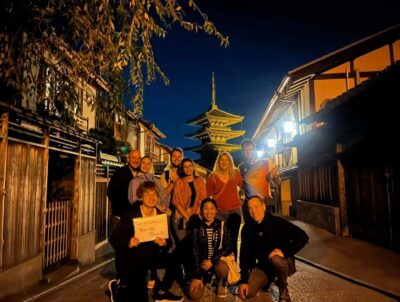
Gion Magical Night Walking Tour with Geisha Trivia
Read our review →
Gion Geisha District Walking Tour – Stories of Geisha
Read our review →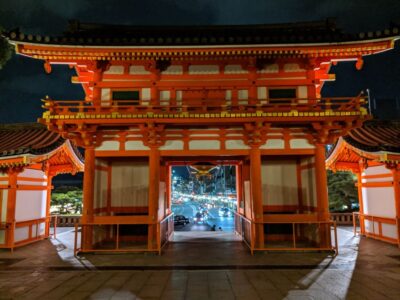
Best of Kyoto: Gion, Geisha, Pagodas & Cobblestones
Read our review →
Kyoto Night Foodie Tour in Gion (9+ dishes + 6 Sake tastings)
Read our review →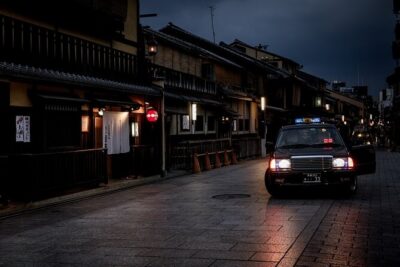
Kyoto Gion Geisha District Walking Tour – The Stories of Geisha
Read our review →
Kyoto Gion: 2-Hour Geisha Culture & History Walking Tour
Read our review →Browse the lists this tour appears in