
Reviewed · GION DISTRICT TOURS
Kyoto: Gion Geisha District Walking Tour – Stories of Geisha
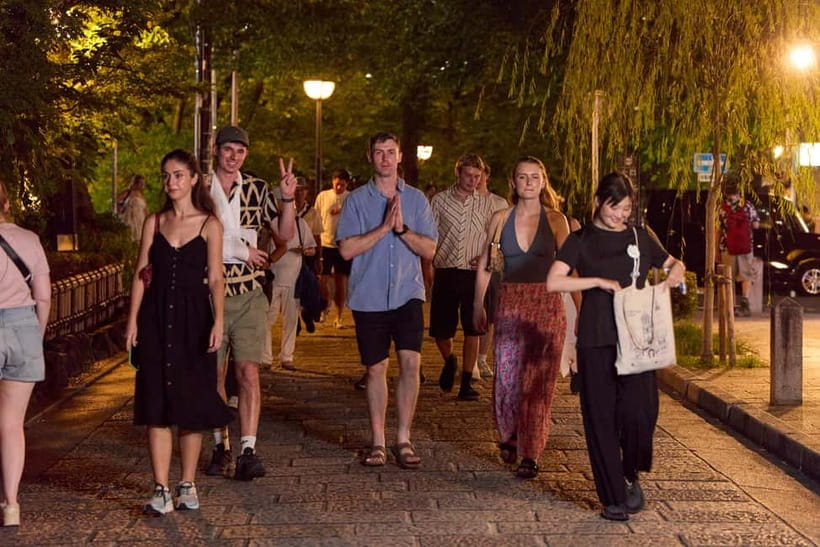
Kyoto’s geisha districts make the most sense after sunset, when the narrow lanes of Pontocho and Gion begin serving as working streets rather than photo backdrops. This two-hour walk connects Pontocho Alley, Yasaka Shrine, and Hanamikoji Street, while your guide explains the lives of geiko and maiko in plain terms.
I like the way the tour combines real neighborhood history with useful cultural context, especially at the statue of Izumo-no-Okuni and around the old teahouses. I also like the relaxed pace, which leaves room for questions and photographs. The main drawback is simple: seeing a geiko or maiko is possible, not promised, and evening darkness can make some buildings and landmarks harder to see.
What makes this Kyoto evening walk worthwhile
- You visit two working entertainment districts: Pontocho and Gion have different moods, and the walk lets you compare them.
- You learn the difference between geiko and maiko: The guide explains their training, clothing, work, and place in Kyoto culture.
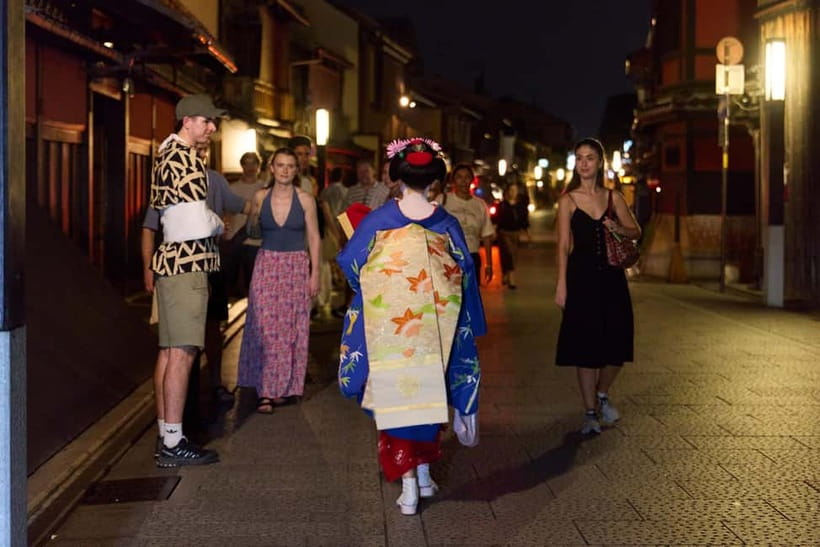
- You may see geiko or maiko on the way to appointments: If you do, the emphasis is on respectful observation rather than staged contact.
- The route includes meaningful historical stops: Izumo-no-Okuni, Yasaka Shrine, Gion Corner, and Hanamikoji each add a different piece to the story.
- The tour costs $20: For two hours with a live English or Spanish speaking guide, that is a modest price for a useful introduction to Kyoto.
- The walk suits curious older children and adults: It is not recommended for children under 10.
Starting at Kyoto Shijo with a clear meeting point
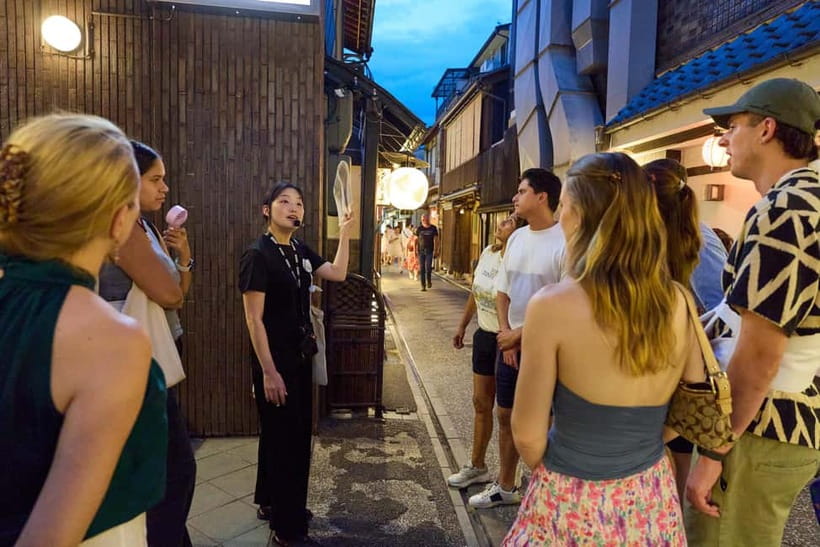
You meet your guide in front of Ben’s Cookies Kyoto Shijo. Look for the guide holding a sign board. This is a practical starting place in central Kyoto, but give yourself enough time to find the shop, particularly if you are arriving by bus or walking from a nearby station.
The guide begins with a short introduction before leading you toward the old entertainment districts. The first explanation matters because geisha culture is often reduced to costumes and makeup. Here, the focus is on training, artistic work, etiquette, performance, and the traditional teahouse system.
Guides vary by departure. Names associated with this experience include Yuki, Nami, Yukari, Deborah, Manuel, Kenji, Michael, Adrian, Shin, Akari, and Melanie. The strongest descriptions of the tour point to guides who adjust their explanations to the group, answer questions without rushing, and use photographs when a visual example helps.
You may join a small group, though the size can vary. Some departures are intimate, while others may include around a dozen people. A smaller group makes it easier to hear explanations in narrow lanes and ask questions, but the tour remains worthwhile if your group is larger.
More ways to walk Gion:
- Kyoto Geisha Walking Tour: Gion District & Hidden Gems
★ 4.7 · 3,273 reviews - Kyoto: Gion Magical Night Walking Tour with Geisha Trivia
★ 4.9 · 2,393 reviews - Best of Kyoto: Gion, Geisha, Pagodas & Cobblestones
★ 4.9 · 2,058 reviews
Pontocho Alley, Kyoto’s narrow evening corridor
Pontocho Alley is one of Kyoto’s best-known traditional dining streets. It is narrow, atmospheric, and lined with Japanese restaurants, teahouses, and elite clubs. Many businesses are private or reservation-based, so this is not a restaurant crawl. The value lies in seeing the street as part of Kyoto’s traditional nightlife.
Your guide explains how the district developed and how the entertainment business works. That context helps you read what you are seeing. A wooden facade may look like a quaint old building, but it can also mark a private establishment where the public cannot simply walk in.
At night, Pontocho has a particular appeal. Lamps and woodwork give the lane a softer look, and the street feels separate from the wider city. It can also be busy, so you should stay close to your guide and avoid blocking doorways. This is a working neighborhood, not a themed attraction.
The route does not promise entry into teahouses or clubs. That is worth knowing before you book. You are walking past and around the districts, learning how they function from the street.
Izumo-no-Okuni and the story behind kabuki
After Pontocho, the group crosses the river and stops at the statue of Izumo-no-Okuni. She is associated with the invention of kabuki, giving the tour a welcome connection between performance traditions and Kyoto’s entertainment culture.
This stop is brief but useful. It widens the story beyond geisha alone and shows how performance, dance, music, and public entertainment have long been tied to Kyoto. The guide uses the statue as a point of reference, helping you understand how traditional arts developed alongside the city’s pleasure districts.
The stop is scheduled for about 15 minutes. That is enough time for an explanation and photographs without turning the tour into a lecture. If your guide has photographs or extra examples, this is also a natural place to ask how kabuki differs from geiko and maiko performance traditions.
Entering Gion and learning the words that matter
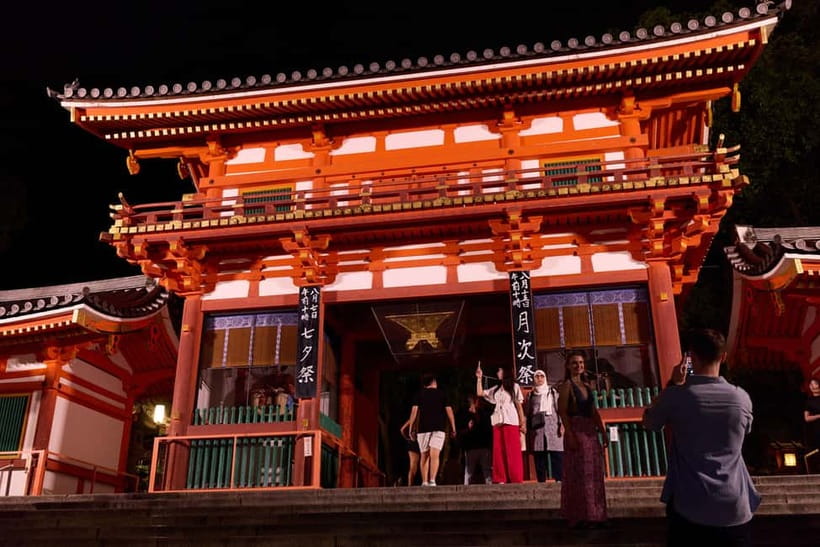
Gion is Kyoto’s most famous geisha district, but the word geisha can create confusion. Your guide explains the terms geiko and maiko used in Kyoto. You also learn about the training that leads a young apprentice toward the professional world of performance and hospitality.
The precise details you receive can depend on your guide. Guides such as Yuki, Nami, Yukari, and Deborah were repeatedly singled out for making the subject clear, lively, and easy to follow. That matters here because the customs can seem mysterious if you only see the clothing and makeup.
The walk through Gion lasts about 30 minutes. Expect narrow streets, traditional wooden buildings, and quiet lanes connecting the better-known points. The guide may point out details you would pass without understanding, including the visual signals of old teahouse architecture and the difference between public streets and private venues.
You should keep your expectations realistic. Gion is a living district, and not every traditional-looking building is open to the public. The tour gives you a respectful introduction from the street rather than access to private geisha entertainment.
More geisha and maiko evenings in Kyoto:
- Night Walk in Gion: Kyoto’s Geisha District
★ 4.5 · 2,003 reviews - Kyoto Gion Geisha District Walking Tour – The Stories of Geisha
★ 5.0 · 1,441 reviews - Kyoto Gion: 2-Hour Geisha Culture & History Walking Tour
★ 5.0 · 1,186 reviews - Kyoto Gion Night Walk & Geisha District Guided Tour
★ 5.0 · 786 reviews
Yasaka Shrine adds a religious side to the route
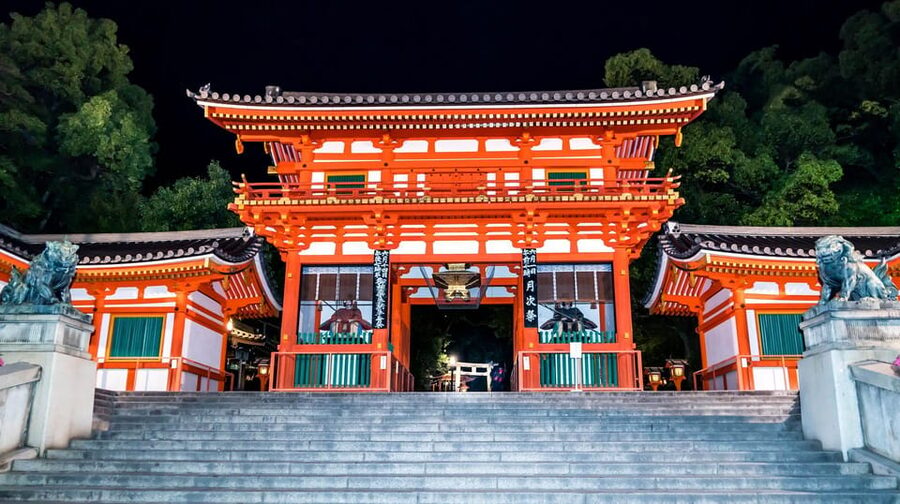
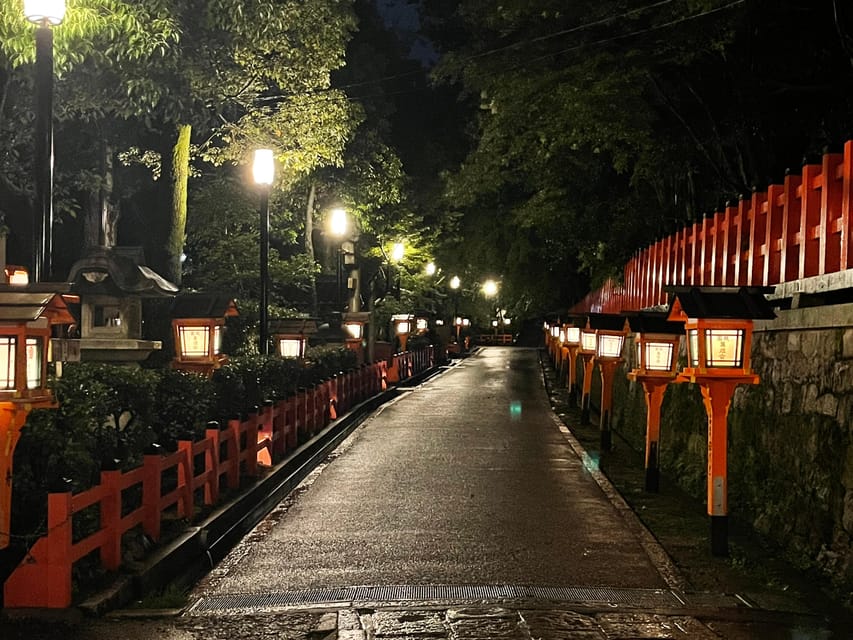
The tour spends about 25 minutes at Yasaka Shrine, one of the route’s longer stops. This gives the experience some balance. You are not only looking at nightlife and teahouses, but also considering the religious and civic setting that surrounds Gion.
Your guide leads you through the important points and explains why the shrine matters to the area. The setting also offers a change of pace after the tight lanes. You have more room to look around, listen, and take photographs.
Evening light can affect what you see. In autumn, it gets dark early, and some architectural details may be easier to appreciate during daylight. On the other hand, the evening timing is what gives the entertainment districts their working atmosphere. I would choose this tour for the nighttime mood, while visiting major temples and shrines separately in daylight if detailed architecture is your priority.
Gion Corner and the practical meaning of traditional arts
Gion Corner is included as a short, roughly 10-minute visit. The stop helps connect the district’s buildings and street life with the performing arts that still shape its identity.
Your guide may use this point to explain how traditional skills are presented and preserved. The tour is not a full performance, and you should not book it expecting a show. Instead, Gion Corner works as a reference point within a broader walk.
This is also where you can ask practical questions. How long does training take? What is the difference between an apprentice and a professional? What does a geiko do during an evening appointment? The guide’s answers are a major part of the value, since the street itself cannot explain these things.
Hanamikoji Street and the chance to see geiko or maiko
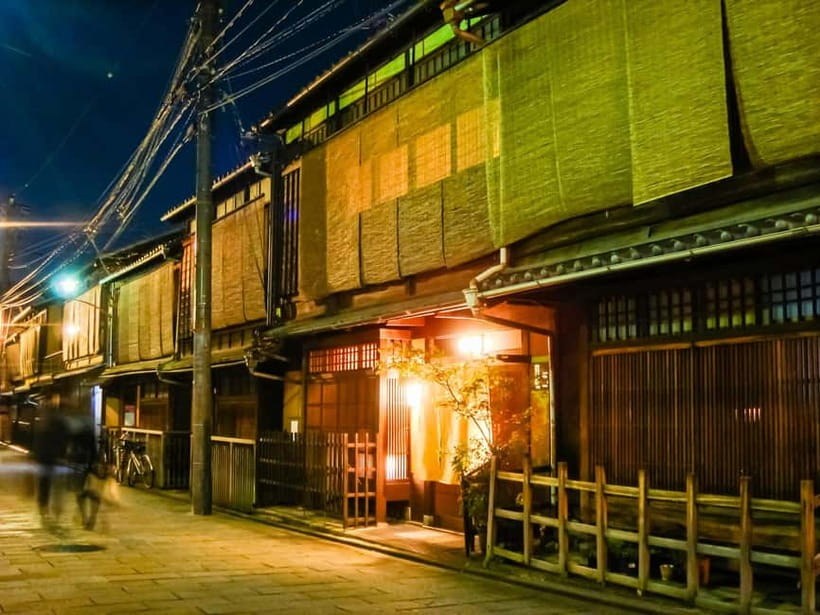
The final major stop is Hanamikoji Street, visited for about 15 minutes. It is one of Gion’s best-known traditional streets, with old wooden facades and a strong connection to the district’s teahouse culture.
This is the part of the walk where you may see a geiko or maiko heading to an appointment. Several departures have included sightings, including one where the group saw a maiko and another where the group saw geiko. But timing, weather, season, and work schedules all matter. You should regard a sighting as a bonus, not the product being guaranteed.
If you do see one, follow your guide’s instructions. Do not crowd the person, block the lane, touch clothing, or treat a working professional as a costumed attraction. The best encounter may last only a few seconds. The guide’s role is to help you understand what you are seeing while keeping the moment respectful.
Hanamikoji can also be busy. Keep your voice down, stay to the side, and listen for instructions. Photography is part of the experience, but it should not come before basic courtesy.
What the guide adds to the two-hour route
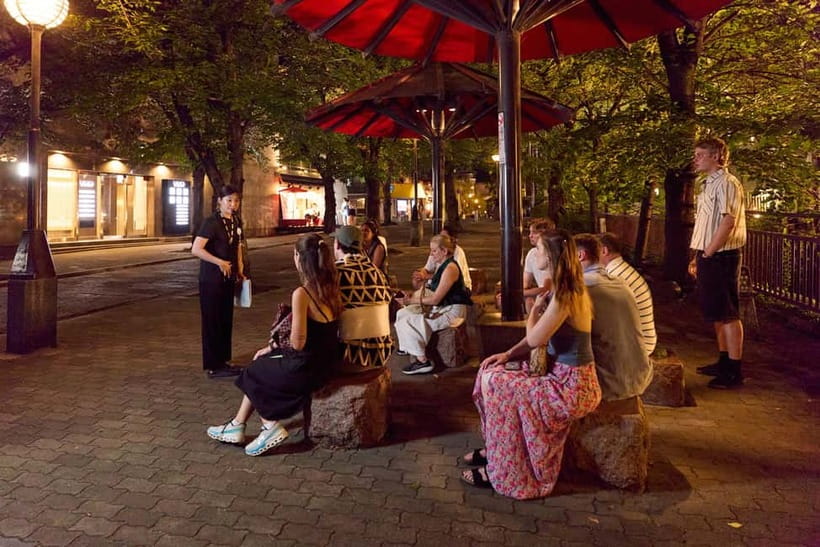
The streets themselves are attractive, but a self-guided walk would leave many questions unanswered. A local guide gives you the background needed to distinguish a maiko from a geiko, understand the purpose of training, and see why Kyoto protects these traditions.
The best guides described for this experience bring different strengths. Yuki is noted for local pride and warmth. Nami is praised for checking that everyone is keeping up and has a chance to ask questions. Deborah is known for using photographs and explaining the subject with energy. Yukari is described as casual and easy to talk with, while Kenji is associated with a well-paced walk and clear historical detail.
That variety is useful because the tour does not depend on one scripted performance. A guide who can adjust the amount of background to suit the group makes the two hours work for both newcomers and people who have already read about geisha culture.
The language options are English and Spanish. Confirm your preferred language when choosing a departure, since the available guide may vary.
Pace, weather, and what to bring
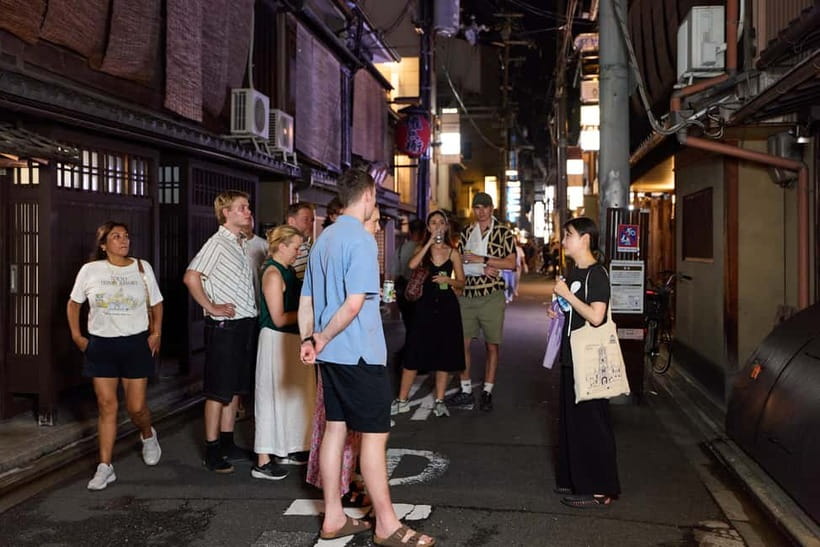
The walk is described as easy, with time for explanations, questions, and photographs. You should still wear comfortable shoes because the route moves through streets and alleyways for two hours. Bring water, as that is the only item specifically listed.
Rain does not automatically ruin the experience. Guides can find sheltered places to stop, though wet streets and umbrellas may make the group harder to keep together. In cooler months, dress for an evening walk. In warm weather, the narrow lanes may feel crowded and close.
The ending point is Hanamikoji Street rather than the original meeting point. That means you should not assume you will finish back at Ben’s Cookies Kyoto Shijo. One useful approach is to treat the final stop as the start of your own evening in Gion, since you can continue exploring or find dinner nearby.
Is $20 good value for Kyoto?
At $20 per person, this is a good-value introduction to Gion and Pontocho. You get two hours, a live local guide, several historic stops, and cultural background that would take time to assemble on your own.
The price does not include a meal, a performance, admission to a private teahouse, or a guaranteed geiko or maiko meeting. If you want an intimate entertainment experience with food and performers, you need a different type of booking.
For a first evening in Kyoto, the value is stronger. The guide gives you a working vocabulary and helps you understand the streets before you return on your own. You also have the option to reserve now and pay later, with free cancellation up to 24 hours before the tour. That is useful when weather and Kyoto schedules are still changing.
The overall rating is 4.7 from 2,187 reviews, and the repeated strengths are clear: guide quality, clear explanations, friendly pacing, and strong local context. The less predictable element is the chance of seeing geisha, which depends on the evening.
Who should book this walk?
I would recommend it to first-time Kyoto visitors, adults interested in Japanese arts, and anyone who wants a manageable introduction to Gion without committing to an expensive dinner or private cultural event.
It also suits people with limited time. Two hours is long enough to cover the main story but short enough to fit before dinner or another evening plan. If you are traveling with older children, check the age rule carefully, since the activity is not suitable for children under 10.
You may want to skip it if you dislike walking in crowded lanes, need guaranteed access inside historic buildings, or expect a performance rather than an outdoor history walk. You should also choose a daytime temple visit instead if your main goal is close architectural study.
Should you book the Gion Geisha District Walking Tour?
Book it if you want an affordable, respectful introduction to Kyoto’s geiko and maiko traditions, with a chance to see the districts at work after dark. The strongest part is not the possibility of a sighting. It is the way a good guide turns streets, signs, clothing, and old wooden facades into a story you can understand.
Go with realistic expectations: you will walk outside, not enter private teahouses; you may see geiko or maiko, but there is no guarantee; and some details are harder to view after sunset. For $20, though, the balance is favorable. You get a well-paced orientation to Gion and Pontocho, plus the knowledge to explore Kyoto more thoughtfully afterward.
FAQ
Where does the tour meet?
Meet your guide in front of the Ben’s Cookies Kyoto Shijo shop. The guide will be holding a sign board.
How long does the walking tour last?
The tour lasts two hours.
Which areas does the tour visit?
The route includes Pontocho Alley, the statue of Izumo-no-Okuni, Gion, Yasaka Shrine, Gion Corner, and Hanamikoji Street.
Can I see a geisha or maiko?
You may encounter a geiko or maiko traveling to an appointment, but sightings are not guaranteed.
What languages are available?
The tour is offered with a live guide in English or Spanish.
How much does the tour cost?
The listed price is $20 per person.
Is the tour suitable for children?
The activity is not suitable for children under 10.
What should I bring?
Bring water. Comfortable shoes are also a sensible choice for a two-hour walk.
Can I cancel the booking?
You can cancel up to 24 hours in advance for a full refund. The reserve-now, pay-later option is also available.
More Walking Tours in Kyoto
- Nishiki Market Brunch Walking Tour (7 Tastings + Brunch)
★ 5.0 · 1,355 reviews - Kyoto Arashiyama Walking Tour: Bamboo, Monkeys, Gardens & Secrets
★ 5.0 · 1,216 reviews - Kyoto: Izakaya Bars Guided Walking Tour
★ 4.9 · 815 reviews - Kyoto Sake Brewery & Tasting Walking Tour
★ 5.0 · 623 reviews
Newest Kyoto experiences on the site
- Treasures of Kyoto: Gion & historical Walking Tour★ 5.0 · 6 reviews
- Whisk Your Own Matcha: A Zen Matcha Experience at Temple★ 3.6 · 7 reviews
- Kyoto tea town for matcha lovers★ 5.0 · 16 reviews
- Uji: Private immersion into Kyoto’s tea and reglious culture★ 5.0 · 17 reviews
- Kyoto Matcha Green Tea Tour★ 4.5 · 23 reviews
- Uji and Wazuka Matcha Farm Half Day Private Guided Tour★ 5.0 · 21 reviews
- Utilising upcycled Matcha! Creating matcha incense (Uji, Kyoto)★ 5.0 · 6 reviews
- Sacred Temple Yoga Experience in Japan★ 5.0 · 3 reviews
Gion District Tours, compared.
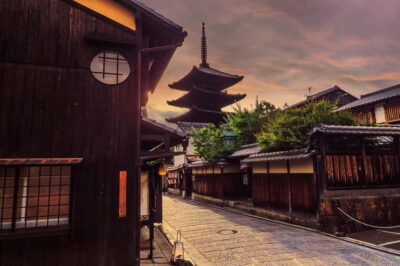
Kyoto Geisha Walking Tour: Gion District & Hidden Gems
Read our review →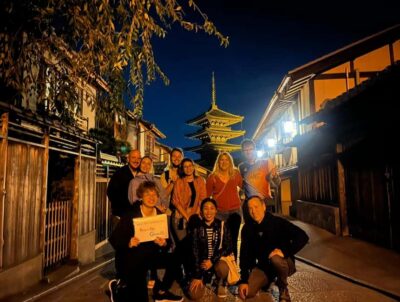
Gion Magical Night Walking Tour with Geisha Trivia
Read our review →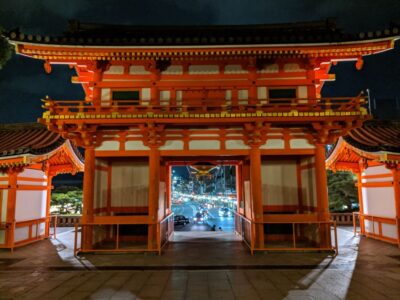
Best of Kyoto: Gion, Geisha, Pagodas & Cobblestones
Read our review →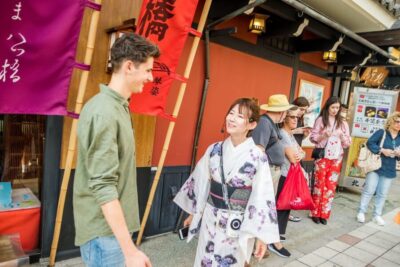

Kyoto Night Foodie Tour in Gion (9+ dishes + 6 Sake tastings)
Read our review →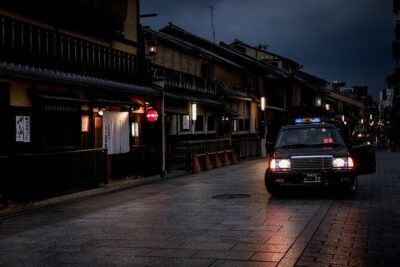
Kyoto Gion Geisha District Walking Tour – The Stories of Geisha
Read our review →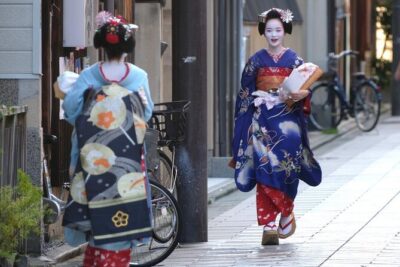
Kyoto Gion: 2-Hour Geisha Culture & History Walking Tour
Read our review →
Chopsticks Making Workshop in Gion with Engraving Option
Read our review →Browse the lists this tour appears in