Reviewed · TOURS
Explore Hidden Alleyway with a Local Expert (Afternoon Tour)
Kyoto reveals itself best in the spaces between its famous sights. This three-hour afternoon bike tour carries you through narrow lanes, old wooden houses, geisha districts, riverside paths, and the broad grounds of the Imperial Palace. You leave the main tourist routes, then pop back onto a busy street with a better sense of how the city fits together.
I like the small private-group format, which keeps the ride more personal and practical, and I like the mix of quiet neighborhoods with major Kyoto sights. The guide training also covers traffic safety, group cycling, and local etiquette. The main drawback is that you need to ride safely on public roads, and the tour is limited to children at least 10 years old and 145 centimeters tall.
Key points to know before booking
- Three hours from a central Kyoto meeting point: The tour begins at 2:00 p.m. and returns to the same place.
- Quiet lanes are the main attraction: You ride through old residential streets instead of seeing Kyoto only from its major avenues.
- Five carefully chosen stops: The route includes Miyagawacho, Gion, Tatsumi Bridge, the Kyoto Imperial Palace, and Kashiwayacho by the Kamo River.
- Small groups keep the ride manageable: One guide takes two to six people, with an extra guide available for groups of seven to twelve.
- Rain does not automatically cancel the ride: You can continue by bike with a free poncho or switch to a walking route using public transportation.
- E-bikes may be available: One recent booking praised the electric bikes, especially for covering more ground with a family.
Why a bike is a smart way to see Kyoto
Kyoto’s most appealing streets are often too narrow for a sightseeing bus and too spread out for a relaxed walking tour. A bicycle lets you cover several districts without spending the afternoon waiting for taxis or changing trains. You also see the transitions: a quiet lane becomes a traditional neighborhood, then a commercial street, then an open riverside path.
That change in mood is central to the tour. The route is not simply a checklist of famous places. You move between areas where people live, work, worship, shop, and commute. The smaller streets give you a feel for Kyoto’s scale and layout that is easy to miss when you travel only between major temples.
The afternoon start at 2:00 p.m. works well if you want a slower morning. You could visit a temple or market before the ride, then spend the afternoon outdoors. The timing also means you should plan for changing light and possible heat, particularly in warmer months. The tour lasts about three hours, so it takes a useful middle position between a short orientation ride and a full-day cycling commitment.
The group size matters. With two to six people per guide, the ride should be easier to keep together than a large city cycling tour. An extra guide can be arranged for seven to twelve people, but a solo booking is not accepted. This tour is built for a couple, family, or small group rather than an individual traveler looking to join strangers.
A few more Kyoto tours worth putting on the shortlist
- PERFECT KYOTO 1-Day Bus Tour
★ 5.0 · 13,518 reviews - Kyoto: Fushimi Inari, Kinkakuji, Bamboo Grove 1 Day Bus Tour
★ 4.8 · 4,316 reviews - Kyoto: Tea Ceremony in a Traditional Tea House in Kiyomizu
★ 4.9 · 3,519 reviews
Miyagawacho and Kyoto’s wooden townhouses
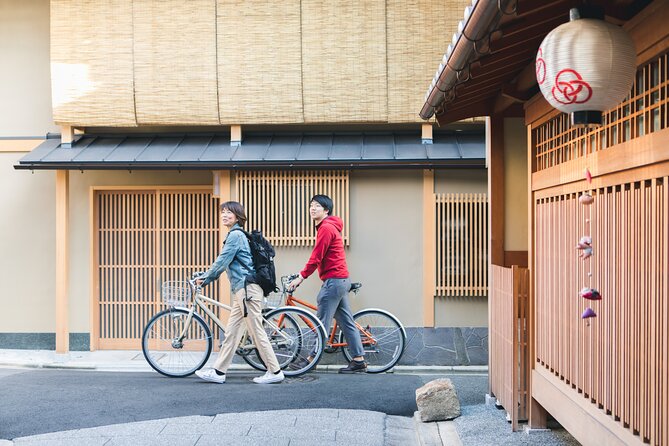
The first stop is Miyagawacho Kaburenjo, in one of Kyoto’s five traditional geisha districts. Miyagawacho is the second largest of those districts, and its narrow lane is lined with traditional wooden houses.
This is a good opening stop because it shows Kyoto at a human scale. The wooden facades and quiet street create a calm first impression, especially after the ride from the meeting point. You get about 15 minutes here, enough for a short explanation and a look at the setting without turning the stop into a long formal visit.
Keep your expectations sensible. This is not presented as a performance or a guaranteed chance to see a maiko or geiko. The value is the street itself, along with the chance to understand how a historic entertainment district still looks from the outside.
You should also remember that these are real neighborhoods, not an open-air stage. Keep your voice down, avoid blocking narrow lanes, and follow the guide’s advice about photographs and local manners. The tour’s emphasis on etiquette is useful here, since the atmosphere depends on quiet respect.
Gion, where postcard Kyoto becomes a real neighborhood
The ride continues to Gion, Kyoto’s best-known geisha district. Gion developed around tea houses and entertainment, and its refined old-town character remains one of the city’s defining sights.
A 15-minute stop gives you time to take in the streets without losing the rhythm of the ride. Gion can be crowded, so arriving by bicycle through smaller lanes helps you see more than the usual postcard view. The guide can also place the district in context, connecting its buildings and traditions with the wider city.
Gion is one of the places where good manners matter most. Do not chase or photograph people without permission, and do not assume every person in traditional clothing is available for a picture. The tour is at its best when it treats Gion as a living neighborhood rather than a backdrop.
The short stop is both a strength and a limitation. It keeps the itinerary moving, but it does not leave time for a long cultural talk or a tea house visit. If Gion is your main reason for coming to Kyoto, you may want to return on foot later and give it more time.
Tatsumi Bridge and the willow-lined stream
Tatsumi Bridge offers a different view of Kyoto. The route follows a narrow stream, with willows moving in the breeze and a quieter feel than the main Gion streets.
The stop lasts about 15 minutes. It is less about a major monument and more about atmosphere, which is exactly why it earns a place on a bike route. The path gives you a pause after the tighter streets of Gion, and the water and trees create a pleasant change in pace.
This is a good example of what the tour adds beyond a standard sightseeing list. A bus can take you to Gion, but it cannot easily connect Gion with a small streamside path and a traditional bridge. You get a sense of how Kyoto’s beauty often comes from modest details rather than grand buildings.
The tradeoff is that the stop may feel brief if you want to linger, sketch, or take many photos. The tour keeps to a schedule so it can reach the Imperial Palace and Kamo River later in the afternoon.
Same city, a completely different kind of day:
- Kyoto Geisha Walking Tour: Gion District & Hidden Gems
★ 4.7 · 3,273 reviews - Kyoto: Tea Ceremony Ju-An at Jotokuji Temple
★ 4.9 · 3,207 reviews - Kyoto: Gion Magical Night Walking Tour with Geisha Trivia
★ 4.9 · 2,393 reviews - Kyoto: 45-Minute Tea Ceremony Lesson Experience
★ 4.3 · 2,378 reviews
Cycling through the Kyoto Imperial Palace grounds
The Kyoto Imperial Palace was once the residence of Japan’s Imperial Family. Today, the surrounding garden is open to the public, with seasonal flowers and broad gravel paths.
You spend about 20 minutes cycling through the grounds. After the narrow lanes of Miyagawacho and Gion, the open space provides a welcome reset. It also demonstrates the range of Kyoto’s city center, from compact wooden streets to expansive public grounds.
The route follows gravel paths, so you should be comfortable handling a bicycle on a surface that may feel different from smooth pavement. The guide’s traffic and group-cycling training is particularly helpful as the group changes from tight urban lanes to a more open setting.
Do not expect a full palace tour. The scheduled stop is a cycle through the grounds, not an extended indoor visit or a long architectural lecture. If you want to study the palace buildings and gardens in detail, set aside separate time. Here, the goal is to experience the grounds as part of a larger ride.
Season matters. The garden changes with the flowers and weather, but the tour does not promise a particular bloom. You are paying for the route and the guide’s context, not a guaranteed seasonal display.
A local pause by the Kamo River at Kashiwayacho
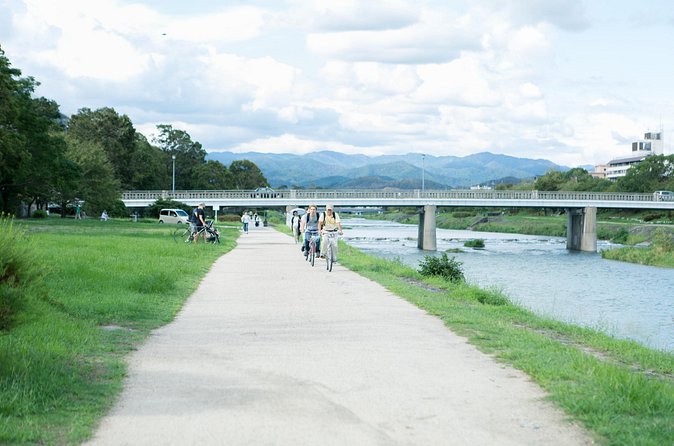
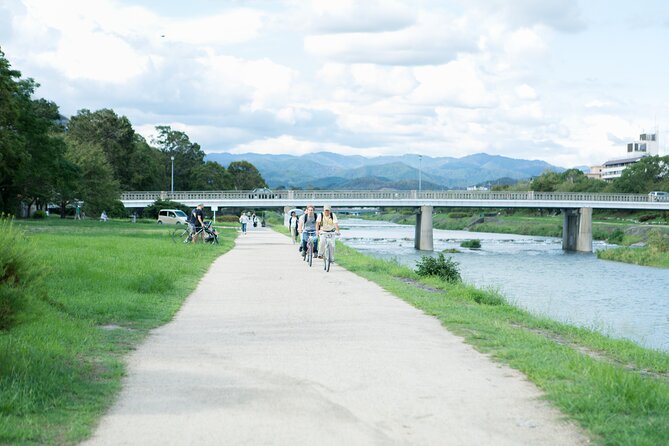
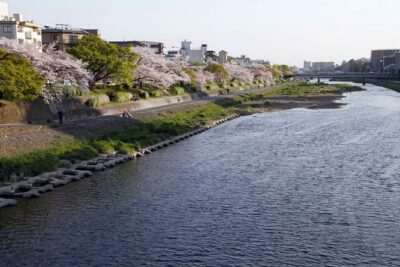
The final stop is Kashiwayacho, where you can relax beside the Kamo River, a favorite place for local residents. The stop lasts about 20 minutes and is included in the tour price.
This is a sensible finish. After several urban districts and a stretch through the Imperial Palace grounds, the river gives you room to slow down. You can watch the city from a less formal angle and consider how much of Kyoto’s daily life is organized around its waterways and public spaces.
The river stop is also a practical rest point before cycling back to the meeting location. The tour ends where it begins, so you do not need to arrange a separate ride from another part of Kyoto. That makes the experience easier to fit into a day of sightseeing.
The route does not appear to include a meal or a dedicated snack break. Bring water and plan to eat before or after the ride. The 20-minute river stop is for relaxing, not a replacement for lunch.
Guides, e-bikes, and the ride itself
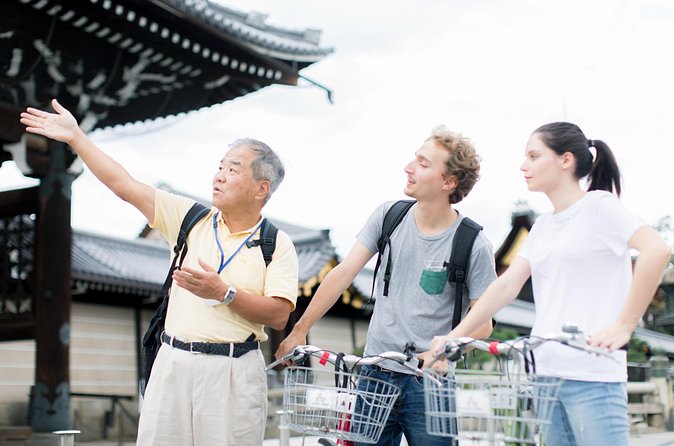
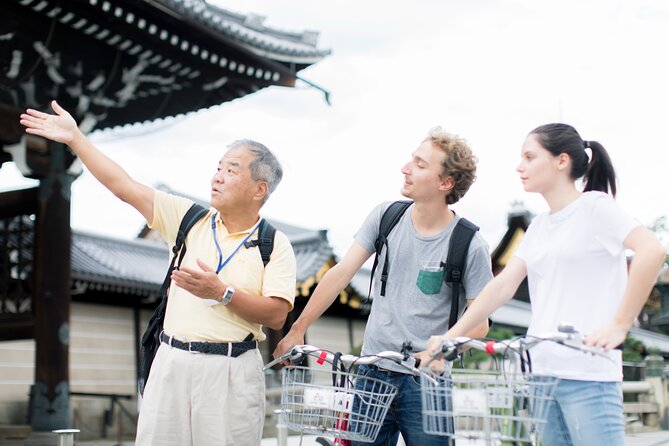
The company trains its guides in Kyoto culture, traffic safety, group riding, and local etiquette. That combination matters more than a long list of facts. A guide who can keep a group together and handle city traffic makes the ride calmer, especially for families or anyone who has not cycled in Kyoto before.
Yuichi received especially strong praise for being personable, informative, and funny. You may not be assigned Yuichi, but his performance gives you a useful picture of the guide style to hope for: practical commentary, a friendly manner, and enough humor to keep a three-hour ride lively.
One booking specifically praised the e-bikes. Electric assistance can make a major difference when you want to see several districts in one afternoon without arriving tired. The supplied details do not specify the exact bike model or how much motor assistance is available, so ask the operator if the bike type matters to you.
You must still be able to ride safely on the road without help. Children need to be at least 10 years old, at least 145 centimeters tall, and able to cycle independently in traffic. The tour is not suitable for someone who is only comfortable riding on a quiet park path.
Rain does not automatically end the outing. You can ride with a free rain poncho, or choose a walking tour using buses or the metro, with public transportation included in the tour fee. That flexibility is valuable in Kyoto, where a forecast can change your plans quickly. The walking option will change the feel of the experience, but it prevents a wet day from ruining the booking.
Is $102.47 a fair price?
At $102.47 per person, this is not a cheap way to get from one sight to another. The value comes from combining a trained guide, bicycles, a private small-group setting, route planning, cultural explanation, and several parts of Kyoto that are awkward to link on your own.
For a family or couple with only a short time in the city, the price can make sense. You cover Miyagawacho, Gion, Tatsumi Bridge, the Imperial Palace, and the Kamo River in three hours, while also getting help with city riding and local manners. An electric bike may add comfort for people who want range without a hard physical workout.
The value is weaker if you already know Kyoto well, have your own bicycles, or prefer to spend long periods inside individual sights. This is a guided overview with character, not a deep visit to the Imperial Palace or Gion. You are paying for access to a well-planned route and a local perspective.
The booking pattern suggests people often reserve around 13 days ahead. I would not leave it to the last minute if your Kyoto dates are fixed, particularly because each guide takes only two to six people.
One important caution: the supplied booking terms conflict. One section says cancellation at least three days before the tour, by 6:00 p.m. Japan time, can qualify for a refund, while another says the experience is non-refundable and cannot be changed. Check the final cancellation terms before paying, and do not assume a change is allowed.
Who should book this Kyoto bike tour?
I would choose this tour if you want to see more than the famous temple gates, have three hours available, and enjoy learning how Kyoto’s districts connect. It suits couples, families with older children, and small private groups that want their own guide rather than a large public departure.
It is also a strong choice if you are short on time. One booking found it useful for seeing several parts of the city when the schedule was tight. The bike gives you more reach than walking, while the small group keeps the outing from feeling like a convoy.
I would hesitate if you dislike cycling near traffic, need a fully accessible sightseeing format, or want long visits at each stop. The route uses public roads and gravel paths, and the itinerary moves steadily. A walking tour may be better if your main goal is detailed time in Gion or the Imperial Palace.
Should you book it?
Book it if you want a practical, personable introduction to Kyoto that combines quiet lanes with major sights. The best parts are the route variety, the small group size, the chance to ride through places a bus cannot reach, and the option to switch to public transportation in rain.
Before booking, confirm the bike type, the cancellation rules, and the final group arrangements. If you can ride confidently and value local context more than extended time at one attraction, this is a well-balanced afternoon tour. If you want a slow temple visit or a formal palace tour, use the same afternoon for a walking itinerary instead.
FAQ
How long does the Kyoto bike tour last?
The tour lasts approximately three hours.
What time does the tour begin?
The tour begins at 2:00 p.m.
Where does the tour start and finish?
It starts at 552-13 Higashiaburanokōjichō, Shimogyo Ward, Kyoto, 600-8235, Japan, and ends back at the same meeting point.
Which places are included on the route?
The route includes Miyagawacho Kaburenjo, Gion, Tatsumi Bridge, the Kyoto Imperial Palace, and Kashiwayacho by the Kamo River.
How many people can join one guide?
A guide can take a minimum of two and a maximum of six people. For groups of seven to twelve, an additional guide can be arranged.
Can one person book the tour?
No. Single-person participation is not accepted.
Can children join the bike tour?
Children must be at least 10 years old, at least 145 centimeters tall, and able to ride a bicycle safely on the road without assistance.
What happens if it rains?
You can continue by bicycle with a free rain poncho, or switch to a walking tour using buses or the metro. Public transportation is included in the tour fee.
Is the tour private?
Yes. Only your group participates in the activity.
Newest Kyoto experiences on the site
- Treasures of Kyoto: Gion & historical Walking Tour★ 5.0 · 6 reviews
- Whisk Your Own Matcha: A Zen Matcha Experience at Temple★ 3.6 · 7 reviews
- Kyoto tea town for matcha lovers★ 5.0 · 16 reviews
- Uji: Private immersion into Kyoto’s tea and reglious culture★ 5.0 · 17 reviews
- Kyoto Matcha Green Tea Tour★ 4.5 · 23 reviews
- Uji and Wazuka Matcha Farm Half Day Private Guided Tour★ 5.0 · 21 reviews
- Utilising upcycled Matcha! Creating matcha incense (Uji, Kyoto)★ 5.0 · 6 reviews
- Sacred Temple Yoga Experience in Japan★ 5.0 · 3 reviews
Tours, compared.
Fushimi Inari, Kinkakuji, Bamboo Grove 1 Day Bus Tour
Read our review →
Kyoto Geisha Walking Tour: Gion District & Hidden Gems
Read our review →
Gion Magical Night Walking Tour with Geisha Trivia
Read our review →
Gion Geisha District Walking Tour – Stories of Geisha
Read our review →
Kyoto Night Foodie Tour in Gion (9+ dishes + 6 Sake tastings)
Read our review →