
Reviewed · KYOTO BUS TOURS
PERFECT KYOTO 1-Day Bus Tour
Kyoto’s biggest challenge is not finding beautiful places. It is fitting them together. This 8 to 9-hour bus tour links Kiyomizu-dera, Sanjusangendo, Arashiyama, Kinkaku-ji, and Fushimi Inari without asking you to decode several train lines and bus routes.
I like the wide range of sights and the included admissions, which make the $129.25 price easier to justify. I also like the guide-led format. Guides such as Sakura, Mai, At-Chan, Hiroko, and Nagomi have been praised for clear explanations, humor, and keeping the day moving. The tradeoff is simple: this is a busy sampling tour, not a slow Kyoto stroll. Crowds, stairs, and short visits can wear you down.
Key points at a glance
- Six major Kyoto stops plus a view of Nijo Castle: You cover the city’s famous temples, shrines, bamboo forest, and Golden Pavilion in one sweep.
- A smart choice for a short stay: The route handles Kyoto’s spread-out sights by air-conditioned coach, with WiFi and a restroom-equipped bus reported on some departures.
- Short visits keep the schedule moving: Plan on roughly 20 to 60 minutes at each main stop, enough for highlights but rarely enough for a full exploration.
- The optional buffet lunch saves planning time: It features Japanese-style local foods, though the quality and temperature may not suit everyone.
- Expect real walking: Hills, stairs, temple floors without shoes, and long stretches on foot make moderate fitness necessary.
- The group can reach 42 people: A strong guide matters, especially when meeting back at the bus in crowded Arashiyama and Fushimi Inari.
Why this one-day Kyoto route works
Kyoto is spread across several districts. Kiyomizu-dera sits in the eastern hills, Arashiyama lies to the west, Kinkaku-ji is farther north, and Fushimi Inari is southeast of the center. Seeing all of them independently in one day means careful timing, transfers, and a willingness to keep checking maps.
This tour solves that problem with a fixed route and reserved admissions at four temples. You meet at 7:50 a.m. at Tully’s Coffee inside Kyoto Avanti, close to Kyoto Station, then return to the same meeting point at the end of the day. There is no hotel pickup, so you need to reach the start on your own and arrive early.
The bus gives you a place to sit between stops, along with air conditioning, WiFi, and multilingual audio guidance in English, Spanish, French, Italian, German, Portuguese, and Ukrainian. An English-speaking guide travels with the group and adds live explanations. That combination is useful if you want more than a photo stop but do not want a full day of complicated public transportation.
The tour can hold up to 42 people. That is not a small private outing, and you should expect a group pace. Still, the coach format keeps the route practical, and strong guides can make a large group feel organized. Sakura has been praised for clear English and a good mix of facts and humor. Mai is noted for an upbeat manner, while At-Chan and Nagomi have been praised for energy and keeping the bus engaged.
More bus tours from Kyoto:
- Kyoto: Fushimi Inari, Kinkakuji, Bamboo Grove 1 Day Bus Tour
★ 4.8 · 4,316 reviews - Kyoto: Hop-on Hop-off Sightseeing Bus Ticket
★ 3.9 · 2,034 reviews - Kyoto/Osaka: Nara, Fushimi Inari Taisha, Arashiyama Bus Tour
★ 4.7 · 1,275 reviews
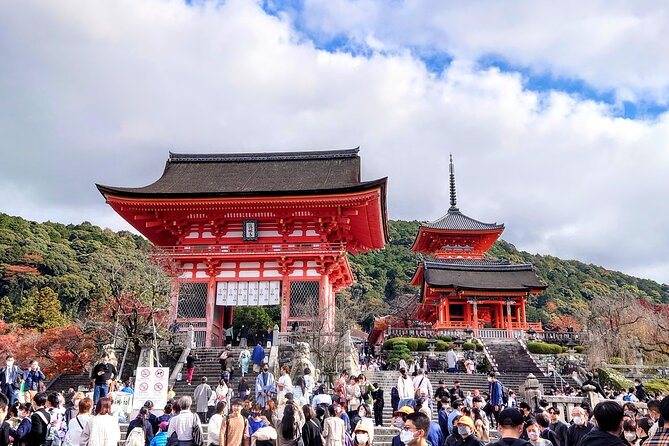
Kiyomizu-dera starts the day with Kyoto views
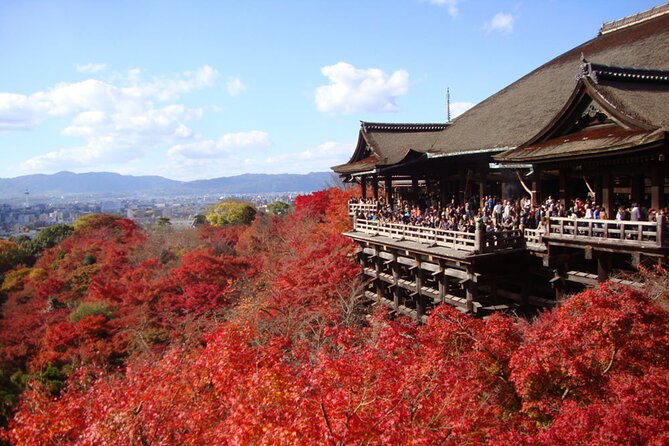
Kiyomizu-dera is a good first stop because it gives you both a major temple and a broad view over Kyoto. Built on the Higashiyama hillside, the complex has traditional buildings, wooded slopes, and a famous wooden stage that looks out across the city.
You get about one hour here, including admission. That sounds generous until you account for walking, group movement, photos, and the slope. Wear shoes with a good grip. The approach includes hills and stairs, and the first stop may be the most demanding part of the day physically.
The morning timing can help. Early visits are often easier to manage than the afternoon stops, though Kyoto’s popular sites can still be crowded. Your guide will explain the temple and help point out the main areas, but do not expect time to inspect every corner of the grounds.
Kiyomizu-dera is one of the places you may want to revisit independently if you have another day in Kyoto. On this tour, you get the essential view and the broad impression. You do not get a leisurely morning in the Higashiyama streets.
Sanjusangendo offers a quieter interior stop
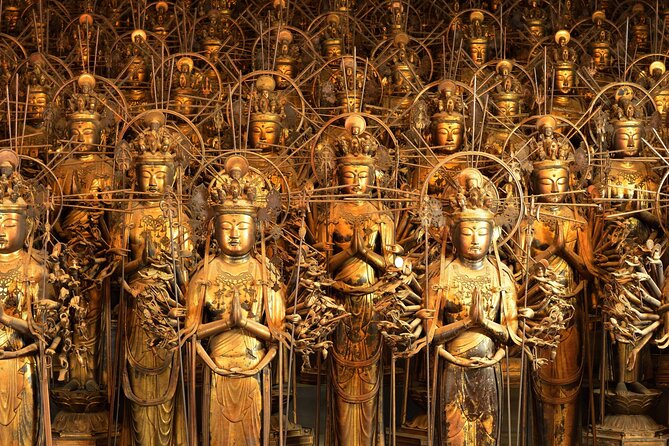
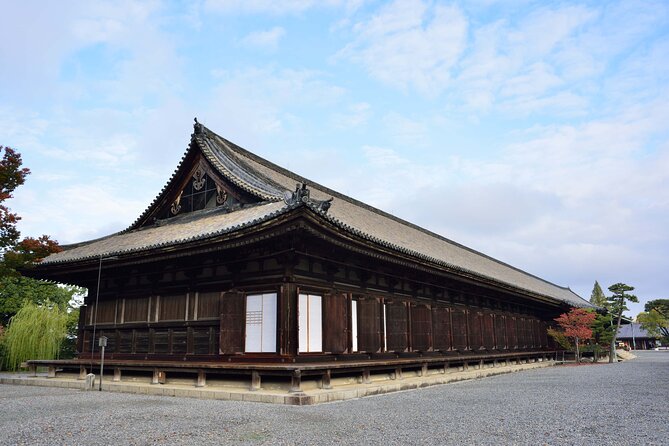
The 40-minute visit to Sanjusangendo shifts the mood. Its main hall is known for rows of statues of Senju Kannon, the thousand-armed form of Kannon. The interior is the main event, so this stop gives you a concentrated cultural experience rather than a long walk through outdoor grounds.
Admission is included. You will remove your shoes in temple areas, and temple floors can feel cold, especially in cooler weather. Wear socks you are comfortable being seen in, and keep your footwear easy to remove.
The short visit works reasonably well here because the hall itself is so focused. Listen carefully to the guide’s explanation, then take in the scale and repeated forms of the statues. Photography rules and indoor conditions can limit how much you record, so this is a place to pay attention rather than rush through with your phone raised.
Arashiyama combines lunch with Kyoto’s most famous bamboo

Arashiyama is the tour’s main western Kyoto stop and one of its busiest. You get a lunch break, then a walk through the Bamboo Forest Trail toward Tenryu-ji.
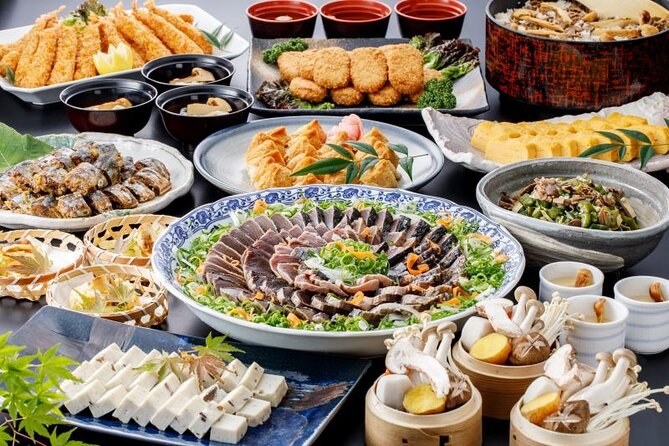
If you select the lunch option in advance, the meal is a Japanese-style buffet with local foods and seasonal dishes. The same buffet is intended to work for vegetarians, but it is not presented as a separate vegetarian menu. If you have strict dietary needs, check carefully before booking.
The lunch option adds convenience, not necessarily a culinary highlight. One meal has been criticized for being cold because the buffet food was not kept on warmers. You can also skip the meal and eat independently in Arashiyama, though you must track the meeting time closely. Adding lunch on the day costs more, listed as 3,000 yen, so decide before departure.
The bamboo walk lasts about 20 minutes. That is enough to enter the famous grove and take photos, but not enough to wander far from the route. Arashiyama can be packed, and the combination of crowds, narrow paths, and a fixed departure time means you need to stay alert.
Do not expect the quiet, empty bamboo path often seen in photographs. The tour gives you access to the signature scene, not a private forest walk. If this is your main reason for visiting Kyoto, return independently at another time and give Arashiyama several hours.
A few more Kyoto tours worth putting on the shortlist
- 10 Must-see Spots in Kyoto One Day Private Tour (up to 7 people)
★ 5.0 · 1,108 reviews - Kyoto 1 Day Tour from Kyoto
★ 4.0 · 582 reviews - Kyoto and Nara Day Trip from Kyoto
★ 4.5 · 445 reviews - Kyoto Customized Private Tour: See Top Attractions in 1 Day
★ 5.0 · 342 reviews
Tenryu-ji adds gardens and breathing room
Tenryu-ji follows the bamboo path and provides a more spacious temple setting. Its garden is the key feature, with ponds, carefully arranged rocks, trees, and seasonal plants. The design has remained largely unchanged for more than 700 years.
You have about 30 minutes and included admission. That makes this a pleasant but brief introduction. The garden rewards patience, yet the schedule encourages you to keep moving. If you enjoy Japanese garden design, note what catches your eye and consider coming back for a longer visit.
This stop also shows why the tour works best as an introduction. You see the bamboo, the temple, and the garden in one visit, then decide which deserves more of your own time. The group will not wait while you explore every side path.
Kinkaku-ji delivers the day’s big visual moment
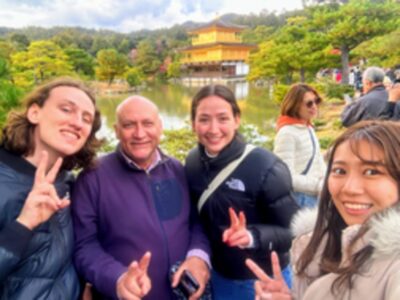
Kinkaku-ji, the Golden Pavilion, is one of Kyoto’s most recognizable sights. The upper stories are covered in gold leaf, and the pavilion reflects in the pond when conditions are right. It is a quick, powerful image, even for someone who has seen it in photographs.
The visit lasts about 40 minutes, with admission included. A path leads you around the pond and through the grounds, giving you several angles on the pavilion. The route is straightforward, but crowds can make the viewing area feel tight.
This is another stop where expectations matter. You are not entering the pavilion for an extended interior visit. The attraction is the exterior, the pond, and the setting. Your guide adds context, but much of your time will be spent moving with the flow of people and finding a clear place for photographs.
Kinkaku-ji and Tenryu-ji were built in the same broad historical era, yet they offer very different impressions. Kinkaku-ji is polished and instantly recognizable. Tenryu-ji is more about garden composition and quiet observation. Seeing both in one day gives you a useful contrast.
Nijo Castle appears from the bus window
On the return route, the coach passes Nijo Castle. The tour does not include a dedicated visit, so you should treat this as a narrated glimpse rather than another attraction.
Nijo Castle matters because it is tied to the Tokugawa shogunate and the return of political power to the emperor. The guide may point out its role and location as you pass. If you want to enter, save it for another day. It cannot be added casually to this tightly timed route.
This small detail is useful because it gives the day some wider historical context. The tour focuses heavily on religious and cultural sites, while Nijo Castle offers a reminder that Kyoto was also a center of political power.
Fushimi Inari ends with thousands of red gates

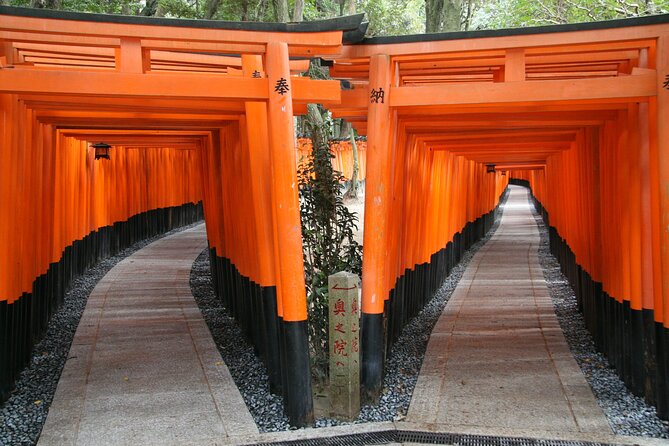
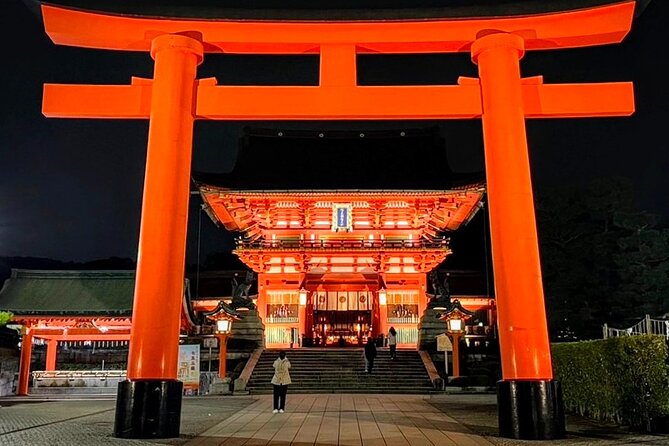
Fushimi Inari-taisha is the final major stop, with about one hour and no admission charge. Its path of orange-red torii gates climbs into the wooded hillside behind the shrine. The gates were donated over time, and the lower section is the part most people come to see.
One hour lets you pass through the first section and experience the rhythm of the gates. It does not give you enough time to climb the entire mountain. The path becomes quieter and more strenuous as it rises, so use your time sensibly and turn back before you risk missing the bus.
Fushimi Inari is often the most crowded stop, especially around the lower gates. It is easy to become distracted by photos and lose sight of the group. Listen closely to the guide’s meeting instructions and allow plenty of time to return.
Ending here has a certain logic. The shrine offers a memorable final image, but it can also be tiring after a full day of temples, stairs, and walking. If you prefer a slower visit, Fushimi Inari deserves its own early morning outing.
What the $129.25 price really covers
At $129.25 per person, the tour is not the cheapest way to see Kyoto. You are paying for the coach, the guide, organized timing, WiFi, multilingual audio, and admission to Kiyomizu-dera, Sanjusangendo, Tenryu-ji, and Kinkaku-ji.
The value is strongest if you have only one day, are visiting Kyoto for the first time, or do not want to manage a complicated route. Admissions alone would otherwise require separate payments, and the coach avoids several transfers between widely separated districts.
The value is weaker if you have three or more days in Kyoto and enjoy moving slowly. You could spend a full morning in Higashiyama, another in Arashiyama, and a separate visit at Fushimi Inari. Independent touring would give you more control over meals, crowd levels, and time inside each temple.
The optional lunch changes the calculation. It can make the day easier, but the meal is not the strongest reason to book. I would choose it for convenience, not because it guarantees a special dining experience.
How to prepare for a long, fixed-schedule day
Start with a solid breakfast. One useful strategy is to carry water and small snacks, since the day moves between stops and the lunch timing can feel fixed.
Wear comfortable shoes and expect stairs, hills, and long walks. The tour is not recommended for anyone unable to walk long distances. Temple visits may require removing shoes, so socks and footwear matter more than you might expect.
Bring a charged phone and keep the mobile ticket easy to access. The meeting point is at Tully’s Coffee in Kyoto Avanti, and the tour begins at 7:50 a.m. Late arrivals cannot join partway through, so arriving early is essential.
Pay attention to your guide’s instructions, especially in Arashiyama and Fushimi Inari. Crowds can separate people quickly. If you have booked separately for members of the same party, provide the booking numbers and total party size in advance so the operator can connect the reservations.
The itinerary can change because of traffic, weather, closures, or operating conditions. An alternative stop may be offered, and refunds are not provided for such changes. That policy is worth understanding before you pay.
Who should book this Kyoto bus tour
I would recommend it to first-time visitors with limited time, families that want one organized day, and people who find Kyoto’s transport system intimidating. It is also useful after a tiring trip when you want someone else to handle the route.
The tour suits you if your goal is to see the major names: Kiyomizu-dera, Fushimi Inari, the bamboo forest, Kinkaku-ji, and several other temples. The guides are a major part of the experience, and many departures have featured warm, energetic leaders such as Sakura, Mai, At-Chan, Hiroko, or Nagomi.
I would hesitate if you dislike crowds, cannot walk for several hours, or want quiet time at each site. I would also think twice if Arashiyama’s bamboo forest or Fushimi Inari is your main priority, because both receive limited time.
Should you book it?
Book this tour if you want maximum coverage with minimum planning. It gives you a strong first look at Kyoto’s major religious and cultural sights, includes several admissions, and removes much of the transport hassle.
Skip it if your ideal Kyoto day means lingering over gardens, eating wherever you please, or returning to one temple after the crowds thin. At $129.25, the tour earns its value through convenience and coverage, not through a relaxed pace. For a short visit, that trade can be excellent. For a longer stay, use this as an introduction, then return to your favorite places on your own.
FAQ
How long does the Kyoto bus tour last?
The experience lasts approximately 8 to 9 hours. It begins at 7:50 a.m. and ends back at the Kyoto Avanti meeting point.
Where does the tour start?
The meeting point is Tully’s Coffee on the first floor of Kyoto Avanti, near Kyoto Station, at 31 Higashikujō Nishisannōchō, Minami Ward, Kyoto 601-8003.
Does the tour provide hotel pickup?
No. Hotel pickup and drop-off are not included. You must reach the Kyoto Avanti meeting point yourself.
Which attractions are included?
The route includes Kiyomizu-dera, Sanjusangendo Temple, Arashiyama, the Bamboo Forest Trail, Tenryu-ji Temple, Kinkaku-ji Temple, and Fushimi Inari-taisha Shrine. The coach also passes Nijo Castle.
Are admission fees included?
Admission is included for Kiyomizu-dera, Sanjusangendo, Tenryu-ji, and Kinkaku-ji. Fushimi Inari and the Bamboo Forest Trail do not require an admission ticket.
Is lunch included?
Lunch is included only if you select the lunch option. The meal is a Japanese-style buffet with local foods, and the same buffet is intended to accommodate vegetarians.
Can I add lunch on the day of the tour?
Yes, but adding lunch on the day costs more, listed as 3,000 yen. Selecting the lunch option in advance is recommended.
Is the tour suitable for someone who cannot walk long distances?
No. The tour includes hills, stairs, and substantial walking at several sites. A moderate level of physical fitness is required.
What languages are available?
A professional English-speaking guide accompanies the tour. Multilingual audio guidance is also available on the bus in English, Spanish, French, Italian, German, Portuguese, and Ukrainian.
Can I cancel for a full refund?
You can cancel for a full refund up to 24 hours before the local start time. Cancellations and changes made less than 24 hours before the tour are not accepted for a refund.
Newest Kyoto experiences on the site
- Treasures of Kyoto: Gion & historical Walking Tour★ 5.0 · 6 reviews
- Whisk Your Own Matcha: A Zen Matcha Experience at Temple★ 3.6 · 7 reviews
- Kyoto tea town for matcha lovers★ 5.0 · 16 reviews
- Uji: Private immersion into Kyoto’s tea and reglious culture★ 5.0 · 17 reviews
- Kyoto Matcha Green Tea Tour★ 4.5 · 23 reviews
- Uji and Wazuka Matcha Farm Half Day Private Guided Tour★ 5.0 · 21 reviews
- Utilising upcycled Matcha! Creating matcha incense (Uji, Kyoto)★ 5.0 · 6 reviews
- Sacred Temple Yoga Experience in Japan★ 5.0 · 3 reviews
Kyoto Bus Tours, compared.
Fushimi Inari, Kinkakuji, Bamboo Grove 1 Day Bus Tour
Read our review →
Nara, Fushimi Inari Taisha, Arashiyama Bus Tour
Read our review →
Nara History Guided Half Day Bus Tour with Lunch
Read our review →
Nara History Guided Half Day Bus Tour with lunch
Read our review →Kyoto Bus Tour: Sagano Railway & Hozugawa River Boat Ride
Read our review →
Amanohashidate & Miyama 1-Day Bus Tour: From Osaka/Kyoto w/ Lunch
Read our review →Browse the lists this tour appears in